
Abu Bakr defeats the Roman army at …
Years: 532 - 675
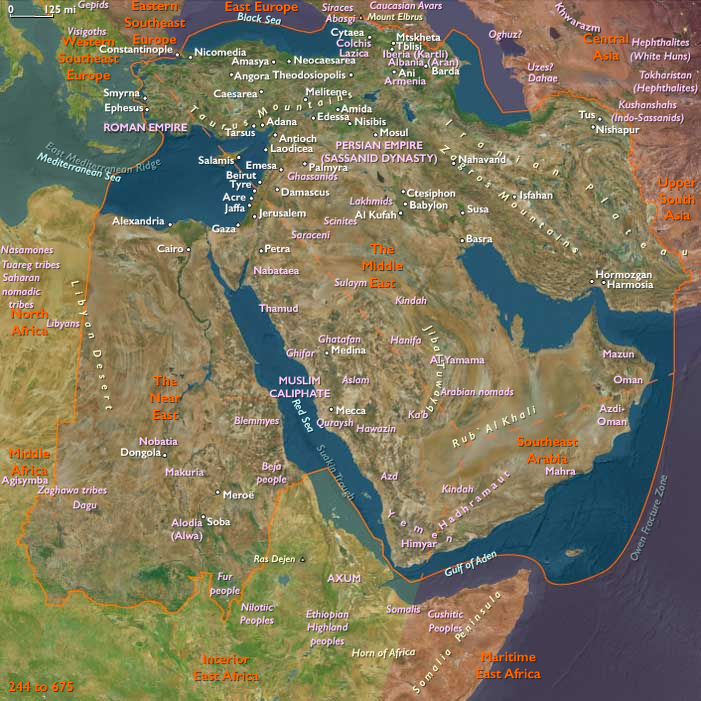
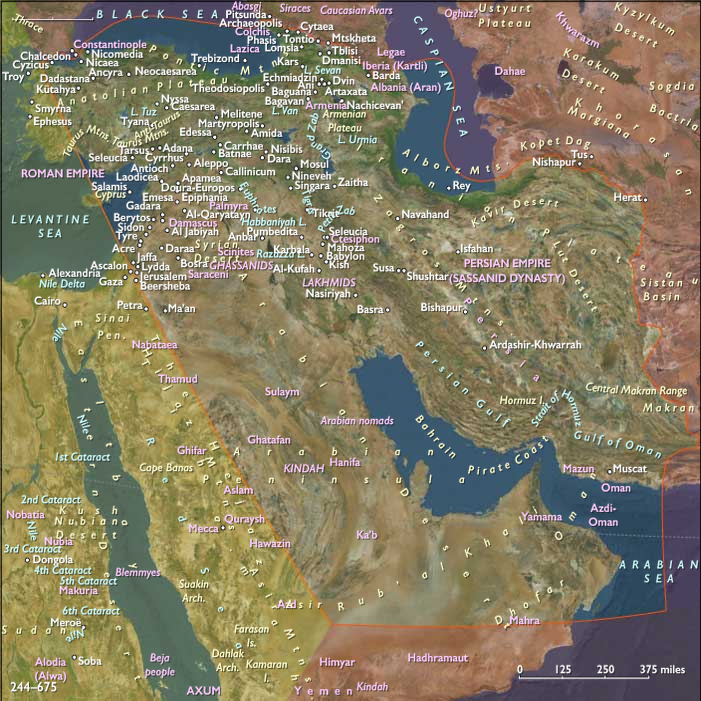
Abu Bakr defeats the Roman army at Damascus in 635, then begins his conquest of Iran.
The Arab forces occupy the Sassanian capital of Ctesiphon (which they rename Madain) in 637, and defeat the Sassanian army at Nahavand in 641-42.
Iran lies open to the invaders after this.
The Islamic conquest is aided by the material and social bankruptcy of the Sassanians; the native populations have little to lose by cooperating with the conquering power.
Moreover, the Muslims offer relative religious tolerance and fair treatment to populations that accept Islamic rule without resistance.
It is not until around 650, however, that resistance in Iran is quelled.
Conversion to Islam, which offers certain advantages, is fairly rapid among the urban population but occurs more slowly among the peasantry and the dihqans.
Locations
People
Groups
- Iranian peoples
- Arab people
- Persian people
- Zoroastrians
- Bedouin
- Persian Empire, Sassanid, or Sasanid
- Quraysh (Arabic tribe)
- Greeks, Medieval (Byzantines)
- Roman Empire, Eastern: Heraclian dynasty
- Islam
- Rashidun Caliphate
Topics
Subjects
Regions
Subregions
Years: 532 - 675
Locations
People
Groups
- Iranian peoples
- Arab people
- Persian people
- Zoroastrians
- Bedouin
- Persian Empire, Sassanid, or Sasanid
- Quraysh (Arabic tribe)
- Greeks, Medieval (Byzantines)
- Roman Empire, Eastern: Heraclian dynasty
- Islam
- Rashidun Caliphate
Topics
Subjects
Regions
Subregions