
The Road to Civil War: Henry III, …
Years: 1264 - 1264
The Road to Civil War: Henry III, Simon de Montfort, and the Mise of Amiens (1264)
By 1264, King Henry III of England found his reign deeply troubled by mounting disputes with his nobility, culminating in civil war. The conflict, later known as the Second Barons' War (1264–1267), stemmed from political favoritism, financial mismanagement, and the king’s autocratic style of rule.
Sources of Baronial Discontent
Several key factors fueled the nobility’s opposition to Henry III:
-
Foreign Influence at Court
- Henry’s Savoyard relatives (connected through his wife, Eleanor of Provence) and his half-brothers from Poitou, the Lusignans, held excessive power and influence in the royal court.
- The native English nobility resented the preferential treatment of these foreign-born favorites, leading to widespread baronial discontent.
-
The Costly Sicilian Campaign
- In 1254, Henry accepted Pope Innocent IV’s offer of the Kingdom of Sicily for his younger son, Edmund, requiring him to finance a war against the ruling Hohenstaufen dynasty.
- This military endeavor was ruinously expensive, deepening Henry’s financial difficulties and further angering the barons, who saw it as a wasteful and reckless policy.
-
The Personal Conflict with Simon de Montfort
- Initially a trusted ally, Simon de Montfort, Earl of Leicester, married Henry’s sister, Eleanor, in 1238. However, their relationship deteriorated, leading to Montfort’s emergence as the leader of the baronial opposition.
- Alongside Richard de Clare, Earl of Gloucester, Montfort became a central figure in the movement to limit royal authority.
The Provisions of Oxford and the First Reforms
- In 1258, Henry was forced to accept the Provisions of Oxford, surrendering much of his royal authority to a council of barons.
- The reforms were expanded in 1259 with the Provisions of Westminster, strengthening baronial control over government.
- Even Prince Edward (future Edward I) initially sided with Montfort and the reformers, although he later returned to his father’s side.
Henry’s Attempt to Reclaim Power (1261–1263)
- In 1261, Henry III secured a papal annulment of the Provisions of Oxford, regaining control of the government.
- Over the next two years, his failure to reconcile with Montfort and his alienation of Gilbert de Clare (son of the Earl of Gloucester) further destabilized the situation.
- In April 1263, Montfort returned from exile in France, reigniting the baronial reform movement.
- By July 16, 1263, Henry was trapped in the Tower of London and forced to once again accept the provisions.
Prince Edward’s Counteroffensive and the Arbitration Appeal
- In October 1263, Prince Edward, now firmly aligned with his father, recaptured Windsor Castle, breaking up Montfort’s alliance.
- With the baronial movement weakened, both sides agreed to submit their dispute to the arbitration of King Louis IX of France.
The Mise of Amiens (January 1264)
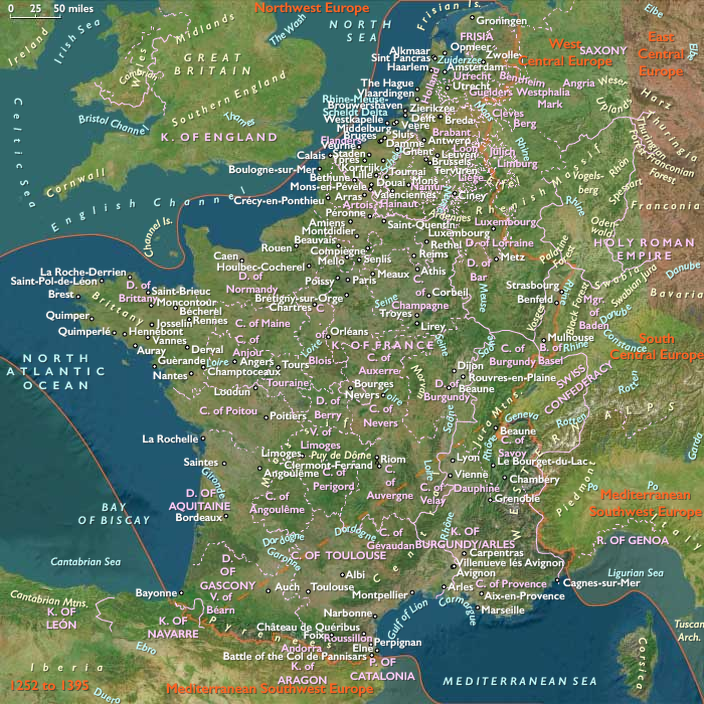
- On December 28, 1263, Henry III traveled to France to present his case to Louis IX at Amiens.
- Montfort, prevented from attending by an accident, was represented by Peter de Montfort and other baronial delegates.
- Henry argued that:
- The barons had violated the royal prerogative by denying him control over ministerial appointments.
- They had destroyed royal castles and pillaged royal lands.
- He was owed compensation totaling £300,000 and 200,000 marks.
- Henry also cited the papal annulment of the Provisions, asking Louis IX to release him from observing them.
Louis IX’s Verdict and the Renewed War
- In January 1264, Louis IX issued his judgment, known as the Mise of Amiens, in which he:
- Ruled entirely in favor of Henry III.
- Declared the Provisions of Oxford invalid, restoring full royal authority.
- Condemned the baronial opposition.
The barons, refusing to accept the ruling, renewed their rebellion, leading directly to the Second Barons' War (1264–1267).
Conclusion: The Inevitability of Conflict
The Mise of Amiens was meant to resolve the dispute, but instead, it triggered a final confrontation. By siding entirely with Henry III, Louis IX failed to address the deep-rooted grievances of the barons, making further conflict inevitable. Within four months, open war had broken out, culminating in the Battle of Lewes (May 1264), where Montfort captured Henry III and Prince Edward, temporarily taking control of England.
Locations
People
- Edward I of England
- Eleanor of Provence
- Gilbert de Clare, 7th Earl of Gloucester
- Henry III of England
- Louis IX of France
- Simon de Montfort
Groups
Topics
Commodoties
Subjects
Regions
Subregions
Related Events
Showing 2 events out of 2 total
Years: 1264 - 1264
Locations
People
- Edward I of England
- Eleanor of Provence
- Gilbert de Clare, 7th Earl of Gloucester
- Henry III of England
- Louis IX of France
- Simon de Montfort
Groups
Topics
Commodoties
Subjects
Regions
Subregions