
The reign of Ethelbert of Wessex, who …
Years: 865 - 865
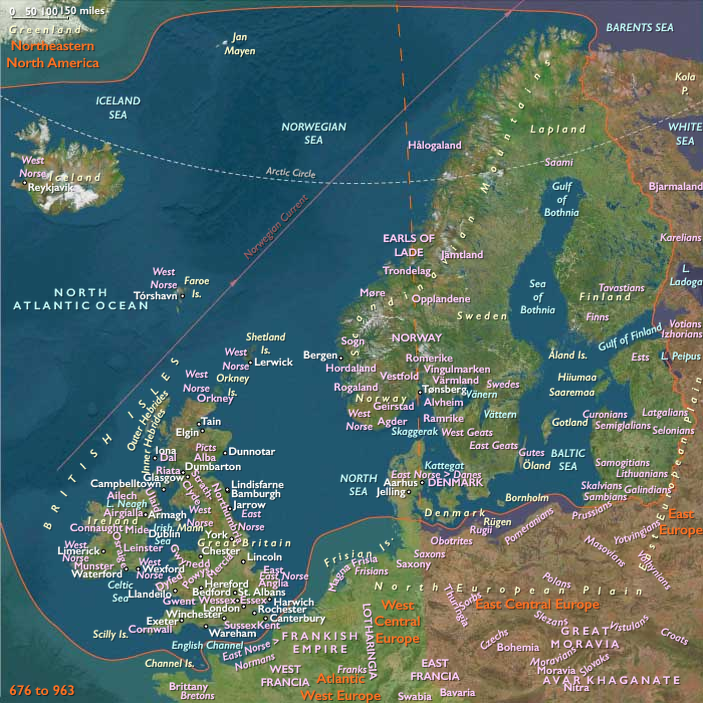
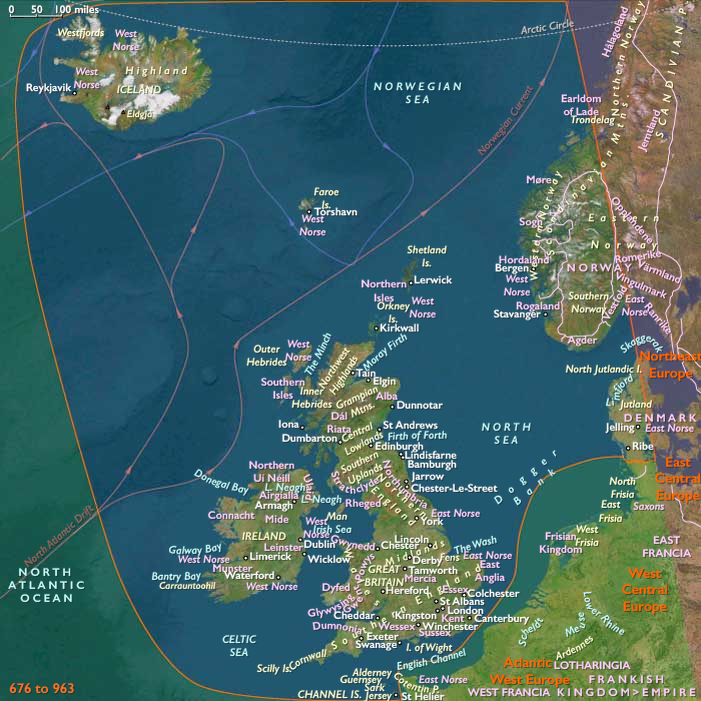
The reign of Ethelbert of Wessex, who is also King of Kent and issues charters under the style of King of the West Saxons and the Kentishmen, has seen a Danish plundering of Kent and raids in Northumbria, both led by Ragnar Lodbrok.
They had also penetrated as far as Winchester in Ethelbert's early reign.
Dying in 865, he is buried at Sherborne Abbey in Dorset.
His brother Ethelred, the fourth son of Ethelwulf, succeeds him.
Locations
Groups
- Saxons
- Jutes
- Anglo-Saxons
- Kent, Kingdom of
- Wessex, English Kingdom of
- Britain, Medieval
- Vikings
- Danes (Scandinavians)
- Saxony, Duchy of
Subjects
Regions
Subregions
Related Events
Filter results
Showing 10 events out of 54002 total
Louis the Younger, the second son of Louis the German, has followed his elder brother’s rebellious ways, and in a further rising is joined by his brother Charles the Fat.
In 865, Emperor Louis divides the remainder of his lands, giving Saxony to Louis the Younger.
The Saffarid dynasty begins with Ya'qub ibn al-Layth al-Saffar (Ya'qub, son of Layth, the Coppersmith), a coppersmith who had moved to the city of Zaranj.
He had left work to become an Ayyar (literally, ‘vagabond”, eferring to a person associated with a class of warriors in Iraq and Iran) and eventually gathers the power to act as an independent ruler.
From his capital Zaranj, …
…he moves east into al-Rukhkhadj and Zamindawar, followed by …
…Zunbil and …
…Kabul by 865.
Lothair II Reconciles with Teutberga Under Threat of Excommunication (865)
By 865, Lothair II of Lotharingia, after years of attempting to divorce his wife, Teutberga, in favor of his mistress, Waldrada, finds himself under increasing pressure from both the Papacy and his powerful Carolingian uncles, Louis the German and Charles the Bald.
The Growing Threat of Excommunication
- Pope Nicholas I, firmly opposed to Lothair’s divorce and remarriage, threatens him with excommunication if he does not reinstate Teutberga.
- The Pope’s intervention is not just religious but political, as Charles the Bald and Louis the German have also begun discussing the partition of Lotharingia, recognizing that Lothair lacks a legitimate heir.
Lothair’s Fears and Political Realities
- Fearing both excommunication and the potential loss of his kingdom, Lothair abandons his efforts to legitimize Waldrada.
- He takes back Teutberga, publicly reinstating her as his rightful queen, though their personal relationship remains strained.
- This move is a political necessity, as opposition from both the Pope and his relatives threatens his rule.
Consequences of Lothair’s Reconciliation with Teutberga
- His reconciliation with Teutberga does not restore his credibility—he has already alienated much of his nobility and clergy.
- His relationship with the Papacy remains tense, and his position as King of Lotharingia continues to weaken.
- Charles the Bald and Louis the German remain eager to divide Lotharingia should Lothair die without an heir.
The Eventual Collapse of Lothair’s Rule
- Lothair continues to struggle politically, and despite this forced reconciliation, his kingdom remains unstable.
- In 869, he dies without a legitimate heir, leading to the partition of Lotharingia between Charles the Bald and Louis the German under the Treaty of Meerssen (870).
Lothair’s reluctant acceptance of Teutberga in 865 marks the final failure of his long struggle to secure an heir, setting the stage for the end of an independent Lotharingia and reinforcing the power of the Papacy over royal marriages in medieval Europe.
Louis the Younger, the second son of Louis the German, had been deployed in military operations against the Abodrites to the east as a young mans in 858 and 862.
At the invitation of the nobles of Aquitaine opposed to Charles the Bald and Pepin II, and coaxed by his father and his cousin Charles, Archbishop of Mainz, he had crossed into Gaul in 854 at the head of an army, intent on receiving the Aquitainian crown, marching as far as Limoges before turning back.
Back home, Louis had forged close ties with the nobles of the East Francia and has become increasingly independent from his father.
He betroths himself to the daughter of Count Adalard and in 865 he and his brother Charles, called the Fat, join in rebellion against their father.
This flirtation with revolt is brief, however, and Louis, Charles, and their father are reconciled later that year, though the elder Louis is forced to make a division of the remainder of his territories between his two sons.
Carloman had already been given the subregulus of Bavaria in 864; now Louis receives Saxony, Thuringia, and Franconia, and Charles Alemannia and Rhaetia.
The legendary Viking chieftain Ragnar Lodbrok (Ragnar 'Hairy-Breeches'), finished with ravaging France, has turned his attention to England.
He lands his ships in 865 in East Anglia and proceeds north, aided by a supply of horses by which King Edmund of East Anglia has bought them off and by civil infighting between royal candidates—the brothers Osbehrt and Aelle—in the Anglian Kingdom of Northumbria.
It is claimed that here he is defeated in battle for the only time, by King Aelle II of Northumbria.
Aelle's men capture Ragnar, and the King orders him thrown into a pit filled with poisonous snakes.
As he is slowly being bitten to death, he is alleged to have exclaimed "How the little pigs would grunt if they knew the situation of the old boar!"
Alternative versions of the story say that he had landed by accident in East Anglia and there befriended King Edmund before being killed by a jealous courtier.
The murderer escapes to Denmark and blames Edmund for Lodbrok's demise.
One Viking saga states that when his four sons heard the manner of his death, they all reacted in great sorrow.
Hvitserk, who was playing tafl, gripped the piece so hard that he bled from his fingernails.
Björn Ironside grabbed a spear so tightly that he left an impression in it, and Sigurd Snake-in-the-Eye, who was trimming his nails, cut straight through to the bone.
Although these stories may not be accurate, like virtually all tales concerning Ragnar Lodbrok, his death has serious consequences.
His other sons, Ivar the Boneless (alias Hingwar) and Ubbe soon learns the details of their father's death and swear that they will avenge his killing, in time-honored Viking tradition.
Constantine and Methodius, to facilitate the task of preaching in the vernacular and translating the Bible into the unwritten Slavic language, invent a script, initially known as Glagolitic, using the phonetic peculiarities of the Slavic tongue.
German leaders, however, want to enforce the use of the Latin liturgy among the Slavs, and the brothers are called to Rome to defend themselves.
After some two and a half years among the Moravians, the two brothers journey to Rome to ask for papal support for their work and their use of the Slavic language.
Constantine enters a convent in Rome, taking the name of Cyril; he will die in 869.
The new alphabet, attributed to Cyril but probably the work of his followers, will subsequently be revised to employ characters resembling those of the Greek to become the Cyrillic alphabet used in modern Slavic languages.
Basil, on Emperor Michael's orders, had divorced his wife Maria and married Eudokia Ingerina, Michael's favorite mistress, in around 865.
During an expedition against the Arabs, Basil had persuaded Michael III that his uncle Bardas covets the imperial throne, and subsequently murders Bardas on April 21, 866, with Michael's approva .
Basil now becomes the leading personality at court and is invested in the now vacant dignity of kaisar (caesar), before being crowned co-emperor on May 26, 866.
This promotion may have included Basil's adoption by Michael III, himself a much younger man.
It is commonly believed that Leo VI, Basil's successor and reputed son, is really the son of Michael.
Although Basil seems to have shared this belief (and hated Leo), the subsequent promotion of Basil to caesar and then co-emperor provides the child with a legitimate and Imperial parent and secures his succession to the imperial throne.
It is notable that when Leo is born on September 19, 866, Michael III celebrates the event with public chariot races, while he pointedly instructs Basil not to presume on his new position as junior emperor.
Years: 865 - 865
Locations
Groups
- Saxons
- Jutes
- Anglo-Saxons
- Kent, Kingdom of
- Wessex, English Kingdom of
- Britain, Medieval
- Vikings
- Danes (Scandinavians)
- Saxony, Duchy of
