…the region of present London but suffer …
Years: 43 - 43
…the region of present London but suffer a second defeat near Durobrivae (present Rochester).
Locations
People
Groups
- Trinovantes (Celtic tribe)
- Catuvellauni (Celtic tribe)
- Silures (Celtic tribe)
- Ordovices (Celtic tribe)
- Roman Empire (Rome): Julio-Claudian dynasty
Topics
- Classical antiquity
- Pre-Roman Iron Age of Northern Europe
- Roman Age Optimum
- Pax Romana
- Aulus Plautius' Roman invasion of Britain
- Roman Conquest of Britain
Commodoties
Subjects
Regions
Subregions
Related Events
Filter results
Showing 10 events out of 61810 total
The Trung sisters’ poorly trained troops, unsupported by the peasantry, are overwhelmed in 43 by invading Chinese forces under General Ma Yuan.
Routed near present Hanoi, the sisters withdraw to Hat Mon (Son Tay), where General Ma decisively defeats them.
Disgraced, the Trung sisters drown themselves at the confluence of the Red and Day Rivers, and the Chinese regain control of the area.
Emperor Guangwu, not having the heart to depose both mother and son, had initially left Guo's son, Crown Prince Jiang, as crown prince.
Crown Prince Jiang, however, realizing that his position is precarious, has repeatedly offered to step down.
In 43, Emperor Guangwu agrees and created Liu Yang, the oldest son of Empress Yin, crown prince instead.
Former Crown Prince Jiang is created the Prince of Donghai.
He also changes Prince Yang's name to Zhuang.
Emperor Guangwu had in 49 once again commissioned Ma Yuan to go on an expedition—against the indigenous people of the Wulin prefecture (modern northwestern Hunan and eastern Guizhou), who had rebelled.
While Ma is on the expedition, however, a number of Ma's political enemies made false accusations against him.
Emperor Guangwu, believing these accusations, begins investigating Ma, who happens to die of illness while on the campaign.
With Ma dead and unable to defend himself, Emperor Guangwu strips Ma of his marquess title and denounces him posthumously.
(Ma's good reputation will not restored until his daughter later becomes empress to Emperor Guangwu's son Emperor Ming.)
Paul, supporting himself as a tentmaker, works in the early 40s with Christians from Antioch in the first organized Christian mission to Cyprus and south Galatia.
The author of the Acts arranges Paul's travels into three separate journeys.
The first journey [Acts 13-14], led initially by Barnabas, who had introduced Paul to the apostles after Paul's conversion, takes Paul from Antioch to Cyprus then southern Asia Minor (Anatolia), and back to Antioch.
Accompanying him are an assistant John Marcus, known as Mark, the son of Mary of Jerusalem (whose house was used as a gathering place by early Christians).
In Cyprus, Paul rebukes and blinds Elymas the magician [Ac 13:8-12] who was criticizing their teachings.
From this point on, Paul is described as the leader of the group.
They sail to Perga in Pamphylia.
John Mark leaves them abruptly and returns to Jerusalem.
Paul and Barnabas go on to Pisidian Antioch.
On the Sabbath they go to the synagogue.
The leaders invite them to speak.
Paul reviews Israelite history from life in Egypt to King David.
He introduces Jesus as a descendant of David brought to Israel by God.
He says that his team came to town to bring the message of salvation.
He recounts the story of Jesus' death and resurrection.
He quotes from the Septuagint to assert that Jesus was the promised Christos who brought them forgiveness for their sins.
Both the Jews and the 'God-fearing' Gentiles invited them talk more the next Sabbath.
At this time, almost the whole city gathers.
This upsets some influential Jews who speak against them.
Paul uses the occasion to announce a change in his mission which from then on would be to the Gentiles.
[Ac 13:13-48] Antioch serves as a major Christian center for Paul's evangelizing.
The Romans, on defeating Antiochus III in 188 BCE, had given Lycia to Rhodes for twenty years, taking it back in 168 BCE.
Lycia in these latter stages of the Roman republic had come to enjoy freedom as part of the Roman protectorate.
The Romanshad validated home rule officially in 168 BCE under the Lycian League.
This native government was an early federation with republican principles; these will later come to the attention of the framers of the United States Constitution, influencing their thoughts.
Despite home rule under republican principles, Lycia is not a sovereign state and had not been since its defeat by the Carians in the mid-fourth century BCE.
The Roman emperor Claudius dissolves the league in 43 BCE, and Lycia is incorporated into the Roman Empire with a provincial status.
Agrippa zealously pursues orthodox Jewish policies in Judaea, earning the friendship of the Jews and (according to Acts of the Apostles) vigorously repressing the new Jewish Christian sect.
Nonetheless, mindful of maintaining Roman friendship, has built a theater and amphitheater, baths, and porticoes in the city of Berytus, and has expressed similar magnanimity in Sebaste, Heliopolis and Caesarea.
He strikes coins in emulation of Rome.
The suspicions of Claudius have prevented him from finishing the fortifications with which he had begun to surround Jerusalem.
His friendship is courted by many of the neighboring kings and rulers, some of whom he houses in Tiberias, which also causes Claudius some displeasure.
Agrippa goes after Passover in 44 to Caesarea, where he has a spectacular series of games performed in honor of Claudius.
Amid his elation, Agrippa sees an owl perched over his head.
A similar omen during his imprisonment by Tiberius had been interpreted as portending his speedy release, with the warning that should he behold the same sight again, he would die within five days.
He is immediately smitten with violent pains, and scolds his friends for flattering him and accepting his imminent death.
He experiences heart pains and a pain in his abdomen, and dies after five days.
Acts 12 relates that he was eaten by worms, (possibly Fournier's gangrene, the same disease that may have killed his grandfather Herod the Great) after God struck him for accepting the praise of sycophants, comparing him to a god. Josephus, in Antiquitates Judaicae xix. Chapter 8 para 3, then relates how Agrippa's brother, Herod of Chalcis, and Helcias sent Aristo to kill Silas:
“But before the multitude were made acquainted with Agrippa's being expired, Herod the king of Chalcis, and Helcias the master of his horse, and the king's friend, sent Aristo, one of the king's most faithful servants, and slew Silas, who had been their enemy, as if it had been done by the king's own command.”
"King Herod", mentioned in the Bible's Acts of the Apostles, is identified by historians as the same person as King Agrippa I.
The identification is based in part on the description of his death, which is very similar to Agrippa's death in Josephus's Antiquities of the Jews 19.8.2, although Josephus does not include the claim that "an angel of the Lord struck him down, and he was eaten by worms".
Further evidence is the identification of the ruler in Acts 12:1 as "Herod the king", since Agrippa I is the only Herod who would have had authority in Jerusalem at that time.
The description of Herod Agrippa I as a cruel, heartless king who persecuted the Jerusalem church, having James son of Zebedee killed and imprisoning Peter, stands in stark contrast with Josephus' account of a kindly man.
According to Josephus, he was a milder ruler than his grandfather Herod the Great, and Josephus records him as talking with and then forgiving a law student accused of political rabble rousing.
Christian scholars argue that the biblical account might make sense if one recalls that Agrippa had been born and raised to revere his Jewishness.
Agrippa would resent a movement begun during his absence from Judæa when explained to him by the religious leaders of Israel as a sacrilegious mission trying to equate a mere man, Jesus of Nazareth, with the One God of Judaism.
Herod Antipas, uncle and predecessor of Agrippa I as ruler of Galilee and Peræa, is the Herod mentioned in the Gospels who authorized the execution of John the Baptist and played a role in the trial of Jesus.
Agrippa’s son, called Agrippa II, has been educated at the court of Claudius, and at the time of his father's death is only seventeen years old.
Claudius therefore keeps him at Rome, and sends Cuspius Fadus as procurator of the Roman province of Judaea.

The area of the Zollfied, a slightly ascending plain in present Carinthia, Austria, had been the cultural and political center of the Celtic kingdom of Raetis.
As the later Roman province of Noricum, when under the rule of Emperor Claudius (41-54 CE) the city of Virunum is established as the province's capital, replacing—or maybe identical with—ancient Noreia.
Claudius, who is not the first emperor to use freedmen to help with the day-to-day running of the Empire, is forced to increase their role as the powers of the Princeps become more centralized and the burden larger.
This is partly due to the ongoing hostility of the Senate but also due to his respect for the senators.
Claudius does not want freeborn magistrates to have to serve under him, as if they were not peers.
The secretariat is divided into bureaus, with each being placed under the leadership of one freedman.
Narcissus is the secretary of correspondence.
Pallas becomes the secretary of the treasury.
Callistus becomes secretary of justice.
There is a fourth bureau for miscellaneous issues, which is put under Polybius until his execution for treason.
The freedmen can also officially speak for the Emperor, as when Narcissus addresses the troops in Claudius' stead before the conquest of Britain.
Since these are important positions, the senators are aghast at their being placed in the hands of former slaves.
If freedmen have total control of money, letters, and law, it seems it would not be hard for them to manipulate the Emperor.
This is exactly the accusation put forth by the ancient sources.
However, these same sources admit that the freedmen were loyal to Claudius.
He is similarly appreciative of them and gives them due credit for policies where he has used their advice.
However, if they show treasonous inclinations, the Emperor does punish them with just force, as in the case of Polybius and Pallas' brother, Felix.
There is no evidence that the character of Claudius' policies and edicts changed with the rise and fall of the various freedmen, suggesting that he was firmly in control throughout.
Regardless of the extent of their political power, the freedmen do manage to amass wealth through their positions.
Pliny the Elder notes that several of them were richer than Crassus, the richest man of the Republican era.
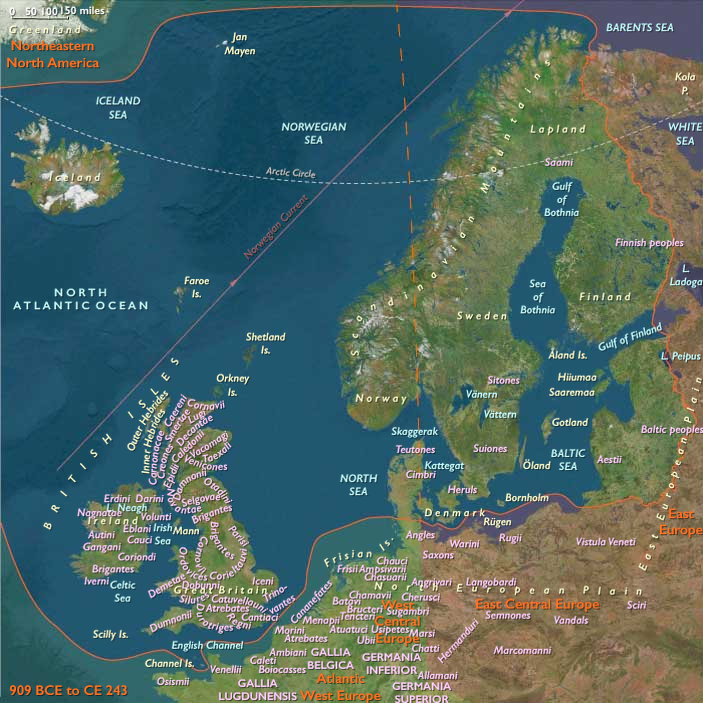
The most far-reaching of Claudius’s expansions of imperial territory is the conquest of Britannia.
Claudius in 43 sends Aulus Plautius with four legions to Britain (Britannia) after an appeal from an ousted tribal ally.
Britain is an attractive target for Rome because of its material wealth—particularly mines and slaves.
It is also a haven for Gallic rebels and the like, and so could not be left alone much longer.
Aulus Plautius, aiming to subdue the intransigent tribal kingdoms, invades with an army of twenty thousand, crossing the English Channel to land at Rutupioae (present Richborough, Kent), an important natural harbor.
The Catuvellauni and Trinovantes warriors, surprised and defeated, retreat toward …
Years: 43 - 43
Locations
People
Groups
- Trinovantes (Celtic tribe)
- Catuvellauni (Celtic tribe)
- Silures (Celtic tribe)
- Ordovices (Celtic tribe)
- Roman Empire (Rome): Julio-Claudian dynasty
Topics
- Classical antiquity
- Pre-Roman Iron Age of Northern Europe
- Roman Age Optimum
- Pax Romana
- Aulus Plautius' Roman invasion of Britain
- Roman Conquest of Britain