
Vladimir's choice of Eastern Orthodoxy reflects his …
Years: 964 - 1107
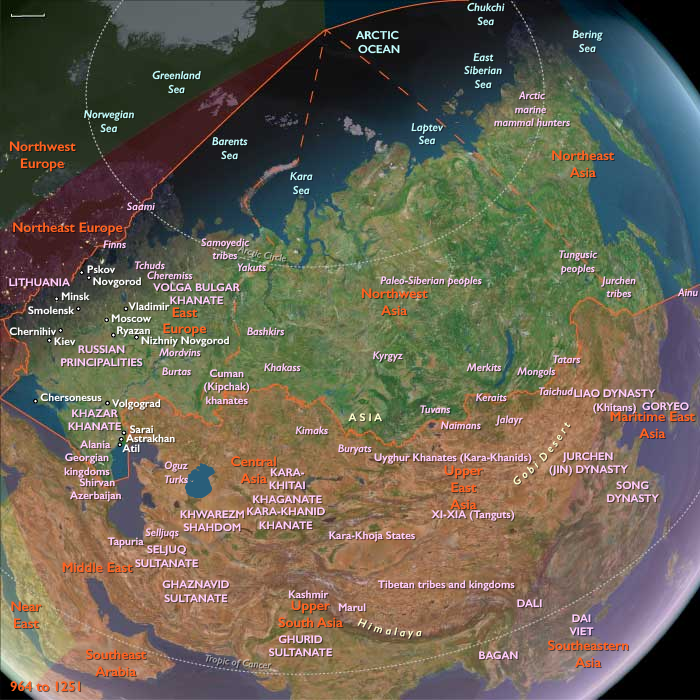
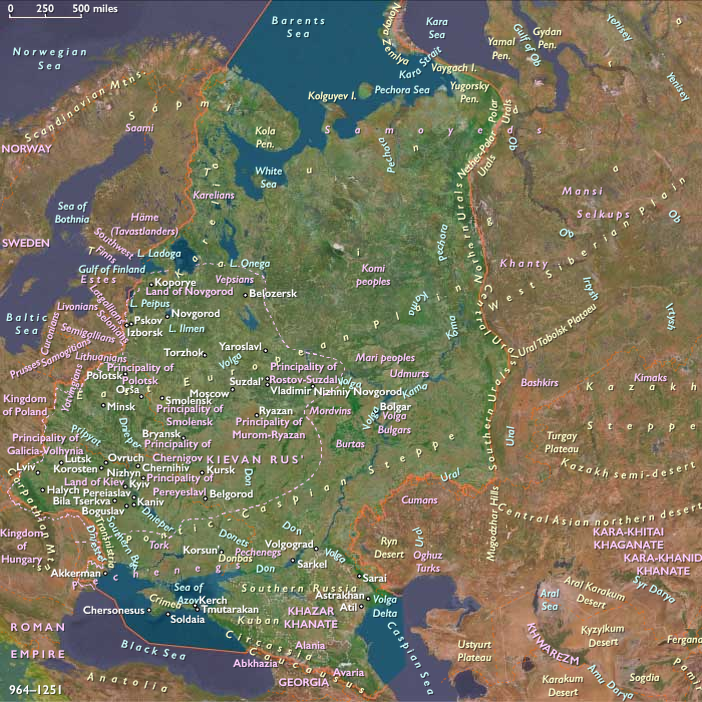
Vladimir's choice of Eastern Orthodoxy reflects his close personal ties with Constantinople, which dominate the Black Sea and hence trade on Kiev's most vital commercial route, the Dnepr River.
Adherence to the Eastern Orthodox Church has long-range political, cultural, and religious consequences.
The church has a liturgy written in Cyrillic and a corpus of translations from the Greek that had been produced for the South Slavs.
The existence of this literature facilitates the East Slavs' conversion to Christianity and introduces them to rudimentary Greek philosophy, science, and historiography without the necessity of learning Greek.
In contrast, educated people in medieval Western and Central Europe learn Latin.
Because the East Slavs learn neither Greek nor Latin, they are isolated from Byzantine culture as well as from the European cultures of their neighbors to the west.
Locations
People
Groups
- Slavs, East
- Greeks, Medieval (Byzantines)
- Rus' people
- Novgorod, Principality of
- Rurik dynasty
- Roman Empire, Eastern: Macedonian dynasty
- Kievan Rus', or Kiev, Great Principality of
- France, (Capetian) Kingdom of
- Hungary, Kingdom of
- Norway, independent Kingdom of
- Poland of the first Piasts, Kingdom of
- Poland of the first Piasts, Kingdom of
- Christians, Eastern Orthodox
Subjects
Regions
Subregions
Years: 964 - 1107
Locations
People
Groups
- Slavs, East
- Greeks, Medieval (Byzantines)
- Rus' people
- Novgorod, Principality of
- Rurik dynasty
- Roman Empire, Eastern: Macedonian dynasty
- Kievan Rus', or Kiev, Great Principality of
- France, (Capetian) Kingdom of
- Hungary, Kingdom of
- Norway, independent Kingdom of
- Poland of the first Piasts, Kingdom of
- Poland of the first Piasts, Kingdom of
- Christians, Eastern Orthodox
Subjects
Regions
Subregions