The rebuilt city of Amphissa had joined …
Years: 167BCE - 167BCE
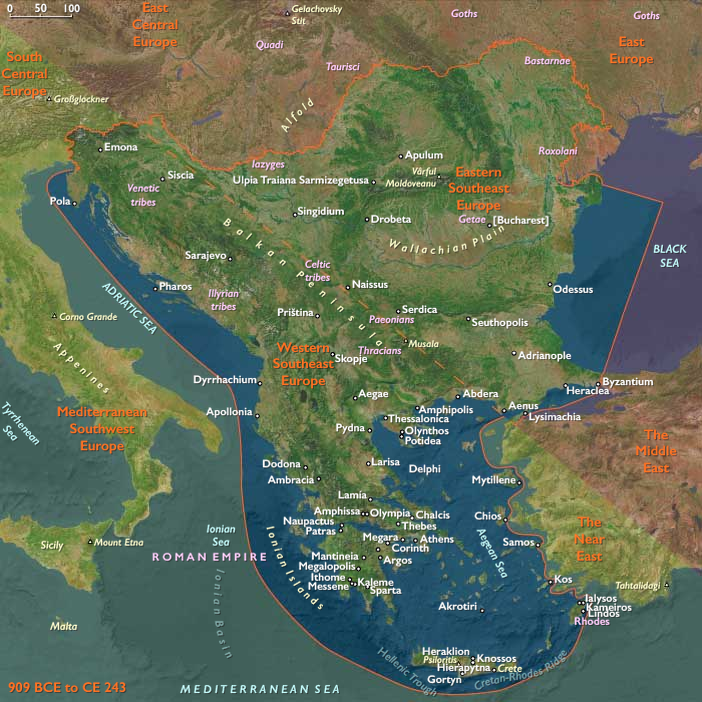
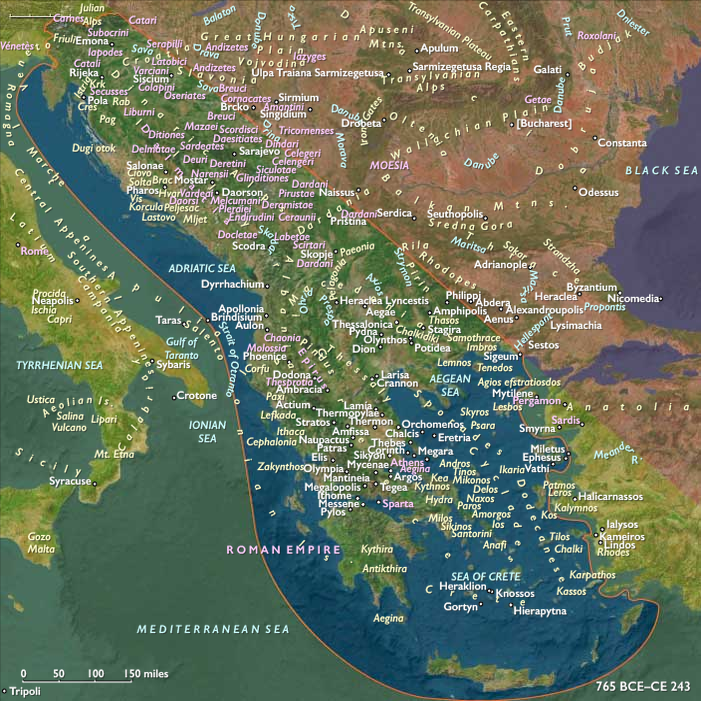
The rebuilt city of Amphissa had joined the Aetolian League and remained a member until 167 BCE, when, like all other cities and towns in central and southern Greece, it is forced to secede by Roman conquest.
Locations
Groups
Topics
Commodoties
Subjects
Regions
Subregions
Related Events
Filter results
Showing 10 events out of 63239 total
Eucratides, either a general of Demetrius or an ally of the Seleucids, manages to overthrow the Euthydemid dynasty and establish his own rule around 170 BCE, probably dethroning Antimachus I and Antimachus II.
The Indian branch of the Euthydemids try to strike back.
Demetrius (very likely Demetrius II), king of Bactria, the son and successor of Euthydemus, who ruled, according to some scholars, from about 190 to about 167 BCE, is said to have returned to Bactria with sixty thousand men to oust the usurper, but he apparently is defeated and killed in the encounter in 167.
Eucratides now rules Bactria as military governor, but resistance continues.
The slight historical evidence for the reign of Demetrius s open to varying interpretations.
Demetrius had earlier made such extensive conquests in northern India that for a brief time he virtually reestablished there the great Mauryan Empire that had collapsed about 184.
Other scholars, however, contend that it was a younger Demetrius (likewise a Bactrian king but not directly related to the son of Euthydemus) who made conquests in India, of a less extensive kind, and lost his kingdom to Eucratides after reigning from about 180 to 165.
The fact that one of these two men was the first to strike coins with a bilingual inscription in Greek and Prakrit suggests that he pursued a policy of treating the Indian peoples and the Bactrian Greeks as equals.

Mithridates, an Arsacid who had become ruler of Parthia in 171, first expands Parthia's control eastward by defeating King Eucratides of the Greco-Bactrian Kingdom.
This gives Parthia control over Bactria's territory west of the Arius river, the regions of Margiana and Aria (including the city of Herat in 167 BCE).
"The satrapy Turiva and that of Aspionus were taken away from Eucratides by the Parthians."
(Strabo XI.11.2) These victories give Parthia control of the overland trade routes between east and west (the Silk Road and the Persian Royal Road).
This control of trade will become the foundation of Parthia's wealth and power and be jealously guarded by the Arsacids, who will attempt to maintain direct control over the lands through which the major trade routes passed.
Antiochus had initially bestowed exemptions and privileges upon the Jews.
Enraged by his defeat and expulsion from Egypt by the Romans in 167 BCE, he sends a financial official to exact taxes from the cities of Judaea.
Upon the request of Menelaus' party, Antiochus' official attacks the city of Jerusalem by guile and largely destroys it, restoring Menelaus and executing many Jews.
Jason is forced to flee to Asia Minor.
He then builds a fortified position on the citadel, called by the Greeks the Akra.
This becomes the symbol of Judaea's enslavement, though in itself the presence of a royal garrison in a Hellenistic city is usual.
The city forfeits its privileges and is permanently garrisoned by Syrian soldiers.
The Greeks and those friendly toward them are united into the community of Antiochians; the worship of Yahweh and all of the Jewish rites, including circumcision and the observance of the Sabbath, are forbidden on pain of death.
Finally, in the holiest part of the Temple precincts, an altar to Zeus Olympios is erected on the twenty-fifth day of the Hebrew month Kislev (December) in 167, and sacrifices are to be made at the feet of an idol in the image of the King.
One thousand leading Achaean men suspected of Macedonian sympathies are taken as hostages to Rome. (Among them is Polybius, who will befriend the noble Scipionic family and will with the aid of privileged access to the views of the senatorial leadership write his great history of the rise of Rome.)
The Illyrians who dwelt near the rivers Neretva and Krka had formed a league against the advancing Romans in the 220s after abetting the destruction of Illyria’s coastal Ardian state.
Their principal town is Delminium, on the present plain of Sinj, or possibly Duvno in Herzegovina, and after that city the tribes call themselves Delmati, or Dalmati.
The earliest mention of Dalmatia occurs in 167 BCE at the time of the Roman conquest of the southern Illyric kingdom.
The islands are peopled by Greeks; the mainland, by Illyrians.
Paullus’ legionaries on their return to Rome are displeased with their share of the plunder.
The consul to keep them happy decides for a stop in Epirus, a kingdom suspected of sympathizing with the Macedonian cause despite the fact that Epirus has not aided Perseus in the war.
The region has been already pacified, but Paullus orders the sacking of seventy of its towns, enslaving one hundred and fifty thousand people and leaving the region to bankruptcy.
The Battle of Pydna and its political aftermath mark the effective end of Macedonian independence, although formal annexation is still some years away.
Rome proceeds in 167 BCE to punish those who had sided with Perseus (such as the Illyrian Genthius), those whose loyalty had wavered (such as Eumenes), and even those who had contemplated acting as mediators in the war (such as the Rhodians).
Enslavement is a common fate for the defeated: the Romans had enslaved five thousand Macedonians in 197 BCE; five thousand Histri (Illyrians of Istria) in 177 BCE; and in 174 BCE an unspecified number of Sardinians, but so many that “Sardinian” will become a byword for “cheap” slave.
These are only a few examples for which the sources happen to give numbers.
More slaves flood into Italy after Rome destabilizes the eastern Mediterranean in 167 BCE, enslaving one hundred and fifty thousand Epirotes in this year, giving pirates and bandits the opportunity to carry off local peoples of Anatolia and sell them on the block at Delos by the thousands. (Delos, independent since 322 BCE, comes under Roman rule in 166 BCE.)
The Carthaginian, Punic, Gallic, and other wars waged by Rome have yielded enormous numbers of enslaved people, producing a slave population eclipsing any in earlier history.
The Romans of this age devastate the artistic treasures of Greece, rob temples and public buildings, decimate the population and bring many Greeks to Rome as slaves.
Aemilius Paulus, the victor of the Battle of Pydna in Greece in 168 BCE, is said to have sold one hundred an fifty thousand Greeks to Rome as slaves in a single market (according to Plutarch), all by himself on a single day in the year 167.
Antiochus IV, having in 173 BCE paid the remainder of the war indemnity that had been imposed by the Romans on his father in 188 at the Treaty of Apamea, demonstrates his might to the world at Daphne, near Antioch, with a grand review of his army.
Forty-six thousand foot soldiers are on parade, among them a Macedonian phalanx of twenty thousand men and five hundred mercenaries equipped with Roman arms, followed by eighty-five hundred horsemen and three hundred and six armored elephants.
Antiochus appears to have underestimated the strength of the Hasidean movement, the Seleucid king's military might notwithstanding.
His sense of his own divinity, represented by the title Epiphanes (God Manifest), is unacceptable to the orthodox Jews who recognize the absolute claims of the God of Israel.
Antiochus' promulgation of decrees against the practice of Judaism and the offensive and cruel measures to enforce them lead to the revolt of an old priest, Mattathias, who kills an apostate Jew who is about to offer sacrifice to Zeus on the altar erected by the Seleucid king.
Mattathias, great-great grandson of Hasmon, flees to his home village of Modein with his five sons, and a guerilla war ensues, led by the Hasmonean family.
The strictly observant Hasideans at first refuse to fight on the Sabbath and at once lose a thousand lives.
Mattathias then insists that all groups of resisters should fight if required on the holy sabbath.
The resistance comes from only a section of the population.
The century-and-a-half of Greek rule has Hellenized much of the upper class of Jerusalem, and some of the characteristic features of Greek city life have been established on the initiative of this section of the ruling class, which is able to accept a less radical observance of Judaism and combine it with loyalty to the throne.