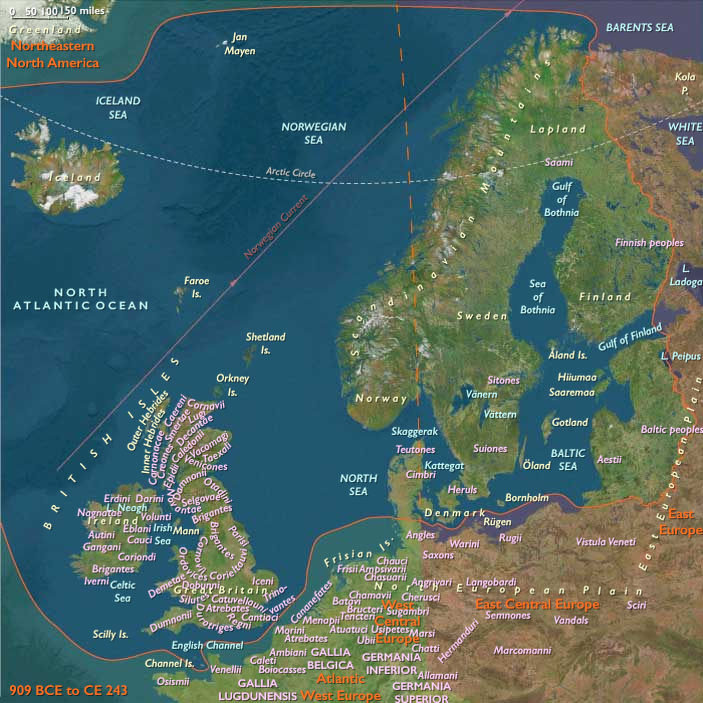
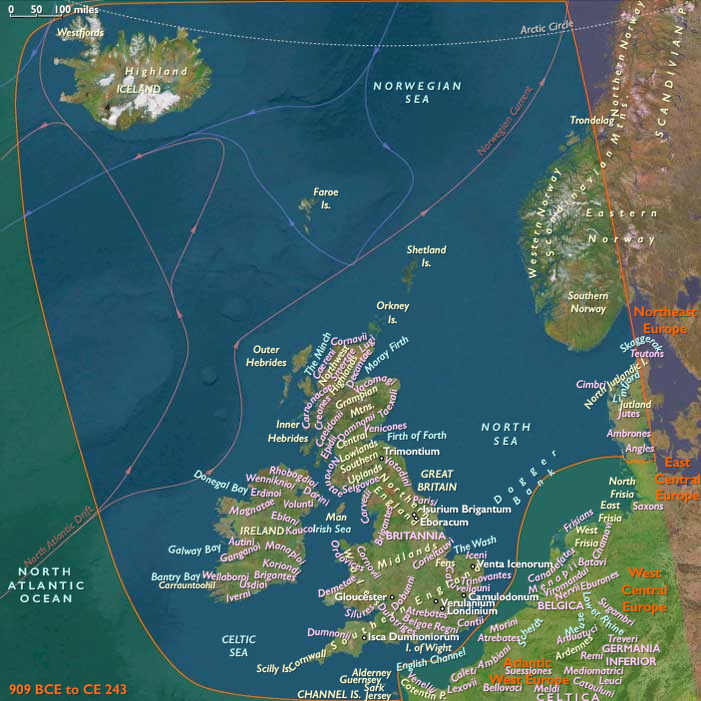
Suetonius regroups with his own Legio XIV Gemina, some vexillationes (detachments) of the XX Valeria Victrix, and any available auxiliaries, while Boudica's army continue their assault in Verulamium.
IX Hispana had been routed trying to relieve Camulodunum, and the prefect of Legio II Augusta, Poenius Postumus, stationed near Exeter, ignores the call, but nonetheless the governor is able to call on almost ten thousand men.
He takes a stand at an unidentified location, probably in the West Midlands somewhere along the Roman road now known as Watling Street, in a defile with a wood behind him—but his men are heavily outnumbered.
Dio says that, even if they were lined up one deep, they would not have extended the length of Boudica's line.
By now the rebel forces are said to have numbered two hundred and thirty thousand, however, this number should be treated with skepticism—Dio's account is known only from a late epitome, and ancient sources commonly exaggerate enemy numbers.
Boudica exhorts her troops from her chariot, her daughters beside her.
Tacitus gives her a short speech in which she presents herself not as an aristocrat avenging her lost wealth, but as an ordinary person, avenging her lost freedom, her battered body, and the abused chastity of her daughters.
She said their cause was just, and the deities were on their side; the one legion that had dared to face them had been destroyed.
She, a woman, is resolved to win or die; if the men want to live in slavery, that is their choice.
However, the lack of maneuverability of the British forces, combined with lack of open-field tactics to command these numbers, puts them at a disadvantage to the Romans, who are skilled at open combat due to their superior equipment and discipline.
Also, the narrowness of the field means that Boudica can put forth only as many troops as the Romans can at a given time.
First, the Romans stand their ground and used volleys of pila (heavy javelins) to kill thousands of Britons who are rushing toward the Roman lines.
The Roman soldiers, having used up their pila, are now able to engage Boudica's second wave in the open.
As the Romans advance in a wedge formation, the Britons attempt to flee, but are impeded by the presence of their own families, whom they have stationed in a ring of wagons at the edge of the battlefield, and are slaughtered.
This is not the first instance of this tactic—the women of the Cimbri, in the Battle of Vercellae against Gaius Marius, were stationed in a line of wagons and acted as a last line of defense.
Ariovistus of the Suebi is reported to have done the same thing in his battle against Julius Caesar.
Tacitus reports that "according to one report almost eighty thousand Britons fell" compared with only four hundred Romans.
According to Tacitus in his Annals, Boudica poisoned herself, though in the Agricola, which was written almost twenty years prior, he mentions nothing of suicide and attributes the end of the revolt to socordiam (indolence); Dio says she fell sick and died and then was given a lavish burial; though this may be a convenient way to remove her from the story.
Considering Dio must have read Tacitus, it is worth noting he mentions nothing about suicide (which was also how Postumus and Nero ended their lives).
Postumus, on hearing of the Roman victory, falls on his sword.
Suetonius conducts punitive operations.