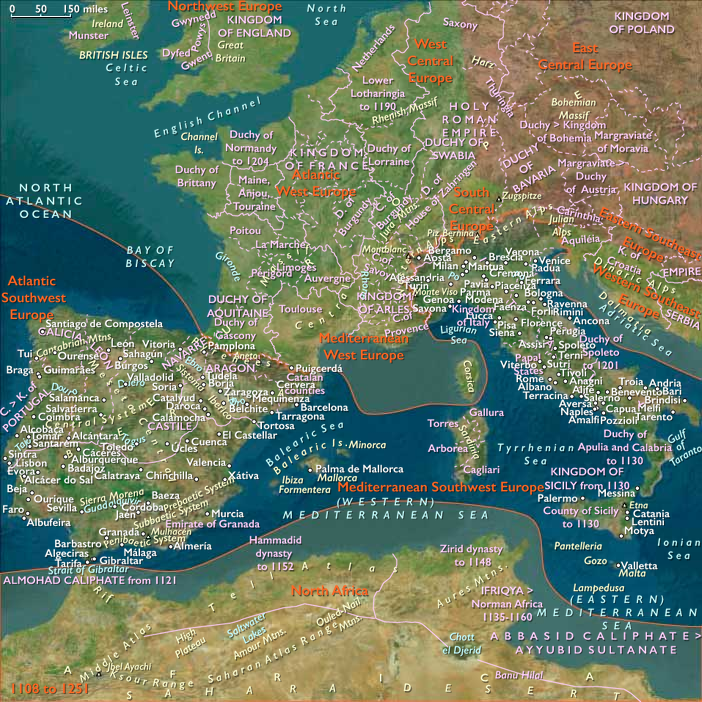
…the rebellious Saracens, whom he resettles in …
Years: 1225 - 1225
…the rebellious Saracens, whom he resettles in Apulia, where they become his most faithful subjects, providing him with a loyal bodyguard immune against papal influence.
Locations
People
Groups
- Muslims, Sunni
- Saracens
- Papal States (Republic of St. Peter)
- Holy Roman Empire
- Christians, Roman Catholic
- Artuqid dynasty of Hasankeyf
- Cyprus, Kingdom of
- Sicily, Hohenstaufen Kingdom of
Topics
Commodoties
Subjects
Regions
Subregions
Related Events
Filter results
Showing 6 events out of 6 total
The Social Structure of Early Portugal: The Dominance of the Clergy
During Portugal’s formative stages, society was divided into three primary social classes:
- Clergy (Oratores) – The most influential and privileged class.
- Nobility (Bellatores) – Warriors and landowners.
- Commoners (Laboratores) – The peasantry, artisans, and merchants.
The Clergy: The Preeminent Social Class
Due to the religious fervor of the era and the kingdom’s role in the Reconquista, the clergy held paramount influence in both spiritual and secular affairs. The Church was the wealthiest institution in the realm and provided most of Portugal’s educated elite, making it the dominant political, intellectual, and administrative force.
Ecclesiastical Hierarchy and Structure
The clergy was divided into two main categories:
- The Secular Clergy – Bishops and parish priests, forming the traditional Church hierarchy.
- The Regular Clergy – Abbots and monks belonging to monastic and military orders, such as the Cistercians, Benedictines, and Knights Templar.
These groups were further classified into:
- Higher Clergy – Bishops and abbots, who controlled vast landholdings, exercised judicial power, and influenced royal policy.
- Lower Clergy – Parish priests and monks, who served local communities but held less political authority.
Privileges and Rights of the Clergy
The clergy enjoyed various privileges that reinforced its power, including:
- Exemption from taxation, allowing it to accumulate vast wealth.
- Judgment in ecclesiastical courts, where clergy members were tried under canon law rather than civil law.
- Right of asylum, enabling churches to shelter fugitives from royal or noble justice.
- Control of education, as monasteries and cathedral schools were the only institutions of higher learning.
The Chancellorship: The Clergy’s Supreme Office
The highest office in the kingdom, the chancellorship, was traditionally held by a high-ranking cleric, further entrenching ecclesiastical power within the monarchy. This position gave the Church direct influence over royal decrees, lawmaking, and administration.
Decline of Clerical Dominance
Over time, as Portugal’s monarchy centralized power and the merchant class gained prominence, the clergy’s political influence diminished. However, during the early medieval period, the Church remained the most powerful institution, shaping Portugal’s laws, culture, and governance.

The Nobility in Early Portugal: A Class Built on the Reconquest
The nobility (fidalguia) in medieval Portugal secured its privileged status primarily through military collaboration with the king during the Reconquista. As the monarchy expanded its domain southward, the Portuguese aristocracyplayed a crucial role in securing and governing newly conquered territories.
Hierarchy of the Portuguese Nobility
The nobility was stratified into several ranks based on wealth, land ownership, and military responsibilities:
-
The "Rich Men" (Homens-Ricos)
- The highest level of nobility, equivalent to great lords or barons.
- Owned vast feudal estates and commanded private armies.
- Exercised jurisdiction over large territories, often with near-sovereign authority in their domains.
- Held close ties to the royal court, advising the king and leading military campaigns.
-
The Lesser Nobility (Infanções and Cavaleiros)
- Held smaller estates granted by the king or the "rich men."
- Defended castles and towns but did not command private armies or exercise judicial autonomy.
- Often served as royal officials, military commanders, or administrative stewards in borderlands.
-
The Villein-Knights (Cavaleiros-Vilãos)
- The highest class of free commoners, often of modest noble lineage.
- Maintained their own horses and weaponry and were obligated to serve the king in military campaigns.
- Frequently settled in colonial frontier communities, where they received special privileges and were encouraged to conduct raids against the Moors for personal gain.
The Role of the Nobility in the Kingdom
The Portuguese nobility played a pivotal role in warfare, administration, and governance, particularly during the kingdom’s territorial expansion southward.
- Military Service: Nobles were expected to lead troops in battle and defend key fortifications along the frontier.
- Land Administration: Many nobles governed towns and castles, overseeing local law and taxation under royal authority.
- Reconquista and Colonization: Nobles helped settle newly conquered lands, strengthening Portuguese control over Muslim-held territories.
The Nobility’s Relationship with the Crown
Although loyalty to the king was expected, the powerful feudal lords often held significant autonomy, leading to periodic conflicts between the monarchy and aristocracy. Over time, as Portugal’s monarchy centralized power, the nobility’s independent influence declined, though they remained a dominant social class well into the early modern period.
The Commoners and the Social Hierarchy in Medieval Portugal
At the bottom of Portugal’s social structure were the commoners, who made up the vast majority of the population. Though lacking the privileges of the nobility and clergy, they formed the backbone of Portugal’s economy and military efforts, particularly during the Reconquista and the colonization of the south.
The Social Strata of Commoners
-
Serfs (Servos) – The Lowest and Most Numerous Class
- Tied to the land by heredity, serfs were bound to royal, noble, or ecclesiastical estates.
- Engaged primarily in agriculture, stockraising, and village crafts, providing essential labor to sustain the kingdom.
- Unlike slaves, serfs had limited rights and could not be sold individually, but they lacked personal freedom.
- Could achieve freedom by migrating south as colonists in newly conquered territories, where they were granted better legal status.
-
Clients (Colonos or Comendados) – Freemen in Dependence
- Freemen without land, they entered into protection agreements with nobles or clergy in exchange for service.
- Often served as laborers, craftsmen, or minor military retainers.
- Dependent on their overlords but maintained a status above serfs due to their legal freedom.
-
Villein-Knights (Cavaleiros-Vilãos) – The Bridge Between Commoners and Nobles
- A special class of commoners who could afford to maintain a horse and weapons.
- Served in military campaigns and were often encouraged to settle on the southern frontier to raid and defend against Muslim forces.
- Though technically commoners, their military role and privileges placed them in a transitional status between commoners and nobility.
Slavery in Portugal
Outside the formal social hierarchy, slaves (escravos) were typically Muslim captives from the Reconquista.
- Most were forced to work on the estates of the military orders, particularly in the Alentejo, where landowners needed labor to sustain agricultural production.
- Slaves were considered chattel property and had no legal rights but could sometimes gain freedom through ransom or conversion to Christianity.
- Unlike serfs, who were tied to the land, slaves could be bought, sold, or transferred at will.
The Changing Status of Commoners
As Portugal expanded southward, the status of commoners evolved. The colonization of new territories provided opportunities for social mobility, allowing serfs to gain freedom, clients to become landowners, and villein-knights to integrate into the lower nobility. Over time, Portugal’s monarchy increasingly relied on the merchant class and free townsmen, further altering the medieval social order.
The Divine Right of Kings and the Royal Council in Medieval Portugal
From the reign of Afonso Henriques onward, Portuguese monarchs ruled by divine right, a principle that legitimized their absolute authority as being ordained by God. This system remained in place until the establishment of a constitutional monarchy in the early 19th century.
The Role of the Royal Council
The early Portuguese kings were assisted by a royal council, composed of their closest advisers and allies, primarily drawn from the higher nobility and clergy. This council played a crucial role in governance, providing strategic, legal, and administrative guidance to the monarch.
Key Functionaries of the Royal Court
The royal council was supported by a group of high-ranking functionaries, each responsible for critical aspects of administration:
- Chancellor – The most powerful official, responsible for keeping the royal seal and overseeing the king’s official documents.
- Notary – Advised on legal matters and ensured that royal decrees adhered to established law and custom.
- Scribe – Drafted the king’s letters and official records, as many early kings were illiterate and relied on written communication through trusted clerks.
- Majordomo – Commanded the king’s household guard, overseeing court security and the protection of the royal family.
The Centralization of Royal Power
While the royal council initially functioned as an advisory body, Portuguese monarchs increasingly centralized authority, reducing noble influence and strengthening the Crown’s direct control over the kingdom’s administration. This gradual transformation laid the groundwork for a more bureaucratic state, which would later evolve into a constitutional monarchy.
The Portuguese Cortes: An Early Representative Assembly (1211–1697)
In medieval Portugal, when matters of exceptional importance arose, the king convoked the cortes, an expanded royal council that brought together representatives of the three estates of the realm:
- The Nobility (Fidalguia) – Representing the landowning warrior class.
- The Clergy (Clero) – Representing the Church and its vast influence.
- The Commoners (Povo) – Representing townsmen and merchants, particularly after the mid-13th century.
The First Cortes and Its Evolution
- The first cortes was held in 1211 at Coimbra, under Afonso II, to legitimize his succession to the throne and to approve new laws for the realm.
- In 1254, at the Cortes of Leiria, Afonso III expanded participation to include representatives of self-governing settler communities (concelhos), marking a milestone in Portugal’s political evolution.
- These early cortes were not legislative bodies in the modern sense but served as a forum for advising the king, presenting petitions and grievances, and discussing matters of taxation, succession, and governance.
Limitations and Decline of the Cortes
- The cortes had no independent legislative power—its resolutions only became law if countersigned by the king.
- Over time, as the Portuguese monarchy centralized power, the authority of the cortes weakened.
- Although it played a role in limiting royal authority during certain periods, the monarchy gradually became more absolute.
- The cortes was convened less frequently, and by 1697, it ceased to be summoned altogether, marking the end of its function as a political institution until its revival in the 19th century during constitutional reforms.
Legacy of the Cortes
Though it ultimately declined, the Portuguese cortes was one of the earliest representative assemblies in Europe, contributing to the development of Iberian and Western parliamentary traditions.
The Royal Franchises and Governance of Portugal’s Settler Communities (Concelhos)
During the medieval period, Portugal’s settler communities, or concelhos, were formally recognized through royal franchises (forais), which established their privileges, tax obligations, and rights of self-government. These franchisesalso regulated the relationship between the Crown, the concelho, and the donatório (a noble or ecclesiastical lord if the community was part of a terra, or seigneurial land grant).
Local Governance and Administration
Each concelho functioned as a self-governing municipality, led by an assembly composed of local homens-bons—freemen not subject to the jurisdiction of the Church, a donatório, or special laws governing Muslims and Jews.
- The concelho was administered by a magistrate, assisted by several assessors, all chosen from among the homens-bons of the assembly.
- The king’s authority was represented locally by an alcalde, a royal official empowered to intervene when necessary to ensure justice and proper administration.
- The degree of local autonomy varied, depending on whether the concelho was a free royal town or subject to a donatório.
The Decline of Municipal Self-Government
Over time, as Portugal’s monarchy centralized its power, the self-governing authority of concelhos gradually declined. The Crown increasingly sought to assert direct control over municipal governance, weakening the independence of local assemblies and expanding the role of royal administrators, marking a shift toward a more centralized state.
Years: 1225 - 1225
Locations
People
Groups
- Muslims, Sunni
- Saracens
- Papal States (Republic of St. Peter)
- Holy Roman Empire
- Christians, Roman Catholic
- Artuqid dynasty of Hasankeyf
- Cyprus, Kingdom of
- Sicily, Hohenstaufen Kingdom of