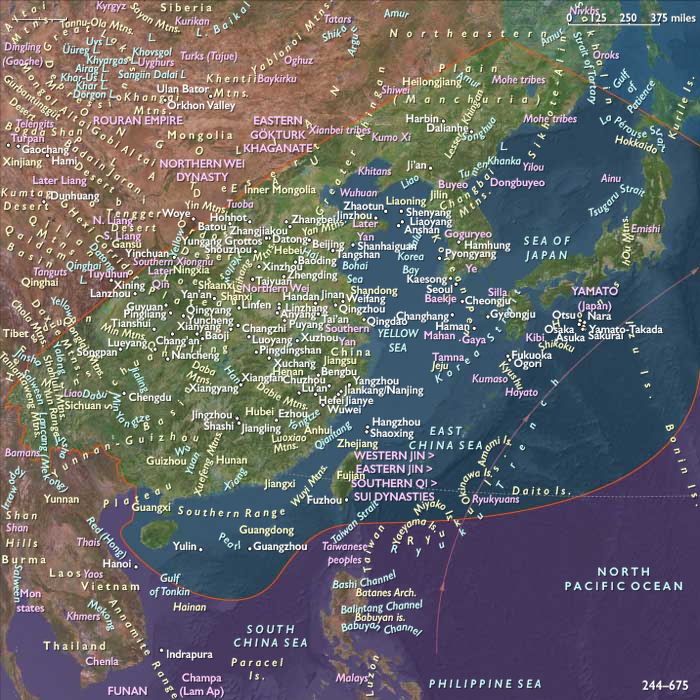
The rebellion of Jin Dynasty general Su …
Years: 327 - 327
The rebellion of Jin Dynasty general Su Jun against Emperor Cheng's regent Yu Liang is initially successful, allowing him to take over the imperial government.
Locations
People
Groups
Topics
- Six Dynasties Period in China
- Sixteen Kingdoms Period in China
- Civil Wars in China triggered by the Wu Hu Invasion
Commodoties
Subjects
Regions
Subregions
Related Events
Filter results
Showing 10 events out of 59903 total
In order to resolve the shortage of labor in the provinces, Constantine decrees in 327 that rural slaves can only be sold in the province where they reside.
Both the cult of Mithras and Zoroastrianism have been commonly practiced in Iberia from the first centuries CE.
The cult of Mithras, distinguished by its syncretic character and thus complementary to local cults, especially the cult of the Sun, had gradually come to merge with ancient Georgian beliefs.
The western Georgian Kingdom of Iberia (Kartli) becomes one of the first states in the world to convert to Christianity in 327, when the King Mirian II establishes it as the official state religion, outlawing the pagan gods.
He founds the church in Mtskheta on the site of which the cathedral of Svetitskhoveli will eventually be erected. (The date of conversion varies based on numerous accounts and historical documents, which indicate Iberia adopting Christianity as a state religion in CE 317, 324, etc. According to Georgian chronicles, St. Nino of Cappadocia converted Georgia to Christianity in 330 during the time of Constantine ‘the Great’.)
Pachomius had set out to lead the life of a hermit near Anthony of Egypt, whose practices he imitated.
An earlier ascetic named Macarius had earlier created a number of proto-monasteries called larves, or cells, where holy men would live in a community setting who were physically or mentally unable to achieve the rigors of Anthony's solitary life.
Pachomius sets about organizing these cells into a formal organization.
Christian asceticism up to this point had been solitary or eremitic.
Male or female monastics, living in individual huts or caves, meet only for occasional worship services.
Pachomius seems to have created the community or cenobitic organization, in which male or female monastics live together and have their possessions in common under the leadership of an abbot or abbess.
Pachomius himself was hailed as "Abba" (father) whence the word abbot derives.
This first cenobitic monastery, established between 318 and 323 by Pachomius, is in Tabennisi, an island of the Nile in Upper Egypt.
His elder brother John had been the first to join him, and soon more than one hundred monks are living at his monastery.
On becoming emperor at York in 306, Constantine had made his mother, Helena, empress dowager; under his influence, she had later become a Christian.
She was devoted to her eldest grandson, Crispus.
Following the double tragedy of Constanine's execution of his son and wife, the story becomes current that Fausta had accused Crispus of attempting to seduce her—hence Crispus' execution.
Fausta, in turn, had been denounced by the grief-stricken Helena and was executed shortly afterward.
It is perhaps in some sense to atone for the family catastrophe that Constantine's mother, Helena, embarks on a pilgrimage to the Holy Land.
Directed by her son to build churches upon sites which commemorated the life of Jesus Christ, her journey is attended by almsgiving and pious works and is distinguished by her church foundations at Jerusalem and at Bethlehem, where she has the Church of the Nativity built over the cave venerated by Christians as the birthplace of Jesus.
A church is also built in the initiative of Eutropia, Constantine's mother-in-law, at Mamre (near Hebron), where, according to an interpretation of Genesis shared by Constantine and Eusebius, Christ had first shown himself to men in God's appearance to Abraham; but …
…the most famous of these foundations follows the sensational discovery of what is purportedly the Holy Sepulcher at Jerusalem.
The site, originally one of veneration for the Christian community in Jerusalem, had been covered with earth and a temple of Venus had been built on top.
Although Eusebius does not say as much in his Life of Constantine, this would probably have been done as part of Hadrian's reconstruction of Jerusalem as Aelia Capitolina in 135, following the destruction of the Jewish Revolt of 70 and Bar Kokhba's revolt of 132–135.
Constantine takes up the discovery with enthusiasm, instructing Macarius, Bishop of Jerusalem, to build a great new basilica at the spot, offering unlimited help with labor and materials and suggestions as to design and decoration.
The people of the Malay Peninsula in the early centuries of the first millennium adopt the Indian religions of Hinduism and Buddhism, religions which are to have a major effect on the language and culture of those living in Malaysia.
The Sanskrit writing system is used as early as the fourth century.
East Central Europe (328–339 CE): Constantine’s Consolidation and Frontier Stability
Between 328 and 339 CE, East Central Europe—encompassing Poland, Czechia, Slovakia, Hungary, and those portions of Germany and Austria lying east of 10°E and north of a line stretching from roughly 48.2°N at 10°E southeastward to the Austro-Slovenian border near 46.7°N, 15.4°E—experienced continued frontier stability under the strong rule of Emperor Constantine the Great (306–337 CE) and his immediate successors. Roman frontier provinces (Pannonia Prima, Pannonia Secunda, Pannonia Savia, Pannonia Valeria, and Noricum) maintained security through effective governance, diplomatic arrangements, and fortified defenses, while interactions with recently settled tribal groups, particularly the Rugii, deepened economically and culturally. At the same time, proto-Slavic communities remained largely settled in their original regions, adapting steadily to Gothic hegemony while preserving local identities.
Political and Military Developments
Constantine’s Frontier Consolidation
-
Under Constantine’s later reign and that of his sons after 337 CE, Roman authority along the Danube remained strong, with robust frontier defenses effectively maintained, and diplomatic ties carefully managed to prevent large-scale tribal incursions.
-
Fortifications were continuously improved, and provincial governance became increasingly efficient and responsive.
Stable Rugian Settlement in Roman Pannonia
-
The Rugian communities established along the upper Tisza River continued their integration within Roman provincial frameworks, maintaining stable diplomatic relations with local Roman authorities and neighboring tribes.
Gothic Dominance and Proto-Slavic Stability
-
Gothic hegemony in Eastern Europe persisted, shaping proto-Slavic settlements and regional power dynamics. However, most proto-Slavic populations remained firmly established in their traditional territories, preserving social cohesion and stability despite external political pressures.
Economic and Technological Developments
Flourishing Economic Exchange
-
Frontier economic activities flourished, benefiting from sustained peace and security. Trade involving Roman frontier towns and Rugian communities intensified, exchanging Roman goods such as ceramics, textiles, and metalwork for regional resources like grain, livestock, and amber.
Infrastructure and Defensive Innovations
-
Continued improvements in frontier infrastructure—including roads, bridges, and fortifications—further strengthened regional stability and economic connectivity, enabling secure, efficient exchanges along the Danube frontier.
Cultural and Artistic Developments
Cultural Integration and Artistic Flourishing
-
The cultural landscape benefited from continued stability, leading to vibrant cross-cultural exchanges. Roman-Rugian interactions produced distinctive artistic blends in pottery, metalwork, and decorative artifacts, enhancing regional cultural richness.
Proto-Slavic Cultural Continuity
-
Despite external pressures, proto-Slavic populations maintained their traditional cultural identities, adapting subtly to Gothic cultural influences without significant displacement or disruption.
Settlement and Urban Development
Frontier Town Development
-
Roman frontier settlements (Carnuntum, Vindobona, Aquincum) remained economically vibrant and well-fortified, expanding modestly as administrative, military, and commercial hubs.
Stable Rugian Settlements
-
Rugian settlements along the upper Tisza stabilized further, becoming established parts of the regional landscape, economically productive, and culturally integrated into frontier life.
Social and Religious Developments
Consolidation of Tribal Leadership
-
Rugian tribal leadership solidified their social and political structures in the new environment, blending diplomatic cooperation with Roman authorities and tribal autonomy.
Proto-Slavic Religious and Social Stability
-
Proto-Slavic communities maintained cohesive social and religious traditions, reflecting resilience despite external Gothic domination, thus preserving their distinctive identities.
Long-Term Consequences and Historical Significance
The era 328–339 CE was marked by sustained frontier stability and regional prosperity under Constantine’s strong governance and subsequent effective administration. The consolidation of Rugian settlements and stable proto-Slavic communities, alongside Roman diplomatic strategies, fostered enduring cultural interactions and economic integration. These developments laid essential groundwork for continued stability, significantly influencing the historical evolution of East Central Europe into subsequent eras.
Eastern Southeast Europe (328–339 CE): Imperial Reforms and Religious Transformation
Settlement and Migration Patterns
Frontier Stability and Urban Growth
From 328 to 339 CE, Eastern Southeast Europe experienced relative frontier stability, enabling continued urban growth and demographic recovery. Major cities like Constantinople, Philippopolis (Plovdiv), and Serdica (Sofia) expanded as key administrative and economic hubs, benefiting from enhanced imperial protection and infrastructure investments.
Increased Roman Military Presence
The Roman Empire further reinforced its military presence along the Danube frontier to mitigate pressure from tribes such as the Goths and Gepids. This increased security bolstered settlement patterns, encouraging stability and economic activity in previously threatened areas.
Economic and Technological Developments
Economic Stability and Trade Revival
Regional economies experienced renewed vitality as security and stability improved trade conditions. Infrastructure projects, particularly in transportation and urban fortifications, facilitated robust trade connections between Eastern Southeast Europe and other Roman provinces, bolstering local markets and regional prosperity.
Technological and Infrastructure Enhancement
Roman authorities continued to invest in technological and infrastructural improvements, including enhanced road networks, bridges, and fortified urban defenses. These projects ensured sustained economic growth and effective military logistics, reinforcing regional stability.
Cultural and Artistic Developments
Expansion of Imperial and Religious Architecture
This era saw extensive construction and enhancement of public, imperial, and religious buildings. Major urban centers received new basilicas, forums, and public baths, reflecting imperial patronage and the expanding influence of Christianity across the region.
Flourishing Classical Scholarship
Educational institutions, especially those in Constantinople, further solidified their roles as centers of classical scholarship. The transmission and enhancement of Greek and Roman intellectual traditions contributed significantly to the cultural and intellectual life of the region.
Social and Religious Developments
Consolidation of Christianity under Constantine
The period from 328 to 339 CE marked significant religious transformation, characterized by Emperor Constantine the Great's support for Christianity. Constantine initiated construction of prominent Christian basilicas, promoted ecclesiastical structures, and fostered the widespread adoption of Christianity, reshaping social and religious landscapes.
Enhanced Provincial Administration
Roman provincial administration underwent further refinement, characterized by greater centralization and efficiency. Enhanced governance frameworks promoted stability, improved tax collection, and facilitated the effective integration of local elites into imperial administrative structures.
Long-Term Consequences and Historical Significance
The era from 328 to 339 CE was pivotal for Eastern Southeast Europe, defined by strengthened frontier defenses, urban expansion, robust economic recovery, and significant religious and administrative transformations. These developments provided essential foundations for sustained regional stability and prosperity, laying critical groundwork for the emerging Byzantine political and cultural identity.

The Middle East: 328–339 CE
Shapur II and Renewed Sassanid Aggression
In 328 CE, the Sassanid king Shapur II, likely motivated by both strategic ambitions and religious differences, disrupts the forty-year peace that had prevailed since the settlement between Narseh and Roman Emperor Diocletian in 297 CE. Shapur’s aggressive policy inaugurates a prolonged phase of intense and often bitter warfare between the Roman and Persian empires.
After successfully suppressing internal rebellions in southern Persia, Shapur mobilizes his armies against Roman territories. His campaigns are marked by swift victories and significant territorial gains, enabling him to recapture Armenia and occupy parts of Roman Mesopotamia. This resurgence of Persian military power dramatically reshapes the geopolitical landscape, placing Roman frontier defenses under severe strain.
The resulting wars, stretching from 337 to 350 and again from 358 to 363, are poorly documented but clearly indicate a shift in power dynamics, with the Sassanids challenging Rome's dominance in the region. Shapur’s victories signal a robust revival of Persian influence, setting the stage for the Middle East to again become a fiercely contested arena between two imperial powers.
Thus, the era 328–339 CE underscores Shapur II’s determination to reassert Persian dominance, profoundly impacting the political and military trajectories of the region for decades to come.
Years: 327 - 327
Locations
People
Groups
Topics
- Six Dynasties Period in China
- Sixteen Kingdoms Period in China
- Civil Wars in China triggered by the Wu Hu Invasion