The ravages of the Lombards have rendered …
Years: 575 - 575
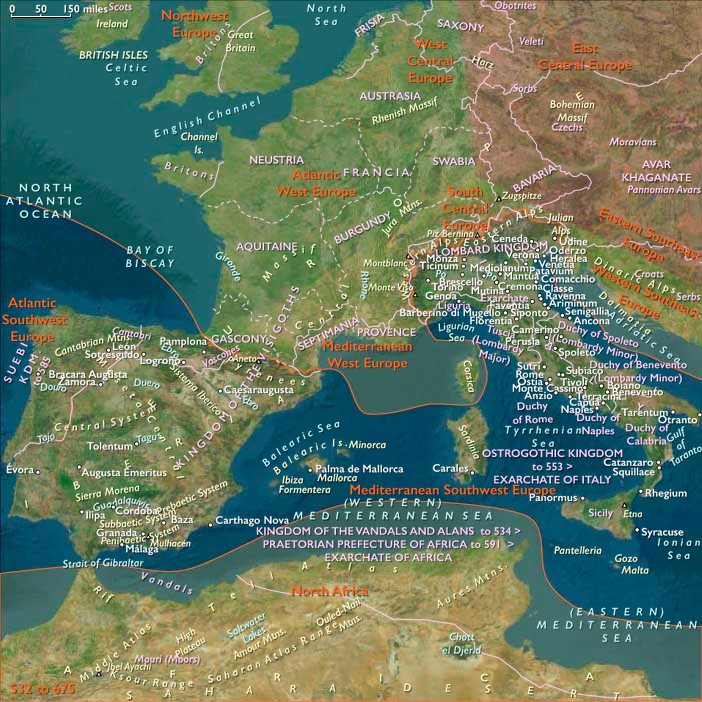
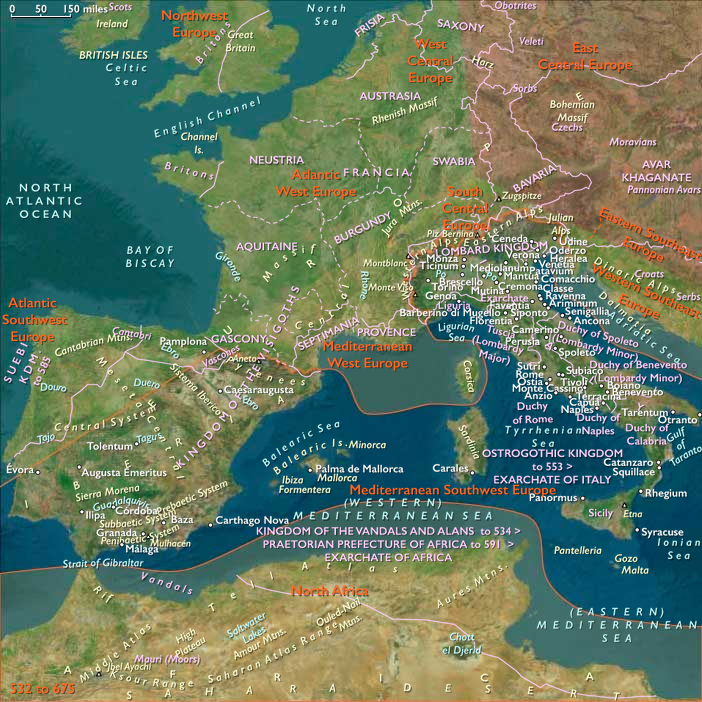
The ravages of the Lombards have rendered it very difficult to communicate with the emperor at Constantinople, who claims the privilege of confirming the election of the popes.
Hence there has been a vacancy of nearly eleven months between the death of John III and the arrival of the imperial confirmation of the election, on June 2, 575, of Pope Benedict, the son of a man named Boniface, called Bonosus by the Greeks.
Locations
People
Groups
- Lombards (West Germanic tribe)
- East, or Oriens, Praetorian prefecture of
- Italy, Praetorian prefecture of
- Roman Empire, Eastern: Justinian dynasty
- Lombards (Italy), Kingdom of the
- Spoleto, Lombard Duchy of
- Benevento, Lombard Duchy of
Topics
- Migration Period
- Migration Period Pessimum
- Byzantine Papacy
- Interregnum, Lombard, or Rule of the Dukes
Subjects
Regions
Subregions
Related Events
Filter results
Showing 10 events out of 57408 total
The Turkic Khaganate is a vast empire from Manchuria and the Chinese wall to the Black Sea.
It is impossible to govern the whole khaganate from a single capital, so while the eastern part is directly ruled by the khagan, the western part is governed by a yabgu (vassal) in behalf of the khagan.
The capital of the west is Ordukent (Suyab) in present day Kyrgyzistan.
Istemi, who was the fist khagan's brother, is the first yagbu and Tardu (İstemi's son) is the second.
The western Turk empire continues to thrive under Tardu, who succeeds his father in 575.
The events of the reign of Al-Mundhir IV are mostly obscure, except for the sack and razing of Hirah by the Ghassanids under al-Mundhir III ibn al-Harith in 575.
A Yemenite appeal to Persia for aid leads in 575 to a relatively brief Persian occupation of Yemen and the end of Christian power in South Arabia.
The Assassination of Sigebert I and the Survival of Childebert II (575 CE)
By 575 CE, Sigebert I has nearly defeated Chilperic I, seizing most of Neustria and being proclaimed king by Chilperic's subjects at Vitry, a key Neustrian stronghold. However, at the moment of his greatest triumph, he is assassinated by agents of Fredegund, abruptly altering the course of Frankish history.
1. The Acclamation of Sigebert at Vitry (575 CE)
- With Chilperic in hiding at Tournai, Sigebert is declared king of Neustria by its nobles and subjects.
- Vitry, a significant Neustrian seat of power, is chosen over Arras, where Chilperic had ruled.
- Sigebert is raised on the shield, following Frankish royal tradition, symbolizing his official acceptance as king.
2. The Assassination by Fredegund’s Agents
- At the moment of his triumph, two assassins, reportedly acting on orders from Fredegund, strike him down.
- The assassination is swift and unexpected, preventing him from fully consolidating his rule over Neustria.
- With Sigebert’s death, Chilperic is saved from certain defeat, allowing him to reclaim Neustria.
3. The Struggle for Childebert II’s Inheritance
- Sigebert’s young son, Childebert II, is now the rightful king of Austrasia.
- Chilperic attempts to seize his lands, taking advantage of Sigebert’s sudden death.
- However, Guntram, King of Burgundy, intervenes to protect Childebert, preventing Chilperic from claiming Austrasia.
- Guntram acts as a mediator, ensuring that the Merovingian civil war does not escalate further.
4. The Aftermath and the Continued Blood Feud
- Brunhild, Sigebert’s widow, becomes the regent for Childebert II, taking control of Austrasia.
- She vows vengeance against Fredegund and Chilperic, ensuring that their rivalry continues.
- The conflict between Neustria and Austrasia persists, dominating Frankish politics for decades.
Conclusion: A Turning Point in the Merovingian Civil War
The assassination of Sigebert I in 575 CE is a pivotal moment in Frankish history, dramatically shifting the balance of power:
- Fredegund’s cunning saves Chilperic from certain defeat, allowing him to regain control of Neustria.
- Childebert II, under the protection of Guntram, survives to rule Austrasia, keeping the Merovingian civil war alive.
- Brunhild and Fredegund’s rivalry intensifies, ensuring decades of dynastic bloodshed, political intrigue, and assassinations.
Sigebert’s premature death prevents the unification of Austrasia and Neustria, prolonging the fragmentation and internecine conflicts that define the Merovingian dynasty.
unhilda’s Vengeance and the Continuation of the Frankish Civil War (575–613 CE)
Following the assassination of her husband, Sigebert I, in 575 CE, Brunhilda, Queen of Austrasia, takes up the fight against Chilperic I of Neustria and his wife Fredegund, the suspected orchestrator of the murder. This dynastic feud, which had already devastated the Frankish realm, now turns into a multi-generational conflict, as Brunhilda continues the savage civil war between Austrasia and Neustria.
1. Brunhilda’s Struggle for Power in Austrasia
- With Sigebert dead, his son Childebert II (only five years old at the time) becomes King of Austrasia, with Brunhilda as his regent.
- However, her position is not secure—many Austrasian nobles resist her influence, as she is a Visigothic princess and a strong-willed woman in a male-dominated court.
- Despite opposition, Brunhilda consolidates power, relying on loyal aristocrats and her alliance with Guntram, King of Burgundy.
2. War with Neustria: Brunhilda vs. Fredegund
- Chilperic and Fredegund seize the opportunity of Sigebert’s death to try to expand Neustrian territory into Austrasia.
- Brunhilda, determined to avenge her husband, leads Austrasia in a prolonged war against Neustria.
- The war becomes a brutal power struggle between two queens—Brunhilda and Fredegund, both ruling through their sons and engaging in ruthless political maneuvers.
3. The Death of Chilperic (584 CE) and Fredegund’s Regency
- In 584 CE, Chilperic is assassinated, allegedly on Fredegund’s orders to remove a political threat.
- Fredegund becomes regent for their infant son, Chlothar II, continuing to battle Brunhilda and Childebert II for control of Frankish lands.
- The Neustrian-Austrasian conflict persists, fueled by assassinations, betrayals, and shifting alliances.
4. The Next Generation: Childebert II’s Death and Continued Conflict
- Childebert II dies in 595 CE, leaving Brunhilda as regent for her grandsons Theudebert II (Austrasia) and Theuderic II (Burgundy).
- However, the Frankish aristocracy turns against Brunhilda, eventually leading to her fall from power.
- In 613 CE, Brunhilda is captured by Chlothar II, Fredegund’s son, and is executed in a brutal fashion, marking the end of her decades-long war with Neustria.
Conclusion: A Multi-Generational Civil War
The murder of Sigebert I in 575 CE does not end the conflict between Austrasia and Neustria—instead, it escalates into a war between two queens, Brunhilda and Fredegund, and their descendants.
- Brunhilda’s determination to avenge her husband ensures that the war rages on for nearly forty years.
- Her political ambition and resilience make her one of the most formidable women in Merovingian history, though it ultimately leads to her violent downfall.
- The long conflict weakens the Merovingian dynasty, setting the stage for the rise of the Carolingians in the following century.
Brunhilda’s war redefines Frankish politics, marking the sixth and seventh centuries as an era of dynastic struggle, blood feuds, and shifting alliances that shape the future of medieval France and Western Europe.

King Jinheung, one of the greatest kings of Silla, has been responsible for expanding Silla territory immensely.
In 576 BCE, the Hwarang Organization is established; it will later play a huge role in the unification of Korea’s three kingdoms.
Jinheung, who dies in this year at forty-three after ruling for thirty-seven years, is succeeded by his second son, Prince Sa-Ryun, who becomes King Jinji.
The alliance between the Persians and the Western Turks has, inevitably, become a source of possible friction, and the Western Turks have sometimes acted as an ally of Constantinople in the war that had begun in 572.
The Turks, angered by the Romans’ treaty with the Avars, not only break off their alliance with Constantinople in 576 but also seize a Roman stronghold in the Crimea.
The Roman-Persian war that had begun five years earlier ends in 576 with Persia’s defeat at Melitene.
Chilperic I’s War Against Guntram and His Gains in Austrasia (575–584 CE)
Following the assassination of Sigebert I in 575 CE, Chilperic I of Neustria takes advantage of the ensuing instability in Austrasia, where Sigebert’s young son, Childebert II, is now king under the protection of Guntram, King of Burgundy. Chilperic sees an opportunity to expand Neustrian power at the expense of Austrasia and Burgundy.
1. War with Guntram and the Seizure of Austrasian Territory
- Guntram, King of Burgundy, positions himself as protector of his nephew, Childebert II, seeking to prevent Neustrian expansion.
- Chilperic, however, launches an aggressive campaign, forcing Guntram to defend Childebert’s eastern Frankish kingdom.
- Chilperic successfully takes Tours and ...
...
- Poitiers from Austrasia, extending Neustrian influence into central Gaul.
- He also captures several locations in Aquitaine, consolidating his position in the region.
2. Fostering Discord in Austrasia
- Chilperic does not merely rely on military conquest—he also engages in political manipulation to destabilize Austrasia.
- He fosters discord among the Austrasian nobility, seeking to weaken Childebert’s rule during his minority.
- This tactic allows him to maintain pressure on his eastern rivals, further undermining the unity of the Frankish realms.
3. The Growing Power Struggle in the Frankish Kingdoms
- With Guntram defending Childebert II and Chilperic expanding Neustrian influence, the Frankish kingdoms remain locked in a prolonged struggle for dominance.
- Meanwhile, Brunhilda, the widow of Sigebert, works to protect her son’s claim while dealing with internal opposition in Austrasia.
- Chilperic’s growing power threatens the balance of power in Frankish Gaul, but his reign is cut short by his assassination in 584 CE, allegedly orchestrated by his own political enemies.
Conclusion: A Temporary Neustrian Expansion
Chilperic’s recovery of Tours, Poitiers, and parts of Aquitaine in the late 570s and early 580s marks a significant Neustrian territorial gain. However, his sudden assassination in 584 CE will leave his wife, Fredegund, and their young son, Chlothar II, vulnerable to retaliation from their rivals in Austrasia and Burgundy.
Despite his temporary success, Chilperic’s wars further fragment the Merovingian realm, ensuring that dynastic feuds and territorial struggles will persist for decades to come.
Years: 575 - 575
Locations
People
Groups
- Lombards (West Germanic tribe)
- East, or Oriens, Praetorian prefecture of
- Italy, Praetorian prefecture of
- Roman Empire, Eastern: Justinian dynasty
- Lombards (Italy), Kingdom of the
- Spoleto, Lombard Duchy of
- Benevento, Lombard Duchy of
Topics
- Migration Period
- Migration Period Pessimum
- Byzantine Papacy
- Interregnum, Lombard, or Rule of the Dukes