
The Quaternary Period, the current and most …
Years: 2599821BCE - 2350990BCE
The Quaternary Period, the current and most recent of the three periods of the Cenozoic Era in the geologic time scale of the International Commission on Stratigraphy (ICS), follows the Neogene Period and spans from 2.588 ± 0.005 million years ago to the present.
Typically defined by the cyclic growth and decay of continental ice sheets driven by Milankovitch cycles and the associated climate and environmental changes that occurred, the Quaternary Period is divided into two epochs: the Pleistocene and the Holocene (eleven thousand seven hundred years ago to today).
The Pleistocene spans the world's recent period of repeated glaciations.
With the onset of the Quaternary glaciation, the first of the several ice ages to follow, decreasing oceanic evaporation results in a drier climate in East Africa and an expansion of the savanna at the expense of forests.
Reduced availability of fruits forces some Australopithecines to unlock new food sources found in the drier savanna climate, representing a move from the mostly frugivorous or omnivorous diet of Australopithecus to the carnivorous scavenging lifestyle of early Homo.
Paranthropus species are still present in the beginning of the Pleistocene, along with early human ancestors, but they disappear during the lower Paleolithic.
The Lower Paleolithic, the earliest subdivision of the Paleolithic or Old Stone Age, begins around two and a half million million years ago when the first evidence of craft and use of stone tools by hominids appears in the current archaeological record.
The genus Homo, which includes modern humans and species closely related to them, is estimated to be about two point three to two point four million years old, evolving from australopithecine ancestors with the appearance of Homo habilis.
Specifically, H. habilis is considered the direct descendant of Australopithecus garhi, a gracile species that lived about two and a half million years ago.
The most salient physiological development between the two species is the increase in cranial capacity, from about four hundred and fifty cubic centimeters (twenty-seven cubic inches) in A. garhi to six hundred cubic centimeters (thirty-seven cubic inches) in H. habilis.
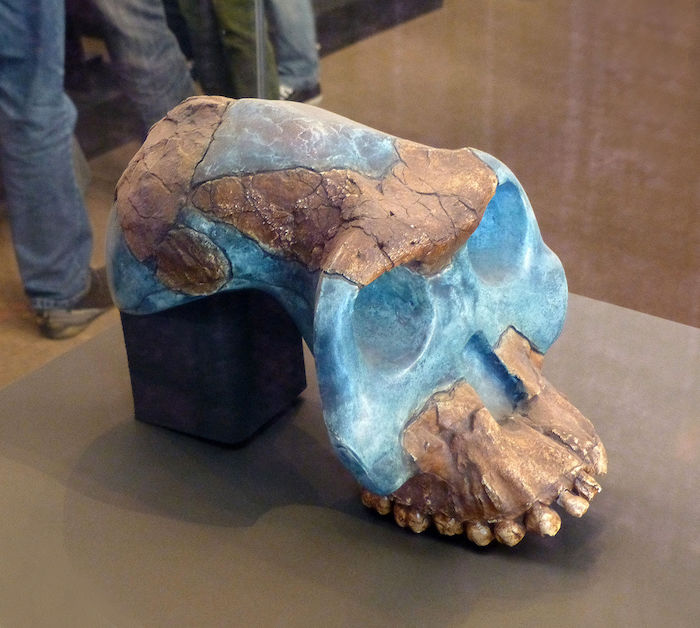
Addis Abeba, Musée national d'Ethiopie : crâne reconstitué d'Australopithecus garhi à partir d'éléments trouvés en 1997 (Awash, région Afar). 2,5 millions d'années. BOU-VP 12/130. 13 January 2014, 13:19:14 by Ji-Elle
Topics
Subjects
Years: 2599821BCE - 2350990BCE
Addis Abeba, Musée national d'Ethiopie : crâne reconstitué d'Australopithecus garhi à partir d'éléments trouvés en 1997 (Awash, région Afar). 2,5 millions d'années. BOU-VP 12/130. 13 January 2014, 13:19:14 by Ji-Elle