
The Pyu complete their commercial center of …
Years: 628 - 639
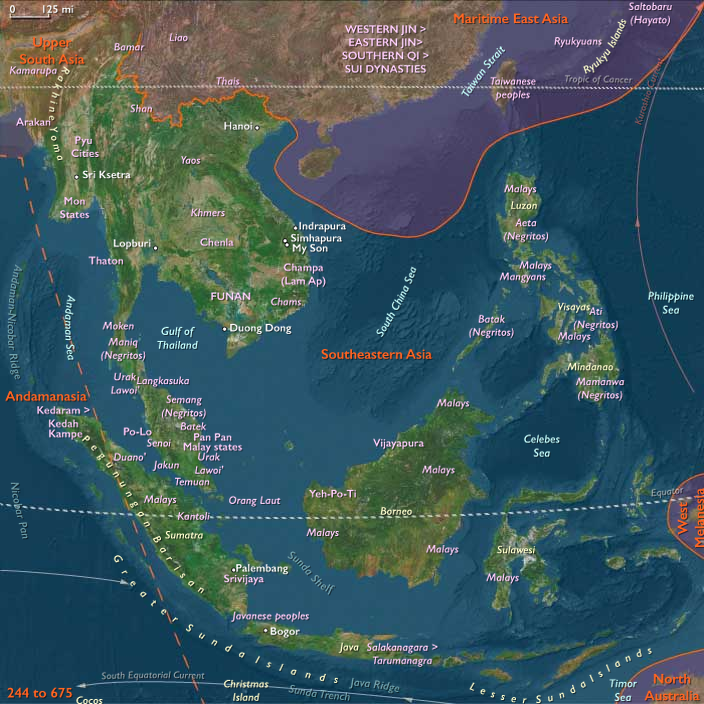
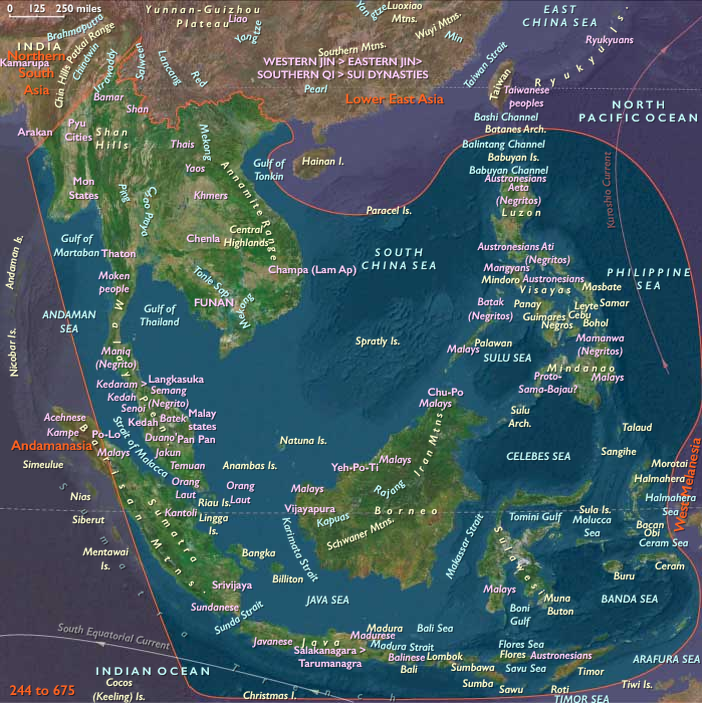
The Pyu complete their commercial center of Sri Ksetra in the dry zone of present northern Burma in 638.
Sri Ksetra or Thaye Khittaya (lit., "Field of Fortune" or "Field of Glory"), located eight kilometers southeast of Prome (Pyay) at present-day Hmawza village, is the last and southernmost Pyu capital.
The city, founded between the fifth and seventh centuries, likely overtook Halin as the premier Pyu city by the seventh or eighth century, and will retain that status until the Mranma arrive in the ninth century.
The city is home to at least two dynasties, and maybe three.
The first dynasty, called the Vikrama Dynasty, is believed to have launched the Pyu calendar, which will later become the Burmese calendar, on March 22, 638.
Locations
Groups
Topics
Subjects
Regions
Subregions
Related Events
Filter results
Showing 10 events out of 56840 total
Phraya Kalavarnadit, the legendary first king of Lavo, is said to have established the city of Lavo around 450 CE as one of the Dvaravati city-states.
Kalavarnadit establishes a new era called the Chulasakaraj, which is the era used by the Siamese and the Burmese until the nineteenth century.
Isanavarman I of Chenla expands Khmer influence to the Chao Phraya valley through his campaigns around the seventh century.
Dvaravati cities that fall under Khmer hegemony become Lavo, while the Western cities are spared from Khmer hegemony and form the Kingdom of Supannabhum.
Lavo is the center from which Khmer authority rules over Dvaravatians.
The only native language found during early Lavo times is the Mon language.
However, there is debate whether Mon was the sole ethnicity of Lavo.
Nonetheless, it also should be noted that the area also home to a sizable Malays and Khmer people earlier during Dvaravati period.
Some historians point out that Lavo was composed of mixed Mon and Lawa people (a Palaungic people), with the Mons forming the ruling class.
It is also hypothesized that the migration of Tai people into Chao Phraya valley occurred during the time of the Lavo kingdom.
The transition from the Sui to the Tang dynasty ends in 628, when Emperor Gaozu's son Emperor Taizong of Tang (Li Shimin) destroys the Liang state ruled by the agrarian rebel ruler Liang Shidu and reunifies China.
Taizong, the second emperor of the Tang Dynasty, had encouraged his father, Li Yuan (later Emperor Gaozu) to rise against Sui Dynasty rule at Taiyuan in 617 and subsequently defeated several of his most important rivals.
He immediately faces a crisis, as the Eastern Gökturk Khaganate launches a major incursion toward Chang'an, and just nineteen days after Emperor Taizong takes the throne in 626, the two khans meet across the river and personally negotiate peace terms, including Tang tributes to the Gökturks.
After Taizong subjugates the Xianbei state Tuyuhun in 635, Tuyuhun's southwestern neighbor, the Tibetan state Tufan, rises in power and soon displaces Tuyuhun as the major threat to Tang's west.
Tufan attacks Tuyuhun and Tang in 638 with a grand force of two hundred thousand and while Tang's fifty thousand troops repel the Tufan attack, Emperor Taizong offers a marriage alliance.
For the rest of Emperor Taizong's reign, there will be no further major battles between Tang and Tufan, although Tufan will pose major military threats for almost the rest of Tang Dynasty rule.
Xuanzang, a Chinese Buddhist monk, scholar, traveler, and translator, becomes famous for his seventeen-year overland journey to India.
The Bulgar tribes consolidate under Khan Kurt, or Kubrat, after the defeat of the Avars by Heraclius.
The Bulgars, a Turkic people who are first mentioned in the sources toward the end of the fifth century CE, live at this time in the steppes to the north of the Black Sea.
The Bulgar tribes are composed of skilled, warlike horsemen governed by khans (chiefs) and boyars (nobles).
The Avars had subdued the Bulgars in the sixth century.
Kubrat (also Kurt or Houvrat) is of the kingly Dulo clan, with the authority of the Western Turkic Khaganate, and the rightful heir of the Bulgar throne.
He had spent his adolescence in Constantinople, where he was educated and baptized, while his maternal uncle Organa ruled over his tribe.
Kubrat returns to his fatherland around 628 to become khagan over the Crimean Huns with the support of the Onogur, who have always violently opposed the European Avar Khaganate.
Khan Kubrat manages to unite the two main Bulgar tribes of Kutrigur and Utigur under a single rule between 630 and 635, creating a powerful confederation which is referred to by the medieval authors as The Old Great Bulgaria and also known as The Onogundur-Bulgar Empire.
Some scholars assume that it also included among its subjects a significant portion of the defeated Avars and stretched as far west as the Pannonian plain.
It is presumed that Kubrat’s capital was the ancient city of Phanagoria on the Taman peninsula.
The Khazars, members of a confederation of Turkic-speaking tribes, are in contact with the Persians in the early seventh century. (The origin of the term Khazar and the early history of the Khazar people are obscure, but it is likely that the Khazars were originally located in the northern Caucasus region and were part of the western Turkic empire in present Turkestan).
The tribes constituting the Khazar union are, according to the most widely approved view, basically Turkic groups, such as the Oğuric peoples, including Šarağurs, Oğurs, Onoğurs, and Bulğars, who formed part of the Tiĕlè confederation.
These tribes, many driven out of their homelands by the Sabirs, who in turn fled the Asian Avars, had begun to flow into the Volga-Caspian-Pontic zone from as early as the fourth century CE and are recorded by Priscus to reside in the Western Eurasian steppelands as early as 463.
They appear to stem from Mongolia and South Siberia in the aftermath of the fall of the Hunnic/Xiōngnú nomadic polities.
A variegated tribal federation led by these Tűrks, probably comprising a complex assortment of Iranian, proto-Mongolic, Uralic, and Paleo-Siberian clans, had vanquished the Rouran Khaganate of the hegemonic central Asian Avars in 552 and swept westwards, taking in their train other steppe nomads and peoples from the Sogdian kingdom.
The Khazars have by about 630 become independent of the Turkic empire to the east.
East Central Europe (628–639 CE): Samo’s Kingdom, Kubrat’s Bulgar Rebellion, and Frankish–Slavic–Bulgar Conflicts
Between 628 and 639 CE, East Central Europe—encompassing Poland, Czechia, Slovakia, Hungary, and those portions of Germany and Austria lying east of 10°E and north of a line stretching from roughly 48.2°N at 10°E southeastward to the Austro-Slovenian border near 46.7°N, 15.4°E—experienced significant geopolitical transformations marked by the establishment of powerful new states and complex regional conflicts. The Slavic federation under King Samo (r. ca. 623–658 CE)decisively resisted Avar and Frankish pressures, securing independence through the notable Battle of Wogastisburg (ca. 631/632 CE). Simultaneously, Khan Kubrat (Kurt), a prominent leader of the Bulgar tribal confederation, successfully led an uprising against Avar domination in the Pannonian Plain and north of the Black Sea, founding a polity that Byzantine chroniclers named Old Great Bulgaria. It is important to note these early medieval Bulgars were a Turkic-speaking people, distinctly different ethnically and linguistically from the later medieval and modern Bulgarians, whose culture and language became predominantly Slavic. Around this same period, chronicler Fredegar records an episode where approximately nine thousand Turkic-speaking Bulgar refugees, fleeing turmoil and Avar reprisals, sought asylum in Bavaria, only to be massacred by Frankish king Dagobert I.
Political and Military Developments
Formation of Samo’s Slavic Kingdom and the Battle of Wogastisburg
-
Samo’s Kingdom, comprising unified West Slavic tribes across Moravia, Bohemia, and surrounding territories, effectively resisted external pressures from Avars and Franks. The critical Slavic victory at Wogastisburg (ca. 631/632 CE), fought against Frankish forces and their Alamanni and Lombard allies, significantly curtailed Frankish ambitions eastward, reinforcing the stability and independence of Slavic territories.
Khan Kubrat’s Bulgar Revolt and Old Great Bulgaria
-
Around 632 CE, the Turkic-speaking Bulgar leader Kubrat (of the Dulo clan) led a powerful rebellion against Avar rule, significantly weakening Avar authority north and east of the Carpathian Basin. Kubrat established a sizable independent state—Old Great Bulgaria—recognized by Byzantine chronicles.
-
These early medieval Bulgars, closely related culturally and linguistically to other Turkic tribes such as the Onogurs, were ethnically and linguistically distinct from the later medieval Bulgarians who became heavily Slavicized.
Fredegar’s Bulgar Episode and Frankish Repression
-
Chronicler Fredegar recounts how, amid the chaos following Kubrat’s rebellion, a group of approximately nine thousand Turkic-speaking Bulgar refugees sought protection in Bavaria. King Dagobert I, suspicious of their intentions, ordered their massacre—highlighting the harshness of Frankish frontier policies and ongoing regional tensions.
Frankish Duchy of Thuringia (ca. 631 CE)
-
Around the same time, the Franks formally organized Thuringia into a duchy (631 CE), aiming to solidify their eastern frontier. Thuringia quickly became embroiled in conflict during Samo’s campaigns against Frankish territories.
Economic and Technological Developments
Continuation of Trade Networks
-
Despite political instability and warfare, trade persisted actively between Frankish, Slavic, Bavarian, and Bulgar regions, exchanging agricultural products, luxury items, metalwork, and textiles.
Enhanced Defensive Fortifications
-
Facing continuous threats, Samo’s Slavic territories and Kubrat’s Bulgar domains developed fortified settlements, strategic defensive systems, and enhanced fortifications.
Cultural and Artistic Developments
Early Medieval Bulgar Cultural Identity
-
Kubrat’s establishment of Old Great Bulgaria fostered a distinctively Turkic Bulgar cultural identity, significantly different from subsequent medieval Bulgarians who were predominantly Slavic-speaking. This Turkic cultural influence is visible archaeologically in weaponry, metalwork, burial customs, and artistic expressions.
Consolidation of West Slavic Cultural Identity
-
Concurrently, Samo’s Slavic federation reinforced a cohesive cultural identity among West Slavic groups, evident in settlement organization, pottery styles, jewelry, and burial rituals.
Continued Avar Cultural Influence
-
Despite military setbacks, the Avar Khaganate maintained significant regional cultural influence, particularly in metallurgy and decorative arts.
Settlement and Urban Development
Expansion of Fortified Bulgar and Slavic Settlements
-
Both Kubrat’s Bulgars and Samo’s Slavs significantly expanded fortified settlements and strongholds, bolstering political stability, agricultural productivity, and social cohesion.
Stability of Bavarian and Thuringian Settlements
-
Bavarian towns (especially Regensburg) and Thuringian frontier settlements remained strategically important, despite occasional conflicts and disruptions.
Social and Religious Developments
Hierarchical Societies: Samo’s Slavs and Kubrat’s Bulgars
-
Both Slavic and Turkic Bulgar societies during this period developed clear political hierarchies, characterized by strong warrior elites and centralized governance structures essential for effective military organization and regional diplomacy.
Frankish Control and Regional Tensions
-
The Franks under Dagobert I implemented harsh frontier policies (exemplified by the Bulgar refugee massacre) to maintain control over ethnically diverse and strategically vulnerable border territories.
Long-Term Consequences and Historical Significance
The era 628–639 CE, significantly shaped by Samo’s Slavic victory, Kubrat’s establishment of Old Great Bulgaria, and Frankish–Slavic–Bulgar conflicts, constituted a crucial turning point in East Central European history. The period marked the first major regional weakening of the Avars and highlighted complex interactions among Turkic-speaking Bulgars, West Slavic peoples, Franks, and Avars. Importantly, early medieval Bulgars—distinctly Turkic-speaking and culturally separate from later Slavicized Bulgarians—began playing a decisive role in regional geopolitics. Collectively, these developments profoundly influenced medieval state formation, political alliances, ethnic identities, and historical trajectories in East Central Europe.
The West Slavs form a polity under Frankish merchant Samo.
A war between the Avars and their west Slav clients, the Wends, is documented by the East Romans and Franks.
In the 630s, Samo, the ruler of the first historically known Slavic polity, Samo's Tribal Union (or Samo's realm), increases his authority over lands to the north and west of the khanate, at the expense of the Avars.
Following this defeat, the prestige and power of the Avars declines.
The devastating impact of the Byzantine–Sassanid War of 602–628, along with the cumulative effects of a century of almost continuous Byzantine-Persian conflict, has left both empires crippled.
The Sassanids are further weakened by economic decline, heavy taxation to finance Khosrau II's campaigns, religious unrest, and the increasing power of the provincial landholders at the expense of the Shah.
Constantinople’s empire is also severely affected, however, with the Balkans now largely in the hands of the Slavs.
Additionally, Anatolia has been devastated by repeated Persian invasions, and the empire's hold on its recently regained territories in the Caucasus, Syria, Mesopotamia, Palestine, and Egypt has been loosened by years of Persian occupation.
Constantinople, its financial reserves exhausted, finds difficulties paying veterans of the war with the Persians and recruiting new troops.
