
The Pyramid Texts, a collection of ancient …
Years: 2349BCE - 2206BCE
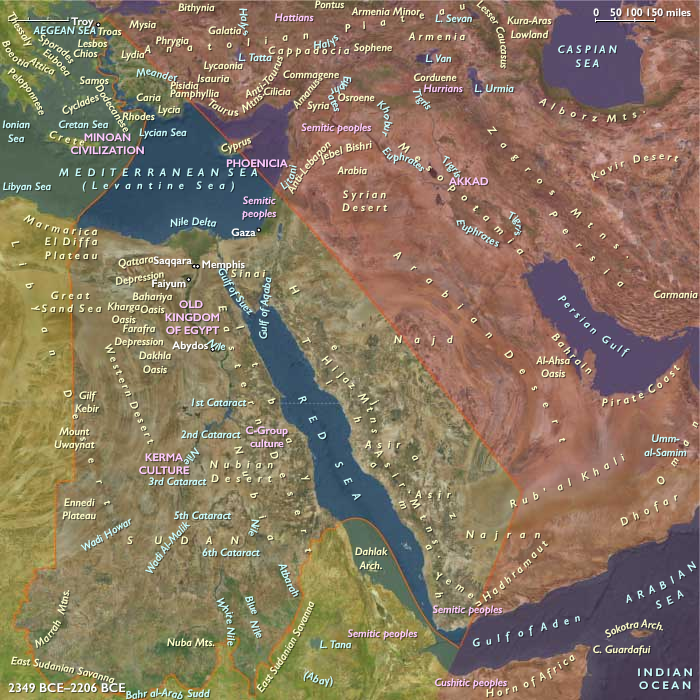
The Pyramid Texts, a collection of ancient Egyptian religious texts from the time of the Old Kingdom, are the oldest known religious texts in the world.
Written in Old Egyptian, the pyramid texts are carved on the walls and sarcophagi of the pyramids at Saqqara during the Fifth and Sixth Dynasties of the Old Kingdom.
The oldest of the texts date to between 2400-2300 BCE.
Egyptians begin placing small pieces of crystal on the forehead of the deceased before mummification.
By about 2350, Egyptians coat the bandaged corpse of mummies with a layer of plaster, colored light green; the facial features are represented in paint like a mask.
Scents and unguents, initially restricted to use in the rituals of mummification, now become an important product in the Egyptian export trade.
Raw essences are gathered from throughout the Mediterranean to be compounded in Egypt and sold as perfumes, creams, and lotions.
Almond, olive, and sesame oils, thyme and oregano, frankincense and myrrh, spikenard, saffron, rosewater, and chypre provide the basis for concoctions that will eventually find use throughout the world.
Locations
Groups
Topics
Commodoties
Subjects
Regions
Subregions
Related Events
Filter results
Showing 10 events out of 68204 total
Maritime East Asia (2349–2206 BCE): Legendary Flood, Sage-Kings, and the Foundation of Gojoseon
Between 2349 BCE and 2206 BCE, Maritime East Asia—comprising lower Primorsky Krai, the Korean Peninsula, the Japanese Archipelago below northern Hokkaido, Taiwan, and southern, central, and northeastern China—enters an era dominated by legendary events and seminal myths that profoundly influence later historical and cultural identities. This period prominently features China’s foundational legends of the Great Flood, the virtuous reigns of the mythical sage-kings Yao and Shun, the rise of Yu the Great, early jade culture, and the mythical establishment of the Korean kingdom of Gojoseon.
The Legendary Great Flood of China
A pivotal event of this era is the legendary Great Flood of China, traditionally dated to the third millennium BCE during the reign of Emperor Yao. According to Confucian historical texts, notably the Classic of History (Shu Jing)and the writings of the historian Sima Qian, the flood devastates extensive areas, inundating both the Yellow (Huang He) and Yangtze (Chang Jiang) river valleys. Catastrophic flooding, accompanied by severe storms and widespread famine, continues unabated for years, causing massive population displacement and social turmoil.
Initially, a figure named Kun attempts to control the floodwaters by constructing dams and barriers. However, Kun’s efforts fail disastrously, leading Emperor Yao to execute him for incompetence. Kun’s son, Yu—later revered as Yu the Great—adopts innovative, natural methods by creating extensive drainage channels that successfully redirect floodwaters into the sea, ultimately stabilizing the environment and restoring productivity.
Reigns of Legendary Sage-Emperors Yao and Shun
Emperor Yao, traditionally reigning from approximately 2356 BCE to 2255 BCE, is venerated in later Confucian literature as the ideal sage-king, embodying benevolence, moral perfection, and civic virtue. Yao’s reign becomes a model for subsequent Chinese rulers, exemplifying enlightened governance. Among Yao's attributed accomplishments is the legendary invention of the strategic board game Weiqi (Go), reportedly developed to positively influence his unruly son, Danzhu.
In Confucian tradition, Yao, recognizing the unworthiness of his son Danzhu, instead chooses the morally exemplary Shun as his successor. Shun’s ascent to rulership is justified by his exceptional virtue and exemplary filial piety, despite personal adversity and familial mistreatment. Yao cements this selection by marrying his two daughters to Shun. After Yao’s death—at age 119 according to tradition—Shun formally becomes emperor following a customary three-year mourning period.
Alternative accounts, notably those presented in the Bamboo Annals, offer differing narratives, claiming Shun rebels against Yao, imprisoning him and causing his death, exiling Danzhu, and consolidating power by force. Nonetheless, mainstream Confucian historiography maintains Shun as the virtuous and rightful heir.
As emperor, Shun (reigning from 2255 BCE) emphasizes governance based on merit rather than hereditary privilege, becoming another revered model of ethical rulership in Chinese culture. Eventually, Shun designates Yu the Great—the celebrated flood-tamer—as his successor, further solidifying the principle of meritocracy. Yu’s accession will lay foundations for the establishment of China’s earliest dynasty (Xia Dynasty) after 2070 BCE.
Early Chinese often speak of Yao, Shun, and Yu as historical figures, though contemporary historians generally interpret them as symbolic leader-chiefs representing transitional governance from tribal alliances to structured societies with hierarchical, patriarchal systems.
Foundation Myth of Gojoseon (2333 BCE)
Meanwhile, on the Korean Peninsula, traditional legend holds that Dangun Wanggeom establishes the first Korean kingdom, Gojoseon (Choson), in 2333 BCE. This foundational myth, recorded centuries later in Korean historical texts such as the Samguk Yusa (13th century) and Jewang Ungi, associates Dangun’s ascension closely with the reign of China’s Emperor Yao. Historical sources offer varying specific dates: Samguk Yusa places Dangun’s rule beginning in the fiftieth year of Yao’s reign, while Sejong Sillok and Dongguk Tonggam suggest alternative timing. Some historians even argue for a much earlier foundation around 3000 BCE.
Gojoseon’s establishment myth profoundly shapes Korean cultural identity, linking Korean origins symbolically to broader regional historical narratives and enhancing a shared cultural heritage in Lower East Asia.
Early Jade Culture and Regional Artistry
Concurrently, jade carving traditions continue to flourish across China, reflecting significant cultural and artistic continuity from earlier Neolithic periods. Jade remains culturally prominent, with primary ancient nephrite jade sources, such as those in the Ningshao region (Yangtze River Delta, Liangzhu Culture, ca. 3400–2250 BCE) and Liaoning Province (Hongshan Culture, ca. 4700–2900 BCE), influencing regional artisanal styles. During this era, jade artifacts typically exhibit simplicity, with minimal ornamentation reflecting early artistic styles and spiritual symbolism deeply ingrained in regional cultural practices.
Legacy of the Era: Legends Shaping Cultural Identity
Thus, the period 2349–2206 BCE profoundly shapes Maritime East Asia’s early historical narrative, blending legendary sagas, foundational myths, and cultural symbolism. China's Great Flood legend, combined with accounts of virtuous sage-emperors Yao and Shun, embeds enduring moral and social principles that define subsequent Chinese political philosophy. Korea’s Gojoseon legend establishes a foundational cultural identity that resonates deeply in Korean history, while regional jade craftsmanship preserves early cultural continuity across East Asia.
Collectively, these legendary narratives, myths, and artistic practices serve as powerful cultural and historical symbols, profoundly influencing subsequent historical interpretations and cultural identities in Lower East Asia throughout subsequent eras.
The Great Flood of China, traditionally dated to the third millennium BCE during the reign of the Emperor Yao, according to historical sources, was a major flood event that continued for many years, resulting in great population displacements and in association with various related disasters, such as storms and famine.
History begins in this age as a continuously recorded literary tradition in China, Mesopotamia, Canaan, and Egypt.
Archaeological investigations have yielded thousands of written documents from this period.
The legendary Dangun Wanggeom supposedly establishes the first Korean kingdom, Gojoseon, or Choson, in 2333 BCE.
The oldest existing record of this founding myth appears in the Samguk Yusa, a thirteenth-century collection of legends and stories.
A similar account is found in Jewang Ungi.
The date differs among historical sources, although all of them put it during the mythical Yao's reign (traditional dates: 2357 BCE – 2256 BCE) in China.
Samguk Yusa says Dangun ascended to the throne in the fiftieth year of Yao's reign, Sejong Sillok says the first year, and Dongguk Tonggam says the twenty-fifth year.
Some historians suggested that Gojoseon was founded around 3000 BCE.
Chinese history as a continuously recorded literary tradition begins with the ancient documents transmitted to posterity through the Records of the Grand Historian, of Sima Qian, which begin this narrative with the reign of the Yellow Emperor, and incorporate two discourses by Confucius.
The great-grandson (or fourth successor) of the Yellow Emperor, according to these, was Yao.
With the reign of Yao, additional literary sources become available, including the Book of History (collected and edited by Confucius); it begins with the "Canon of Yao” that describes the events of Yao's reign.
Yao, the first of the legendary sage-emperors regarded as the founders of China, rules, according to Confucian tradition, from 2356 BCE.
The benevolence and diligence of Yao, who is often extolled as the morally perfect sage-king, serves as a model to future Chinese monarchs and emperors.
It is during Yao's reign that the Great Flood begins, a flood so vast that no part of Yao's territory is spared, and both the Yellow River and the Yangtze valleys flood.
According to the Confucian works The Classic of History (Shu jing) and the Book of Mencius, the great flood continues for years, devastating China.
A man named Kun (K’un) attempts to control the flood by constructing dams, but fails and is executed by Emperor Yao.
Kun’s son Yu resorts to natural methods, using hidden channels in the earth to successfully drain the waters away.
According to legend, Yao became the ruler at twenty and died at one hundred and nineteen when he passed his throne to Great Shun, to whom he gave his two daughters in marriage.
Of his many contributions, Yao is said to have invented the game of Weiqi, or Go, reportedly to favorably influence his vicious playboy son Danzhu.
After the customary three year mourning period after Yao's death, Shun named Danzhu as the ruler but the people only recognized Shun as the rightful heir.
The Bamboo Annals offers a different story.
Shun rebelled and imprisoned Yao where he is left to die.
Danzhu is exiled and later defeated by Shun.
Shun, the legendary sage-emperor who supposedly succeeds Emperor Yao in 2255 BCE, had remained loyal to his family despite their mistreatment of him, and thus won the approval of the emperor.
Impressed by Shun's virtue, the emperor had given him his two daughters in marriage and passed over his own unworthy son to make Shun his successor.
As ruler, Shun emulates Yao in emphasizing merit over hereditary right (becoming, to the later Confucians, a Chinese exemplar of filial piety).
Shun considered his son, Shangjun, as unworthy and picked Yu, the tamer of floods, as his heir.
Yu takes over this leadership in 2070 BCE and creates what will later become the Xia Dynasty.
With his son Qi to follow in the leadership, this will eventually become China's first dynasty.
Yu met at Mount Miao in the eighth year of his reign and declared that he wanted his tribe to be more than a tribe, that he wanted to become a king of a nation.
According to the the Book of History, Yu divided the world into nine zhou or provinces.
Early Chinese often speak of Yao, Shun and Yu as historical figures, and contemporary historians believe they may represent leader-chiefs of allied tribes who established a unified and hierarchical system of government in a transition period to the patriarchal feudal society.
In the Book of History, (aka the Classic of History) one of the Five Classics, the initial chapters deal with Yao, Shun, and Yu.
Jade has been used in virtually all periods of Chinese history and generally accords with the style of decorative art characteristic of each period.
Thus, the earliest jades, of the Neolithic Period, are quite simple and unornamented.
During Neolithic times, the key known sources of nephrite jade in China for utilitarian and ceremonial jade items were the now depleted deposits in the Ningshao area in the Yangtze River Delta (Liangzhu culture 3400–2250 BCE) and in an area of the Liaoning province in Inner Mongolia (Hongshan culture 4700–2900 BCE).
Dushan Jade was mined as early as 6000 BCE.
Eastern Southeast Europe (2349–2206 BCE): Formation of Tribal Identities
Stable communities formed, providing the basis for future urbanization.
Indo-European-speaking tribes have begun to settle in Macedonia and Thrace.
The Middle East (2349–2206 BCE): Akkadian Ascendancy and the Expansion of Empires
Akkadian Political Dominance
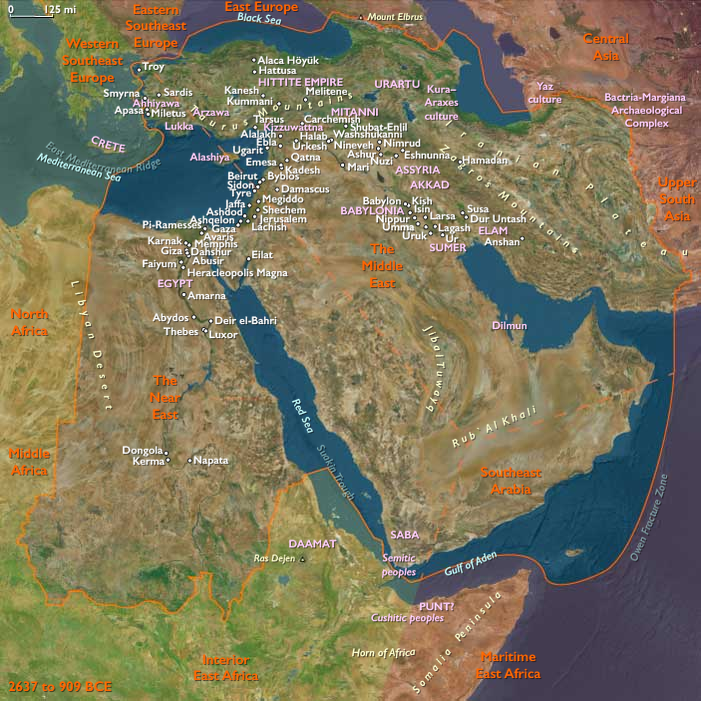
From 2349 to 2206 BCE, Mesopotamia witnessed the ascendancy of the Semitic-speaking Akkadians, who began exerting influence over central and northern Mesopotamia around 2400 BCE. This marked a critical power shift from the Sumerian city-states in the lower valley toward the Akkadians, whose political reach expanded rapidly westward into Syria and eastward as far as Susa in present-day Iran.
Under the leadership of Sargon of Akkad (r. approximately 2334–2279 BCE), the first great empire-builder in recorded history, Akkadian forces penetrated deep into Egypt and possibly Ethiopia. Sargon's reign saw a significant separation between religious and secular authority, with the establishment of a conscripted army, allowing him to mobilize large labor forces for ambitious irrigation and infrastructure projects. Akkadian military power was further enhanced by the introduction of the composite bow, a weapon superior to previous designs.
Ebla: Center of Commerce and Literacy
During this age, Ebla reached the peak of its economic and cultural influence. Located in northern Syria, Ebla thrived as a central hub in an extensive trade network spanning Anatolia, Mesopotamia, Egypt, Cyprus, and Persia. The discovery of approximately eighteen hundred clay tablets and numerous fragments in the palace archives at Ebla revealed intricate details of the city’s administration, commerce, and diplomatic activities. These tablets, written primarily in the Eblaite language using Sumerian cuneiform script, represent one of the most significant linguistic discoveries of the period. Eblaite was initially identified as proto-Canaanite but later recognized as a unique early Semitic language.
The Ebla tablets contain references to notable locations such as Canaan, Ugarit, and Lebanon, indicating the city's extensive interactions with other civilizations. Ebla maintained an intense commercial rivalry with Mari, leading to protracted conflicts that lasted nearly a century. Despite political turmoil, Ebla remained a vital educational center, pioneering important linguistic innovations that promoted literacy and administrative efficiency across the region.
Cultural and Artistic Achievements
Mesopotamian culture during the Akkadian period produced notable artistic and technological achievements. Scribes refined cuneiform writing, transitioning toward a more streamlined and efficient phonetic system. This era also saw the creation of important narrative reliefs and monumental stelae commemorating imperial triumphs. A prominent example includes the bronze bust from Nineveh, possibly depicting Sargon or his grandson Naram-Sin, who also significantly expanded Akkadian territory.
Regional Instability and Climatic Crisis
The early twenty-third century BCE was marked by geological and climatic disruptions, including severe earthquakes and volcanic activity. This period coincided with a prolonged drought lasting nearly three centuries, profoundly affecting regional stability and contributing to the weakening and eventual collapse of established city-states and empires, including Akkad and Ebla.
Rise of the Hurrians and Hattians
Amid this period of upheaval, non-Semitic Hurrians began migrating from the Caucasus region into northern Mesopotamia and the Zagros foothills, gradually establishing themselves around key sites such as Urkesh and Nuzi. Hurrian political entities allied with Akkadian rulers, notably Naram-Sin, gaining significant regional influence.
In Anatolia, the indigenous non-Indo-European speaking Hattians organized into feudal city-states and small theocratic kingdoms, forming alliances and conflicts with Mesopotamian rulers. The oldest reference to "Land of the Hatti" appears in Mesopotamian records of Sargon’s time, highlighting the region's emerging importance.
Emergence of Major Trade Centers
Commerce flourished across the Persian Gulf and Mediterranean regions. Cities like Dilmun (modern Bahrain) emerged as vital commercial entrepôts, facilitating trade between Mesopotamia and distant markets. Extensive archaeological finds in Dilmun, such as burial mounds dating to this period, underscore the significance of trade-based prosperity in these coastal communities.
Urban and Military Innovations
Significant urban fortifications appeared, exemplified by Gilgamesh's legendary city wall around Uruk, underscoring heightened concerns over security amid increasing regional conflicts. Military advancements, such as the disciplined infantry formations depicted on the Stele of the Vultures, provided further evidence of a rapidly evolving martial culture across Mesopotamia.
Babylon and New Settlements
The earliest known references to Babylon appeared during this era, attributed to Sargon, who purportedly founded or significantly developed the city near the Euphrates River. This development foreshadowed Babylon's future prominence as a political and cultural powerhouse.
Elamite Resurgence
In southwestern Iran, the city-state of Susa, temporarily under Akkadian administration, regained autonomy under governor Kutik-Inshushinak around 2240 BCE. His rebellion led to a revival of Elamite culture, turning Susa into an influential literary and administrative center once again.
The age 2349–2206 BCE thus represented a dynamic period characterized by the rise and consolidation of empires, significant cultural exchanges, extensive economic networks, and crucial innovations in military, urban, and linguistic practices, laying important foundations for subsequent historical developments.
The Middle East (2349–2206 BCE): Akkadian Ascendancy and the Expansion of Empires
Akkadian Political Dominance
From 2349 to 2206 BCE, Mesopotamia witnessed the ascendancy of the Semitic-speaking Akkadians, who began exerting influence over central and northern Mesopotamia around 2400 BCE. This marked a critical power shift from the Sumerian city-states in the lower valley toward the Akkadians, whose political reach expanded rapidly westward into Syria and eastward as far as Susa in present-day Iran.
Under the leadership of Sargon of Akkad (r. approximately 2334–2279 BCE), the first great empire-builder in recorded history, Akkadian forces penetrated deep into Egypt and possibly Ethiopia. Sargon's reign saw a significant separation between religious and secular authority, with the establishment of a conscripted army, allowing him to mobilize large labor forces for ambitious irrigation and infrastructure projects. Akkadian military power was further enhanced by the introduction of the composite bow, a weapon superior to previous designs.
Ebla: Center of Commerce and Literacy
During this age, Ebla reached the peak of its economic and cultural influence. Located in northern Syria, Ebla thrived as a central hub in an extensive trade network spanning Anatolia, Mesopotamia, Egypt, Cyprus, and Persia. The discovery of approximately eighteen hundred clay tablets and numerous fragments in the palace archives at Ebla revealed intricate details of the city’s administration, commerce, and diplomatic activities. These tablets, written primarily in the Eblaite language using Sumerian cuneiform script, represent one of the most significant linguistic discoveries of the period. Eblaite was initially identified as proto-Canaanite but later recognized as a unique early Semitic language.
The Ebla tablets contain references to notable locations such as Canaan, Ugarit, and Lebanon, indicating the city's extensive interactions with other civilizations. Ebla maintained an intense commercial rivalry with Mari, leading to protracted conflicts that lasted nearly a century. Despite political turmoil, Ebla remained a vital educational center, pioneering important linguistic innovations that promoted literacy and administrative efficiency across the region.
Cultural and Artistic Achievements
Mesopotamian culture during the Akkadian period produced notable artistic and technological achievements. Scribes refined cuneiform writing, transitioning toward a more streamlined and efficient phonetic system. This era also saw the creation of important narrative reliefs and monumental stelae commemorating imperial triumphs. A prominent example includes the bronze bust from Nineveh, possibly depicting Sargon or his grandson Naram-Sin, who also significantly expanded Akkadian territory.
Regional Instability and Climatic Crisis
The early twenty-third century BCE was marked by geological and climatic disruptions, including severe earthquakes and volcanic activity. This period coincided with a prolonged drought lasting nearly three centuries, profoundly affecting regional stability and contributing to the weakening and eventual collapse of established city-states and empires, including Akkad and Ebla.
Rise of the Hurrians and Hattians
Amid this period of upheaval, non-Semitic Hurrians began migrating from the Caucasus region into northern Mesopotamia and the Zagros foothills, gradually establishing themselves around key sites such as Urkesh and Nuzi. Hurrian political entities allied with Akkadian rulers, notably Naram-Sin, gaining significant regional influence.
In Anatolia, the indigenous non-Indo-European speaking Hattians organized into feudal city-states and small theocratic kingdoms, forming alliances and conflicts with Mesopotamian rulers. The oldest reference to "Land of the Hatti" appears in Mesopotamian records of Sargon’s time, highlighting the region's emerging importance.
Emergence of Major Trade Centers
Commerce flourished across the Persian Gulf and Mediterranean regions. Cities like Dilmun (modern Bahrain) emerged as vital commercial entrepôts, facilitating trade between Mesopotamia and distant markets. Extensive archaeological finds in Dilmun, such as burial mounds dating to this period, underscore the significance of trade-based prosperity in these coastal communities.
Urban and Military Innovations
Significant urban fortifications appeared, exemplified by Gilgamesh's legendary city wall around Uruk, underscoring heightened concerns over security amid increasing regional conflicts. Military advancements, such as the disciplined infantry formations depicted on the Stele of the Vultures, provided further evidence of a rapidly evolving martial culture across Mesopotamia.
Babylon and New Settlements
The earliest known references to Babylon appeared during this era, attributed to Sargon, who purportedly founded or significantly developed the city near the Euphrates River. This development foreshadowed Babylon's future prominence as a political and cultural powerhouse.
Elamite Resurgence
In southwestern Iran, the city-state of Susa, temporarily under Akkadian administration, regained autonomy under governor Kutik-Inshushinak around 2240 BCE. His rebellion led to a revival of Elamite culture, turning Susa into an influential literary and administrative center once again.
The age 2349–2206 BCE thus represented a dynamic period characterized by the rise and consolidation of empires, significant cultural exchanges, extensive economic networks, and crucial innovations in military, urban, and linguistic practices, laying important foundations for subsequent historical developments.
Years: 2349BCE - 2206BCE
Locations
Groups
Topics
Commodoties
Subjects
Regions
Subregions