
Filters:
The public had generally accepted the mistresses …
Years: 1749 - 1749
The public had generally accepted the mistresses of Louis XIV, who, apart from Madame de Maintenon, had all been chosen in the highest spheres of the aristocracy and had very little influence on the government, but that the king would thus compromise himself with a commoner is felt to be a disgrace.
Soon thereare libels published called poissonnades, a pun on Pompadour's family name, Poisson, which means "fish" in French.
Despite her critics, the Marquise de Pompadour has an undeniable influence on the flourishing of French arts during the reign of Louis XV, a reign that is often considered to represent the pinnacle of French architecture and interior design.
A patron of the arts, the Marquise is amassing a considerable amount of furniture andobjets d'artat her various estates.
She is responsible for the tremendous growth of the porcelain manufacturing in Sèvres, which has become one of the most famous porcelain manufacturers in Europe, and her commissions ensure the living of artists and families of craftsmen for many years.
She is also a prominent patron of architecture, responsible for the building of the Place Louis XV (now called the Place de la Concorde) and the École Militaire in Paris, both designed by her protégé Ange-Jacques Gabriel.
Her efforts to establish the École Militaire demonstrate her commitment to the training of officers from poor families of the aristocracy.
The Marquise is a political liberal at heart, and she steadily defends the Encyclopédie against the attacks from the Church.
She is also a supporter of Enlightenment philosophy and has tried to win the king over to its new ideas, albeit not quite as successfully as she hoped.
She is criticized for the lavish display of luxury at her various estates, although her wealthy family of financiers in many instances has given money to the government and saved the monarchy from bankruptcy. She has bequeathed all her estates to the state; they will revert to the crown at her death.
The Marquise de Pompadour is officially settled on the third floor (second story) of the Palace of Versailles in small but comfortable apartments that can still be visited today.
The atmosphere in these private quarters is so relaxed that the king is said to serve coffee during the suppers organized fro him by the Marquise.
Soon thereare libels published called poissonnades, a pun on Pompadour's family name, Poisson, which means "fish" in French.
Despite her critics, the Marquise de Pompadour has an undeniable influence on the flourishing of French arts during the reign of Louis XV, a reign that is often considered to represent the pinnacle of French architecture and interior design.
A patron of the arts, the Marquise is amassing a considerable amount of furniture andobjets d'artat her various estates.
She is responsible for the tremendous growth of the porcelain manufacturing in Sèvres, which has become one of the most famous porcelain manufacturers in Europe, and her commissions ensure the living of artists and families of craftsmen for many years.
She is also a prominent patron of architecture, responsible for the building of the Place Louis XV (now called the Place de la Concorde) and the École Militaire in Paris, both designed by her protégé Ange-Jacques Gabriel.
Her efforts to establish the École Militaire demonstrate her commitment to the training of officers from poor families of the aristocracy.
The Marquise is a political liberal at heart, and she steadily defends the Encyclopédie against the attacks from the Church.
She is also a supporter of Enlightenment philosophy and has tried to win the king over to its new ideas, albeit not quite as successfully as she hoped.
She is criticized for the lavish display of luxury at her various estates, although her wealthy family of financiers in many instances has given money to the government and saved the monarchy from bankruptcy. She has bequeathed all her estates to the state; they will revert to the crown at her death.
The Marquise de Pompadour is officially settled on the third floor (second story) of the Palace of Versailles in small but comfortable apartments that can still be visited today.
The atmosphere in these private quarters is so relaxed that the king is said to serve coffee during the suppers organized fro him by the Marquise.
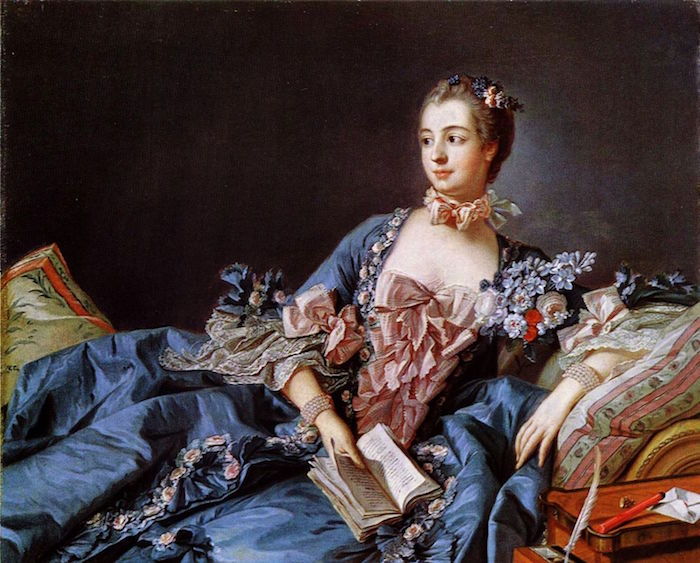
François Boucher: Madame de Pompadour (circa 1750-1758). Oil on canvas. 37.9 × 46.3 cm (14.9 × 18.2 in) (framed 64.14 × 55.88 × 8.89 cm (25.3 × 22 × 3.5 in)) Scottish National Gallery.
Locations
People
Groups
Topics
Commodoties
Subjects
- Commerce
- Products
- Writing
- Architecture
- Engineering
- Painting and Drawing
- Government
- Custom and Law
- Finance
Regions
Subregions
Years: 1749 - 1749
François Boucher: Madame de Pompadour (circa 1750-1758). Oil on canvas. 37.9 × 46.3 cm (14.9 × 18.2 in) (framed 64.14 × 55.88 × 8.89 cm (25.3 × 22 × 3.5 in)) Scottish National Gallery.
Locations
People
Groups
Topics
Commodoties
Subjects
- Commerce
- Products
- Writing
- Architecture
- Engineering
- Painting and Drawing
- Government
- Custom and Law
- Finance
Regions
Subregions