
Tvrtcko I, the prominent ban of Bosnia …
Years: 1391 - 1391
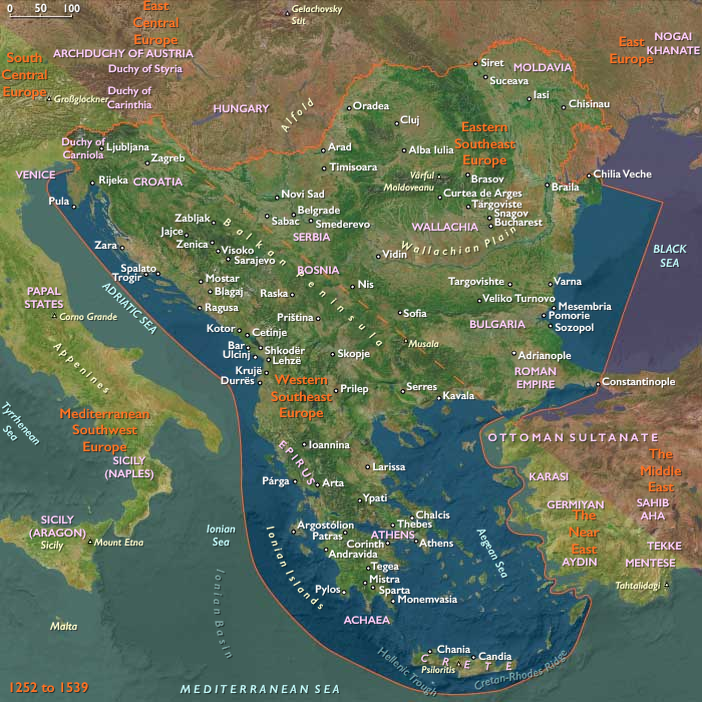
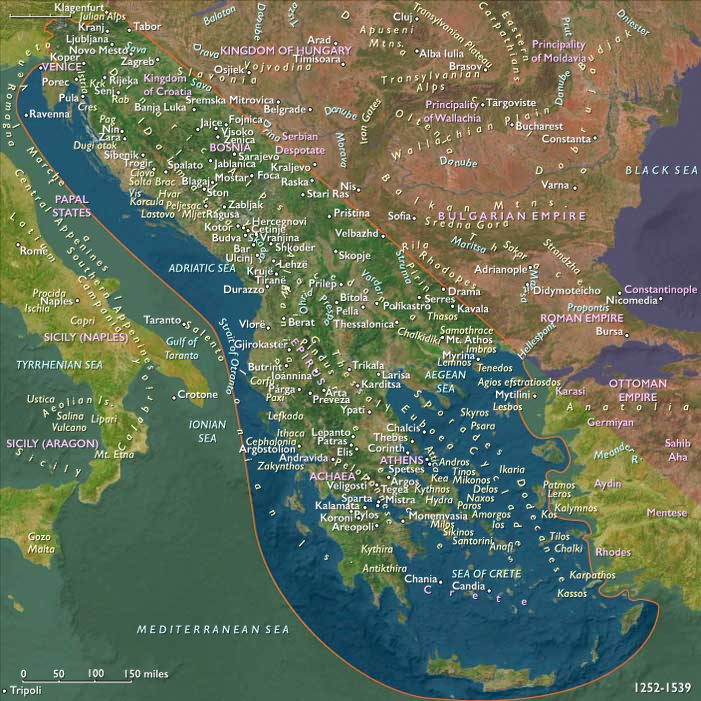
Tvrtcko I, the prominent ban of Bosnia who had earlier adopted the title of King of Bosnia and Serbia, has annexed eastern Herzegovina, part of Serbia/Raska (as far as the monastery at Mileseva), and Dalmatia nearly to Venice’s port of Zadar.
After the defeat of Nikola Altomanović, Prince Lazar had emerged as the most powerful lord on the territory of the former Serbian Empire.
He wants to reunite the Serbian state, and the Serbian Orthodox Church sees him as most fitted to succeed the Nemanjić dynasty.
The Church, which is the strongest cohesive force among the Serbs at the time, does not support Tvrtko's aspirations in this regard.
Tvrtko I had by 1390 expanded his realm to include a part of Croatia and Dalmatia, making Bosnia the major Slavic state in the Balkans.
At the peak of his power, he is "King of Bosnia, Serbia, Croatia, Hum, Usora, Soli, Dalmatia, Donji Kraji", but after his death on March 20, 1391, the power of the Bosnian state will slowly fade in power and influence.
The Ottoman Empire has already started its invasion of Europe and will pose a major threat to the Balkans throughout the first half of the fifteenth century.
The Bosnian kingdom begins to disintegrate in 1391; the southern part becomes the independent Duchy of Herzegovina.
Stephen Dabiša, an illegitimate son of Vladislav Kotromanić, born after his half-brother Tvrtko I, succeeds Tvrtko I in 1391.
At the time of his ascension to power, Bosnia is already decentralized by the semi-independent nobility.
Beljak and Radič Sanković rule independently in the Hum and Popovo.
The Sankovići give Konavle to the Republic of Ragusa, which then starts to stir Kotor and other Dalmatian cities to revolt against the Bosnian King's rule, asking them to reaccept the supreme rule of the Hungarian King Sigismund, but they refuse.
King Stephen Dabiša in 1391 dispatches vojvoda Vlatko Vuković and knez Pavle Radenović to Konavle, where they oust the Sankovići and distribute their lands among themselves.
Beljak dies and Radič is imprisoned; thiis marks the end of the Sanković family.
Locations
People
Groups
Topics
Commodoties
Subjects
Regions
Subregions
Related Events
Showing 10 events out of 43471 total
Years: 1391 - 1391
Locations
People
Groups
Topics
Commodoties
Subjects
Regions
Subregions