
The prolific Flemish painter Peter Paul Rubens …
Years: 1616 - 1616
November
The prolific Flemish painter Peter Paul Rubens is a proponent of an exuberant Baroque style that emphasizes movement, color, and sensuality.
Altarpieces such as The Raising of the Cross (1610) and The Descent from the Cross (1611–1614) for the Cathedral of Our Lady had been particularly important in establishing Rubens as Flanders' leading painter shortly after his return to Antwerp.
The Raising of the Cross, for example, a prime example of Baroque religious art, demonstrates the artist's synthesis of Tintoretto's Crucifixion for the Scuola di San Rocco in Venice, Michelangelo's dynamic figures, and Rubens's own personal style.
His fondness of painting full-figured women, such as Venus at the Mirror, circa 1615, will rise to the terms 'Rubensian' or 'Rubenesque' for plus-sized women.
The term 'Rubensiaans' is also today commonly used in Dutch to denote such women.
In addition to running a large studio in Antwerp which produces paintings popular with nobility and art collectors throughout Europe, Rubens is a classically educated humanist scholar and art collector.
He has used the production of prints and book title-pages, especially for his friend Balthasar Moretus—owner of the large Plantin-Moretus publishing house—to further extend his fame throughout Europe during this part of his career.
With the exception of a couple of brilliant etchings, he only produces drawings for these himself, leaving the printmaking to specialists, such as Lucas Vorsterman.
He has recruited a number of engravers trained by Goltzius, who he carefully schools in the more vigorous style he wants.
He also designs the last significant woodcuts before the nineteenth century revival in the technique.
Rubens has established copyright for his prints, most significantly in Holland, where his work is widely copied through print.
In addition, he has established copyrights for his work in England, France and Spain.
In November 1616, Rubens begins work on his famous classical tapestries, when a contract is signed in Antwerp with cloth dyers Jan Raes and Frans Sweerts in Brussels, and the rich Genoese merchant Franco Cattaneo.
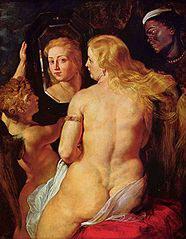
Peter Paul Rubens: Venus at the Mirror (1612-1615) 124 × 98 cm, Fürstlich Lichtensteinische Gemäldegalerie, Vaduz
Locations
People
Groups
Topics
Subjects
Regions
Subregions
Related Events
Showing 10 events out of 33161 total
Years: 1616 - 1616
November
Peter Paul Rubens: Venus at the Mirror (1612-1615) 124 × 98 cm, Fürstlich Lichtensteinische Gemäldegalerie, Vaduz
Locations
People
Groups
Topics
Subjects
Regions
Subregions