
The private life of Frederick IV, king …
Years: 1721 - 1721
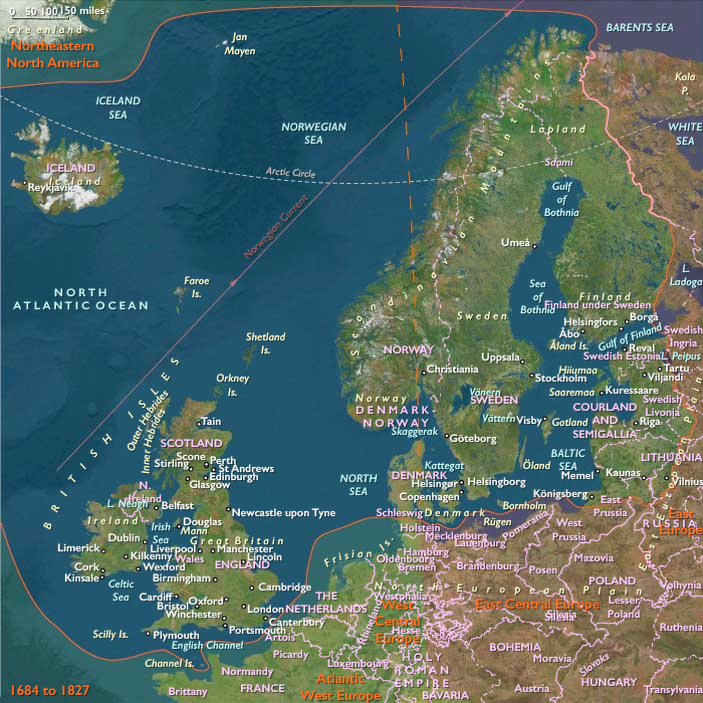
The private life of Frederick IV, king of Denmark and Norway from 1699, has often aroused indignation.
Having married Louise of Mecklenburg-Güstrow in 1695, he has entered into two morganatic marriages during her lifetime.
The second of these, in 1712, is with Anna Sophie, daughter of the chancellor, Conrad, Count Reventlow, and after Louise's death in 1721, despite opposition within the royal family, he raises Anna Sophie to the dignity of queen.
Locations
People
Groups
Subjects
Regions
Subregions
Related Events
Filter results
Showing 10 events out of 52 total
Maria Theresa has herself crowned Queen of Bohemia on May 12, 1743, in St. Vitus Cathedral.
The Austrians have not been idle in the interim.
The able Austrian Field Marshal Maximilian Ulysses Count Browne, though initially surprised by the early Prussian attack, has been retreating skillfully and concentrating his armed forces towards Prague.
Here he establishes a fortified position to the east of the town, and an additional army under Prince Charles of Lorraine arrives, swelling the Austrian numbers to sixty thousand.
The prince now takes command.
The Austrian army under von Browne has taken up a near invincible position on the Ziska and the Tabor mountains.
The town is on their left flank, with a steep gorge to the north, and to the west by a marshy slope with a brook at the bottom.
The two Austrian commanders are in disagreement about the course of action: von Browne wants to attack, but Charles decides to wait for Königsegg, who had been defeated at the Battle of Reichenberg but is known to be retreating towards Prague, and possibly even for the arrival of Daun.
The Austrians form for battle facing north and east.
Frederick orders an immediate assault, but Schwerin convinces him to make a reconnaissance around the Austrian right flank.
He returns with the information that gradually sloping green meadows offer a better chance for attack at the Austrian rear.
The Prussian army starts marching around seven AM, and succeeds in staying largely out of sight until the Austrian generals notice the movements around ten AM.
Field Marshal von Browne shifts six infantry regiments to take up position to the south east.
Schwerin, accompanied by General Winterfeldt, is finally prepared to attack.
Winterfeldt's infantry leads the attack.
The Prussian infantry soon find themselves not in meadows, but in the remains of fish ponds.
While they struggle through, Winterfeldt is hit by a musketball.
The Prussian infantry wavers and Schwerin rallies them, leading them from the front.
He is hit several times by Austrian canister.
Frederick, when he hears the news, orders the assault to continue.
The Austrian infantry smells the Prussian confusion and starts to press the Prussians back down the slope, opening a gap between themselves and the remainder of the Austrian line still facing north.
At this time von Browne is mortally wounded by Prussian infantry fire and carried into Prague.
While King Frederick and General von Zieten reorganize the Prussian infantry in the south for another attack, the generals Hautcharmoy and Bevern spot the gap in the Austrian line and start to filter infantry into the gap.
Austrian Croats have engaged Prussians to the north of the Austrian left flank, but with the gap in the Austrian line being exploited by a steady stream of Prussians he pulls back and forms a new line running south from the west end of the Tabor mountain.
The final phase of the battle starts around 3 pm, with Prussians engaging the still-forming Austrian line and outflanking them from the south.
Charles withdraws into the town, the retreat being covered by his cavalry.
Having suffered over fourteen thousand casualties in his own army, losses hard to replace for the small Prussia, Frederick decides not to assault the city walls of Prague, calculating that forty thousand soldiers in addition to seventy-five thousand inhabitants will soon consume the city stores.
The Prussian army now lays siege to the city.
The Frankists, or Zoharists, in Bohemia-Moravia outwardly remain Jews, although they are antirabbinical.
The crisis posed by Frankism does not discredit Kabbala, but it leads the spiritual authorities of Judaism to watch over and severely curtail its spread and to exercise rigorous ideological control, by concrete acts of censorship and repression, over anyone, even a person of tested piety and recognized knowledge, who is suspected of Sabbatean sympathies or of messianic pretensions.
Because it is first performed in Prague, it is popularly known as the Prague Symphony.
An opera in two acts, based on the legends of Don Juan, a fictional libertine and seducer (K. 527; complete title: Il dissoluto punito, ossia il Don Giovanni, literally The Rake Punished, namely Don Giovanni or The Libertine Punished), Da Ponte's libretto is billed as a dramma giocoso, a common designation of the time that denotes a mixing of serious and comic action.
Mozart enters the work into his catalogue as an opera buffa.
Although sometimes classified as comic, it blends comedy, melodrama and supernatural elements.
The opera had been commissioned as a result of the overwhelming success of Mozart's trip to Prague in January and February 1787.
The subject matter may have been chosen in consideration of the long history of Don Juan operas in Prague; the genre of eighteenth-century Don Juan opera originated in Prague.
A staple of the standard operatic repertoire, Don Giovanni for the five seasons 2011/12 through 2015/16 will be ninth on the Operabase list of the most-performed operas worldwide.
It will also prove a fruitful subject for writers and philosophers.
The war against revolutionary France and the subsequent Napoleonic wars causes a temporary interruption of the reactionary movement.
In 1804 Francis II transfers his imperial title to the Austrian domains (Austria, Bohemian Kingdom, Hungary, Galicia, and parts of Italy), and two years later the Holy Roman Empire is formally dissolved.
The Austrian Empire comes into existence and is to play a leading role in the newly established German Confederation.
From 1815, after the conclusive defeat of Napoleon, the policy of reaction devised by Austria's foreign minister, Prince Metternich, will dominate European affairs.
...Prague, and ...
The Paris revolution of February 1848 precipitates a succession of liberal and national revolts against autocratic governments.
Revolutionary disturbances pervade the territories of the Austrian Empire, and Emperor Ferdinand I (1835-48) promises to reorganize the empire on a constitutional, parliamentary basis.
In the Bohemian Kingdom, a national committee is formed that includes Germans and Czechs, but Bohemian Germans favor creating a Greater Germany out of various German-speaking territories.
The Bohemian Germans soon withdraw from the committee, signaling the Czech-German conflict that will characterize subsequent history.
František Palacký proposes Austro-Slavism as the creed of the Czech national movement.
He advocates the preservation of the Austrian Empire as a buffer against both German and Russian expansionism.
He also proposes the federalization of the empire on an ethnographic basis to unite the Bohemian
Germans with Austria in one province and Czechs and Slovaks in another.
Palacký further suggests that the various Slavic peoples of the empire, together constituting a majority, should form a political unit to defend their common interests.
In June 1848 the Czechs convene the first Slavic Congress to discuss the possibility of political consolidation of Austrian Slavs, including Czechs, Slovaks, Poles, Ruthenians (Ukrainians), Slovenes, Croats, and Serbs.
