
The principality of Wallachia had been established …
Years: 1301 - 1301
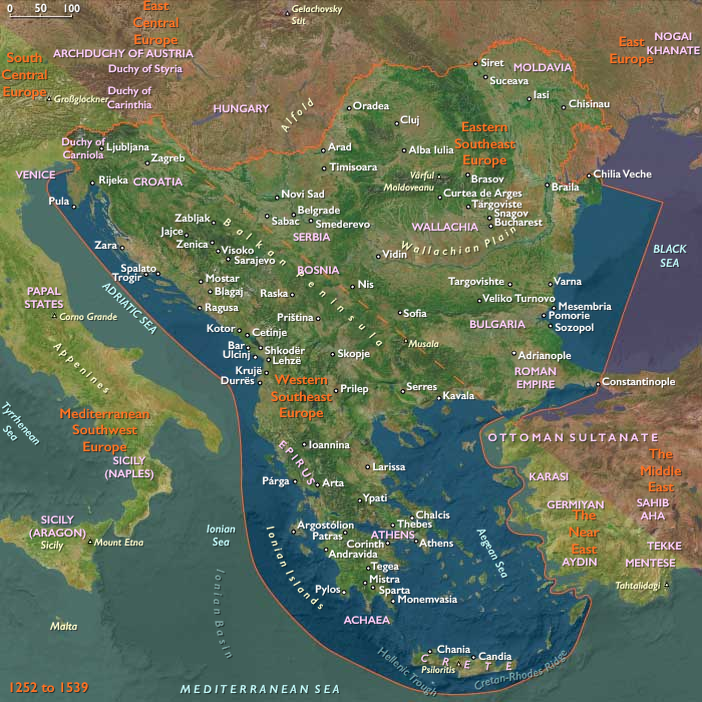
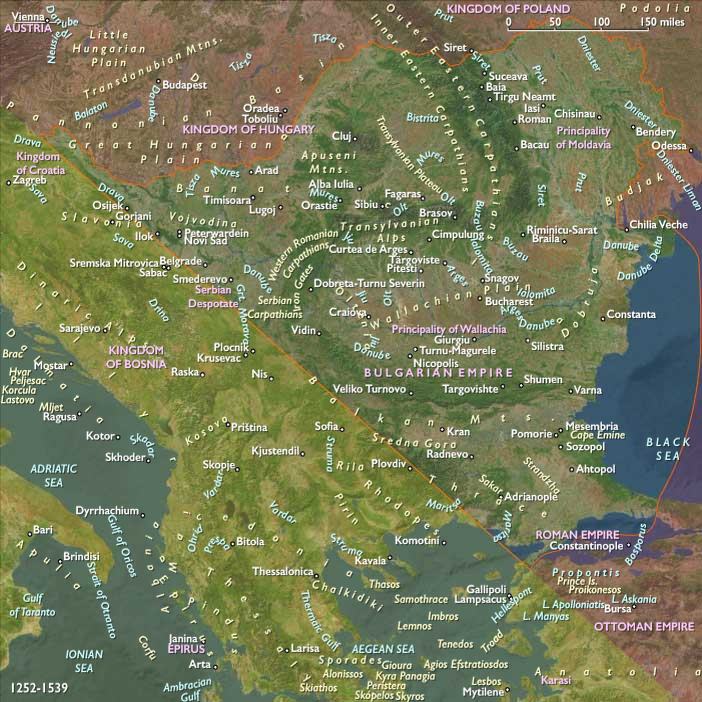
The principality of Wallachia had been established in the eastern Balkans at the end of the thirteenth century.
Prior to the consolidation of a Wallachian state, its plains had been held by various migrating peoples, the last of them being the Pechenegs (around 900-1100) and Cumans, who had vanquished the Pechenegs through an alliance with Constantinople, the decisive battle being the Battle of Levounion.
The territories of eastern Wallachia and southern Moldavia had then been part of Cumania for more than one hundred and fifty years, the political power in the region being held by the various Cuman tribal chiefs.
The Cumans had begun to lose power in the region with the Hungarian expansion and especially during the 1241-1242 Mongol invasion of Europe, after which many of them had fled to Hungary.
The earliest document where the Romanians are reported to live in the region is the Kievan Primary Chronicle (1113) of Nestor, which mentions the Vlachs as fighting the Hungarians.
The next reference to Romanians is from Transylvania and dates from 1222, being a letter written by Andrew II of Hungary who had donated the land of Burzenland and gave privileges to the Teutonic Knights.
The area mentioned as being the Vlachs' is probably Făgăraş, one of the the traditional Romanian areas of Transylvania, for some time being ruled by Wallachian voivodes.
Just two years later, a 1242 document grants the Teutonic Knights the right to make use of the forest of the Vlachs and Pechenegs.
Oltenia, unlike Muntenia, was never part of Cumania, Cuman influence in this region being minimal.
The Banate of Severin had been founded in the 1230s as a territory of Hungary, the first ban, Luke, being mentioned in 1233.
In 1247, King Béla IV of Hungary had allowed the Knights Hospitaller to settle in Severin to defend the Hungarian borders against the invaders.
A diploma had given them Severin and other possessions pertaining to it, including the "knyazates of John and Farkas", but excluding the voivodate of Litovoi, which was to be left to the Vlachs who were holding it.
They had been allowed also to use the land beyond the Olt River ("Cumania"), with the exception of the Vlach voivodate of Seneslau, which had similar rights as Litovoi.
The Knights Hospitallers probably failed in their mission, as only a few years later, they disappeared from the region.
In the meantime, Litovoi had increased his power, rebelling in 1272 against the Hungarian King Ladislaus IV wanting to gain the territory of the Banate of Severin, an important strategic point.
The king had sent George, son of Simon, to fight against Litovoi, killing him in battle and capturing his brother, Bărbat, bringing him to the royal court.
Bărbat became Litovoi's successor, ruling his voivodate between 1285 and 1288.
The continuing weakening of the Hungarian state by further Mongol invasions and the fall of the Árpád dynasty in 1301 has opened the way for the unification of Wallachian polities, and to independence from Hungarian rule.
Locations
Groups
Topics
- Ostsiedlung (German: Settlement in the East), a.k.a. German eastward expansion
- Mongol Conquests
- Hungarian Civil War of 1301-48
Commodoties
Subjects
Regions
Subregions
Years: 1301 - 1301
Locations
Groups
Topics
- Ostsiedlung (German: Settlement in the East), a.k.a. German eastward expansion
- Mongol Conquests
- Hungarian Civil War of 1301-48
Commodoties
Subjects
Regions
Subregions