The princes of Mecklenburg—a hilly, lake-filled, glaciated …
Years: 1348 - 1348
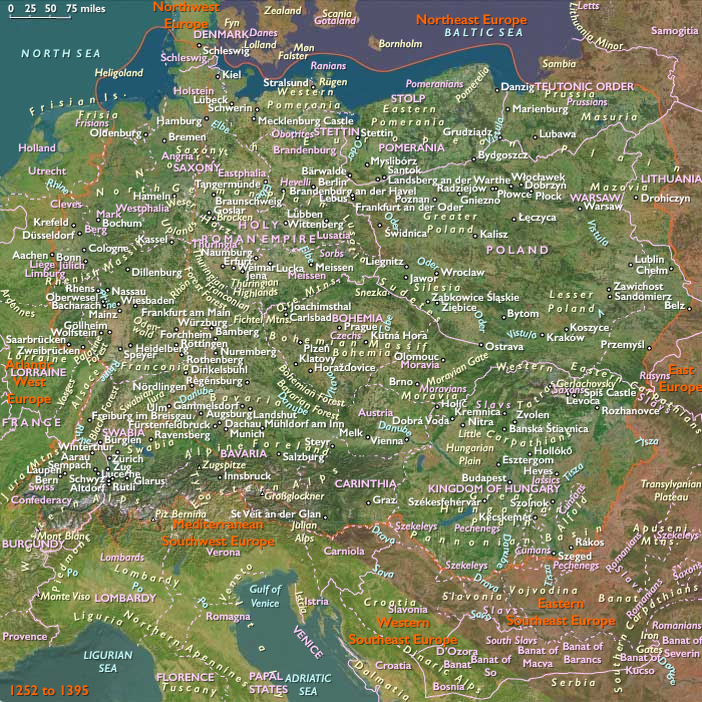
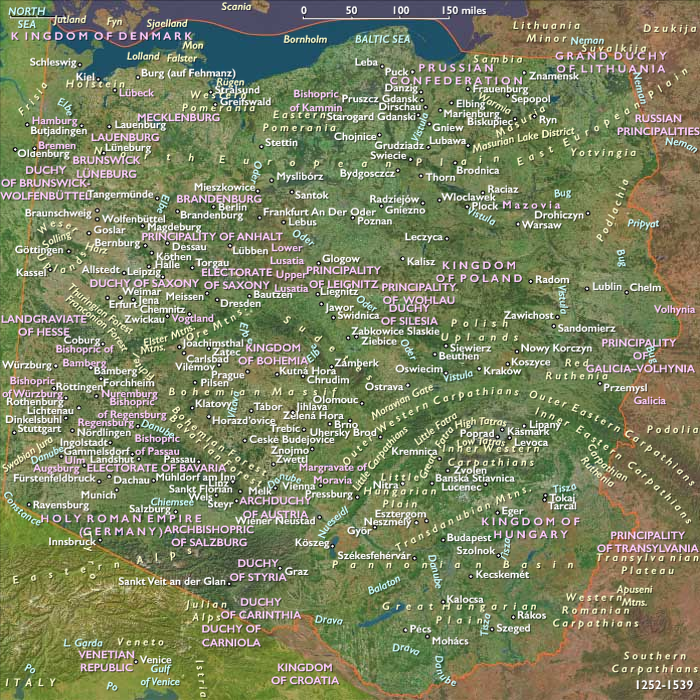
The princes of Mecklenburg—a hilly, lake-filled, glaciated plain with an irregular coastline and several islands located on the Baltic Sea between the Elbe and Oder rivers—vassals of the Holy Roman Empire from the twelfth century, become dukes in 1348.
Strictly speaking, Mecklenburg’s princely dynasty is descended linearly from the princes (or kings) of a Slavic tribe, the Obotrites, and had its original residence in a castle (Mecklenburg) in Dorf Mecklenburg (Mikelenburg) close to Wismar.
As part of a feudal union under German law from 1160—at first under the Saxons—Mecklenburg is granted imperial immediacy in 1348 and its princely rulers styled Dukes of Mecklenburg.
Locations
Groups
Subjects
Regions
Subregions
Related Events
Filter results
Showing 10 events out of 44318 total
The northern state of Lanna, centered in Chiang Mai, is another Thai state that coexists with Sukhothai and had emerged in the same period.
King Phya Mangrai is its founder.
Lanna has evidently become closely allied with Sukhothai.
Sukhothai is finally subdued after the Ayutthaya kingdom has emerged and expanded its influence from the Chao Phraya valley,
Fierce battles between Lanna and Ayutthaya also constantly take place and Chiang Mai is eventually subjugated also, becoming Ayutthaya's 'vassal'.
The western neighbor of the Khmer, the first Thai kingdom of Sukhothai, after repelling Angkorian hegemony, is conquered in 1350 by another stronger Thai kingdom in the lower Chao Phraya Basin, Ayutthaya, which has become became Angkor's rival.
Angkor is besieged by the Ayutthayan king Uthong in 1352, and following its capture the next year, the Khmer monarch is replaced with successive Siamese princes.
Then in 1357, the Khmer king Suryavamsa Rajadhiraja regains the throne.
Gajah Mada, the able prime minister of Hayam Wuruk following the latter's accession to the throne of the Majapahit Empire in 1350, initiates a series of conquests that (according to some historians) extend Majapahit influence to all of present Indonesia and parts of Malaysia. (Other scholars, however, limit Majapahit to the islands of Java, Bali, and Madura.)
Ram Khamhaeng, the third king of the Phra Ruang dynasty, who ruled the Sukhothai Kingdom (a forerunner of the modern kingdom of Thailand) from 1279–1298, during its most prosperous era, is credited with the creation of the Thai alphabet and the firm establishment of Theravada Buddhism as the state religion of the kingdom.
Much of the traditional biographical information on him comes from the inscription on the Ramkhamhaeng stele, composed in 1292, and now in the National Museum in Bangkok.
This stone allegedly was discovered in 1833 by King Mongkut, at the time a Buddhist a monk, in Wat Mahathat.
The authenticity of the stone—or at least portions of it —has been brought into question.
Piriya Krairiksh, an academic at the Thai Khadi Research institute, notes that the stele's treatment of vowels suggests that its creators had been influenced by European alphabet systems.
He concluded that the stele was fabricated by someone during the reign of Rama IV or shortly before.
The subject is very controversial, since if the stone is a fake, the entire history of the period will have to be re-written Scholars are sharply divided on the stele's authenticity.
It remains an anomaly among contemporary writings, and no other source refers to King Ramkhamhaeng by name.
Some scholars claim the inscription was completely a nineteenth-century fabrication; others claim the first seventeen lines are genuine; while a third view is that the inscription was fabricated by King Lithai (a later Sukhothai king).
Most Thai scholars hold to the inscription's authenticity.
The Ramkhamhaeng stele has also been brought into the discussions of the Wat Traimit Golden Buddha, a famous Bangkok tourist attraction.
In lines 23-27 of the first stone slab of the stele, "a gold Buddha image" is mentioned as being located "in the middle of Sukhothai City".
This has been interpreted by some as referring to the Wat Traimit Golden Buddha.
Officially titled Phra Phuttha Maha Suwan Patimakon and today located in the temple of Wat Traimit, Bangkok, Thailand, he Golden Buddha is the world's largest solid gold statue, with a weight of five and a half tons (fifty-five hundred kilograms).
The origins of this statue are uncertain.
It is made in the Sukhothai Dynasty style of the thirteenth and fourteenth centuries, though it could have been made after that time.
The head of the statue is egg-shaped, which indicates its origin in the Sukothai period.
Given that Sukothai art has Indian influences and metal figures of the Buddha made in India used to be taken to various countries for installation, this suggests the Golden Buddha statue may have been cast in parts in India.
Later, the statue is probably moved from Sukhothai to Ayutthaya, about 1403 The scholarly Lithai, who had ascended the throne in 1347, devotes his reign to the advancement of Therevada Buddhism but neglects the kingdom’s defenses.

The Chinese novel entitled Water Margin (Shui Hu Zhuan, sometimes abbreviated to Shui Hu), attributed to Shi Nai'an, is also translated as Outlaws of the Marsh, Tale of the Marshes, All Men Are Brothers, Men of the Marshes, or The Marshes of Mount Liang.
Considered one of the Four Great Classical Novels of Chinese literature, the novel is written in vernacular Chinese rather than Classical Chinese.
The story, set in the Song dynasty, tells of how a group of outlaws gathers at Mount Liang (or Liangshan Marsh) to form a sizable army before they are eventually granted amnesty by the government and sent on campaigns to resist foreign invaders and suppress rebel forces.
It will introduce to readers many of the most well known characters in Chinese literature, such as Wu Song, Lin Chong and Lu Zhishen.
Stories about the outlaws became a popular subject for Yuan dynasty drama.
During this time, the material on which Water Margin is based evolves into what it is in the present.
The number of outlaws increases to 108.
Even though they came from different backgrounds (including scholars, fishermen, imperial drill instructors etc.), all of them eventually came to occupy Mount Liang (or Liangshan Marsh).
There is a theory that Water Margin became popular during the Yuan era as the common people (predominantly Han Chinese) resented the Mongol rulers.
The outlaws' rebellion was deemed "safe" to promote as it was supposedly a negative reflection of the fallen Song dynasty.
Concurrently, the rebellion was also a call for the common people to rise up against corruption in the government.
The rivalry between Japan’s two imperial courts—that of deposed emperor Daigo II in the south at Yoshino, and …
…that of Shogun Ashikaga Takauji’s puppet emperor at Kyoto—has spread throughout the country.
Feudal lords support various factions, often switching allegiances, and lawlessness and brigandage become endemic.
The Mongol rulers of China, having since the time of Kublai Khan increasingly distanced themselves from their Chinese subjects and become more factionalized and dissolute, have by the 1350s lost all authority, are unable to contain or control the rebellions in the Yangtze River valley, and cannot prevent warlords from establishing themselves as independent rulers.
The Red Turban Rebellion is an uprising influenced by the White Lotus Society members that targets the ruling Yuan dynasty of China between 1351 and 1368, eventually leading to its overthrow.
Goryeo has been a semi-autonomous vassal state under the overlordship of the Mongol Yuan dynasty since the Mongol invasions of Korea in the thirteenth century.
Starting with King Chungnyeol, prospective rulers of Korea have married Mongolian princesses and are customarily sent to the Yuan Court, in effect, as hostages.
As per this custom, King Gongmin, Goryweo’s current monarch, had spent many years in the Yuan court, being sent there in 1341, before ascending the Korean throne in 1351.
He has married a Mongolian princess who becomes Queen Noguk.
The Yuan dynasty begins to crumble during the mid-fourteenth century.
With the disintegration of Yuan, which has influenced the Korean peninsula since the Mongol invasion of Korea of 1238, Gongmin begins efforts to reform Goryeo government.
His first act is to remove all pro-Mongol aristocrats and military officers from their positions.
These deposed people form a dissident faction that plots an unsuccessful coup against the king.
High official Jo Il-shin even tries to take over the government, but this rebellion is put down by general Choi Young.
During the Mongol invasions of Korea, between the 1250s and the 1270s, the Mongols had annexed the northern provinces of Korea and incorporated them into their empire as Ssangseong and Dongnyeong Prefectures.
In 1356, the Goryeo army retakes these provinces partly thanks to the defection of Yi Ja-chun, a minor Korean official in service of Mongolians in Ssangseong, and his son, Yi Seong-gye.
In addition, Generals Yi Seong-gye and Ji Yongsu lead a campaign into Liaoyang.
The question of land holdings is another important issue.
The land-grant system had broken down, and Mongol-favored officials, along with a handful of landed gentry, own the vast majority of agricultural land, which is worked by tenant farmers and bondsmen.
However, King Gongmin's attempt at land reform is met with opposition and subterfuge from those officials who are supposed to implement his reforms, as they are landowners themselves.
The Wokou, yet another problem encountered during Gongmin's reign, have been troubling the peninsula for some time and have become well-organized military marauders raiding deep into the country, rather than the "hit-and-run" banditry they had originally practiced.
Gongmin calls upon Generals Choi Young and Yi Seong-gye to combat them.
The Introduction of the Jew’s Harp to Europe (c. 1350)
The Jew’s harp, an ancient percussive instrument found across multiple cultures, was introduced into Europe from Asia around 1350. Despite its name, the term "Jew’s harp" is likely a corruption of "jaw’s harp", referring to its placement against the teeth and jawbone when played.
Structure and Playing Technique
- The instrument consists of a horseshoe- or clothespin-shaped frame, which is held between the teeth.
- A flexible metal strip (tongue or reed) is attached to the frame and is plucked or strummed with a finger to create vibrations.
- Changes in the shape of the oral cavity (through tongue and throat movements) modify the resonance, producing overtones and different pitches.
Origins and Cultural Presence
- The Jew’s harp has ancient origins, with early versions made from bamboo or metal.
- It was historically played in Asia, Europe, and Oceania, with bamboo variations common in Indonesia and the Pacific Islands.
- The instrument became popular in medieval Europe, where it was used in folk music, rituals, and entertainment.
Enduring Popularity
- Over time, the Jew’s harp has remained a staple of traditional and folk music, particularly in Central Europe, Russia, and Scandinavia.
- Today, it is used in contemporary and experimental music, showcasing its versatility and unique sound.
The introduction of the Jew’s harp to Europe in the mid-14th century added a distinctive, resonant element to medieval musical traditions, further enriching the continent’s cultural and instrumental diversity.