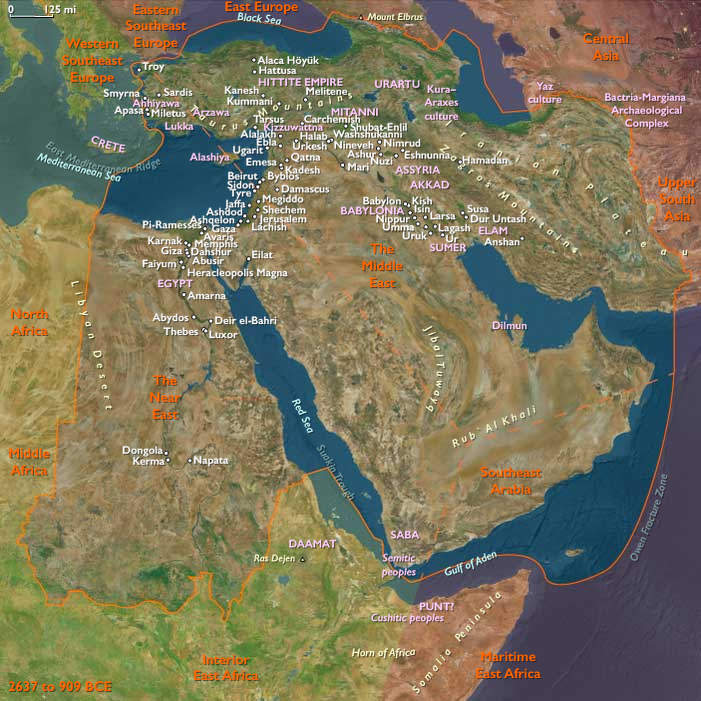
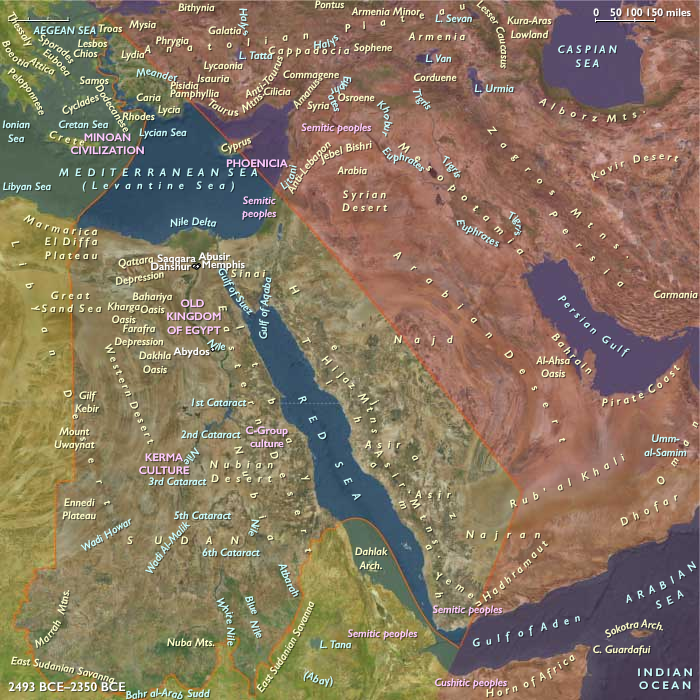
The prenomen of Sahure’s successor, Neferirkare Kakai, …
Years: 2457BCE - 2446BCE
The prenomen of Sahure’s successor, Neferirkare Kakai, means "Beautiful is the Soul of Re."
From the large size of his mortuary complex at Abusir, he was probably an important king, but since the Palermo stone breaks off during his rule, little is actually known about his reign.
The Pyramid of Neferirkare Kakai (burial place) of the king was initially designed as a six-step pyramid fifty-two meters high, but later it was extended to the form of a typical pyramid and it reached a height of seventy-two meters.
The mortuary complex is unfinished, and only part of the lower mortuary temple was completed before, it is supposed, the abandonment of the project.
Neferirkare was probably the brother of pharaoh Sahure and son of pharaoh Userkaf, the founder of the dynasty.
Locations
People
Groups
Topics
Subjects
Regions
Subregions
Related Events
Filter results
Showing 10 events out of 68213 total
Kish is lost to Khamazi tribesmen of the Kurdistan mountains in the vacuum left by Ur’s defeat of Mesalim of Kish; Elamites from Awan occupy parts of Sumer, overthrowing Ur and Uruk, and adding Lagash and Kish (Roux 1980).
The First Dynasty of Lagash, which holds power from about 2500 BCE to about 2271 BCE, is not mentioned in the King List, though it is well known from inscriptions.
Eannatum, grandson of Ur-Nanshe, is a king of Lagash who conquers all of Sumer, including Ur, Nippur, Akshak (controlled by Zuzu), Larsa, and Uruk (controlled by Enshakushanna, who is on the King List).
He also annexes the kingdom of Kish, which is to regain its independence after his death.
He makes Umma a tributary, where every person had to pay a certain amount of grain into the treasury of the goddess Nina and the god Ingurisa.
Eannatum expands his influence beyond the boundaries of Sumer, conquering parts of Elam, including the city Az on the Persian Gulf, allegedly smites Shubur, and demands tribute as far as Mari.
However, often parts of his empire are in revolt.
During Eannatum’s reign, many temples and palaces are built, especially in Lagash.
The city of Nina, probably a precursor of Niniveh, is rebuilt, with many canals and reservoirs being excavated.
Shepseskare Isi, also spelt Shepseskare, (in Greek known as Sisiris), is thought to have reigned from around 2426 BCE – 2419 BCE.
He is the most ephemeral ruler of this Dynasty and some Egyptologists such as Miroslav Verner have strongly argued that his reign lasted a few months at the most based upon the evidence of an unfinished royal pyramid at Abusir, whose base was barely completed, before it was abandoned.
However, both the Turin King List and Manetho suggest that he ruled Egypt for seven years.
Nefererfe (in Greek possibly identified with Cheris) is given a reign of some twenty years in Manetho, but the anthropological analysis of his mummy reveals him to have died in his early twenties, between twenty and twenty-three years, which evidence accords well for a king who died relatively soon into his reign.
Mesannepada (or Mesh-Ane-pada, "hero chosen by Heaven", sometimes called Nanne), who is listed to have ruled for eighty years, at some point overthrows Mesilim of Kish and Lugal-kitun of Uruk; he also gives gifts to the kings of Mari.
Mesannepada is the first king listed for the first dynasty of Ur on the Sumerian king list.
Elulu is listed as the third king of the first dynasty of Ur on the Sumerian king list, which states he reigned for twenty-five years.
One early inscription for an "Elulu (or Elili), king of Ur" was found at nearby Eridu, stating that this king had built up the abzu ziggurat for Enki.
According to the Sumerian King List, Balulu is the final king of Ur, before Ur was defeated and the kingship moved to Awan.
Menkauhor Kaiu, (in Greek known as Menkeris), was Pharaoh in Egypt during the Fifth dynasty.
The Turin King List assigns him eight years of rule.
His pyramid has not been discovered but contemporary records indicate it was either located at Dahshur or Saqqara, rather than Abusir.
He is the last pharaoh to build a sun temple.
He is, historically, the second most obscure ruler after the ephemeral Shepseskare, although several references from royal officials, one major quarry inscription at Wadi Maghara in the Sinai, a single seal and a small alabaster statue prove his existence beyond doubt.
His successor, Djedkare Isesi is ascribed a relatively long reign of twenty-eight years from the Turin Canon though some Egyptologists believe this is an error for thirty-eight years.
Manetho ascribes him a reign of forty-four years, while the archaeological evidence suggests that his reign exceeded thirty-two years.
He did not, as had been customary for his dynasty, build his own sun temple, but did build his pyramid at Saqqara instead of Abusir.
This is believed to be a sign that Osiris had now replaced the sun-god Ra as the most popular god.
Titles were now thought to hold magical power; their inflation believed to be a sign of a gradual decentralization of power.
Nyuserre Ini, also spelt as Neuserre Izi or Niuserre Izi (in Greek known as Rathoris), was Pharaoh of Egypt during the Fifth dynasty, reigning from about 2445 BCE to about 2421 BCE.
His prenomen, Niuserre, means "Possessed of Re's Power."
He was the younger son of pharaoh Neferirkare Kakai by queen Khentkaus II, and brother of the short-lived Neferefre.
He is said in Manetho's Epitome to have reigned for forty-four years, but this data is considered suspect.
The Turin King List data for his reign is badly damaged and gives a figure which could be read as eleven to fourteen years or twenty-one to twenty-four years.
However, a reference to a Sed Feast in his solar temple at Abu Gurab may imply a reign of thirty years for Nysurre.
Military campaigns to Libya and Asia are mentioned in documents of this period, but we have no other evidence of the military activities of this ruler.
Nyuserre Ini’s burial place is a pyramid at Abusir located between those of pharaohs Sahure and Neferirkare Kakai.
Its initial height was around fifty meters, with a base of about seventy-nine square meters and a slope of 52 degrees.
His queen, Reput-Nebu, was also buried nearby.
At Abu Gurab he built a magnificent temple of the solar cult, called Joy of Re.
Urukagina, alternately rendered as Uruinimgina, is a ruler (énsi) of Lagash in Mesopotamia about the twenty-fourth century BCE, is best-known for his reforms to combat corruption, which are sometimes cited as the first example of a judicial code.
Although the actual text has not been discovered yet, much of its content may be surmised from other references to it that have been found.
In it, he exempts widows and orphans from taxes; compels the city to pay funeral expenses (including the ritual food and drink libations for the journey of the dead into the lower world); and decrees that the rich must use silver when purchasing from the poor man, and if the poor does not wish to sell, the powerful man (the rich man or the priest) cannot force him to do so.
Urukagina's code is perhaps the first known example of government self-reform.
Like the Magna Carta and the United States Constitution that followed (and like the Codes of Hammurabi, et al.
to some degree), Urukagina's code limits the power of politicians, governing government.
The text describing Urukagina's reforms is also the first known use of the word freedom, in this case the Sumerian ama-gi.
Urukagina frees the inhabitants of Lagash from usury, burdensome controls, hunger, theft, murder, and seizure (of their property and persons).
He also participates in several conflicts, notably a losing border conflict with Uruk.
During his reign, Uruk falls under the leadership of Lugal-Zage-Si, patesi of Umma, who ultimately overthrows Urukagina, annexes Lagash, and establishes a Mesopotamian Empire.
Maritime East Asia (2349–2206 BCE): Legendary Flood, Sage-Kings, and the Foundation of Gojoseon
Between 2349 BCE and 2206 BCE, Maritime East Asia—comprising lower Primorsky Krai, the Korean Peninsula, the Japanese Archipelago below northern Hokkaido, Taiwan, and southern, central, and northeastern China—enters an era dominated by legendary events and seminal myths that profoundly influence later historical and cultural identities. This period prominently features China’s foundational legends of the Great Flood, the virtuous reigns of the mythical sage-kings Yao and Shun, the rise of Yu the Great, early jade culture, and the mythical establishment of the Korean kingdom of Gojoseon.
The Legendary Great Flood of China
A pivotal event of this era is the legendary Great Flood of China, traditionally dated to the third millennium BCE during the reign of Emperor Yao. According to Confucian historical texts, notably the Classic of History (Shu Jing)and the writings of the historian Sima Qian, the flood devastates extensive areas, inundating both the Yellow (Huang He) and Yangtze (Chang Jiang) river valleys. Catastrophic flooding, accompanied by severe storms and widespread famine, continues unabated for years, causing massive population displacement and social turmoil.
Initially, a figure named Kun attempts to control the floodwaters by constructing dams and barriers. However, Kun’s efforts fail disastrously, leading Emperor Yao to execute him for incompetence. Kun’s son, Yu—later revered as Yu the Great—adopts innovative, natural methods by creating extensive drainage channels that successfully redirect floodwaters into the sea, ultimately stabilizing the environment and restoring productivity.
Reigns of Legendary Sage-Emperors Yao and Shun
Emperor Yao, traditionally reigning from approximately 2356 BCE to 2255 BCE, is venerated in later Confucian literature as the ideal sage-king, embodying benevolence, moral perfection, and civic virtue. Yao’s reign becomes a model for subsequent Chinese rulers, exemplifying enlightened governance. Among Yao's attributed accomplishments is the legendary invention of the strategic board game Weiqi (Go), reportedly developed to positively influence his unruly son, Danzhu.
In Confucian tradition, Yao, recognizing the unworthiness of his son Danzhu, instead chooses the morally exemplary Shun as his successor. Shun’s ascent to rulership is justified by his exceptional virtue and exemplary filial piety, despite personal adversity and familial mistreatment. Yao cements this selection by marrying his two daughters to Shun. After Yao’s death—at age 119 according to tradition—Shun formally becomes emperor following a customary three-year mourning period.
Alternative accounts, notably those presented in the Bamboo Annals, offer differing narratives, claiming Shun rebels against Yao, imprisoning him and causing his death, exiling Danzhu, and consolidating power by force. Nonetheless, mainstream Confucian historiography maintains Shun as the virtuous and rightful heir.
As emperor, Shun (reigning from 2255 BCE) emphasizes governance based on merit rather than hereditary privilege, becoming another revered model of ethical rulership in Chinese culture. Eventually, Shun designates Yu the Great—the celebrated flood-tamer—as his successor, further solidifying the principle of meritocracy. Yu’s accession will lay foundations for the establishment of China’s earliest dynasty (Xia Dynasty) after 2070 BCE.
Early Chinese often speak of Yao, Shun, and Yu as historical figures, though contemporary historians generally interpret them as symbolic leader-chiefs representing transitional governance from tribal alliances to structured societies with hierarchical, patriarchal systems.
Foundation Myth of Gojoseon (2333 BCE)
Meanwhile, on the Korean Peninsula, traditional legend holds that Dangun Wanggeom establishes the first Korean kingdom, Gojoseon (Choson), in 2333 BCE. This foundational myth, recorded centuries later in Korean historical texts such as the Samguk Yusa (13th century) and Jewang Ungi, associates Dangun’s ascension closely with the reign of China’s Emperor Yao. Historical sources offer varying specific dates: Samguk Yusa places Dangun’s rule beginning in the fiftieth year of Yao’s reign, while Sejong Sillok and Dongguk Tonggam suggest alternative timing. Some historians even argue for a much earlier foundation around 3000 BCE.
Gojoseon’s establishment myth profoundly shapes Korean cultural identity, linking Korean origins symbolically to broader regional historical narratives and enhancing a shared cultural heritage in Lower East Asia.
Early Jade Culture and Regional Artistry
Concurrently, jade carving traditions continue to flourish across China, reflecting significant cultural and artistic continuity from earlier Neolithic periods. Jade remains culturally prominent, with primary ancient nephrite jade sources, such as those in the Ningshao region (Yangtze River Delta, Liangzhu Culture, ca. 3400–2250 BCE) and Liaoning Province (Hongshan Culture, ca. 4700–2900 BCE), influencing regional artisanal styles. During this era, jade artifacts typically exhibit simplicity, with minimal ornamentation reflecting early artistic styles and spiritual symbolism deeply ingrained in regional cultural practices.
Legacy of the Era: Legends Shaping Cultural Identity
Thus, the period 2349–2206 BCE profoundly shapes Maritime East Asia’s early historical narrative, blending legendary sagas, foundational myths, and cultural symbolism. China's Great Flood legend, combined with accounts of virtuous sage-emperors Yao and Shun, embeds enduring moral and social principles that define subsequent Chinese political philosophy. Korea’s Gojoseon legend establishes a foundational cultural identity that resonates deeply in Korean history, while regional jade craftsmanship preserves early cultural continuity across East Asia.
Collectively, these legendary narratives, myths, and artistic practices serve as powerful cultural and historical symbols, profoundly influencing subsequent historical interpretations and cultural identities in Lower East Asia throughout subsequent eras.

The Great Flood of China, traditionally dated to the third millennium BCE during the reign of the Emperor Yao, according to historical sources, was a major flood event that continued for many years, resulting in great population displacements and in association with various related disasters, such as storms and famine.