
The Pre-Pottery Neolithic (PPN, around 9000 to …
Years: 7821BCE - 7678BCE
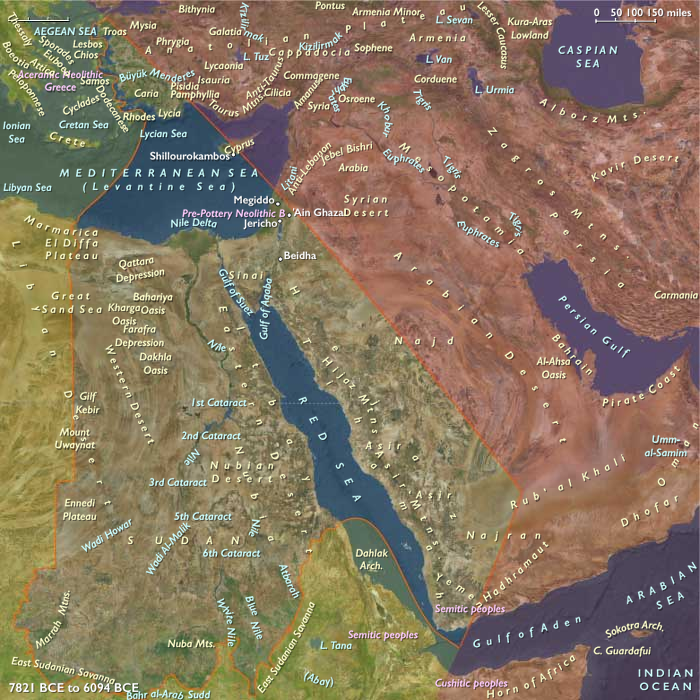
The Pre-Pottery Neolithic (PPN, around 9000 to 6000 BCE) represents the early Neolithic in the Levantine and upper Mesopotamian region of the Fertile Crescent.
It succeeds the Natufian culture of the Epipaleolithic (Mesolithic) as the domestication of plants and animals is in its beginnings and triggered by the Younger Dryas.
The Neolithic period is traditionally divided to the Pre-Pottery (A and B) and Pottery phases.
Kathleen Kenyon originally defined these in the type-site of Jericho (Palestine), established by around 8000 BCE during the Pre-Pottery Neolithic A (PPNA).
Jericho is one of the oldest continuously inhabited cities in the world, with evidence of settlement dating back to 9000 BCE, providing important information about early human habitation in the Near East.
The first permanent settlement was built near the Ein as-Sultan spring, between 10,000 and 9000 BCE and consisted of a number of walls, a religious shrine, and a twenty-three foot (seventeen meter) stone tower with an internal staircase.
Bricks of baked mud are used for the first time around 8000 BCE at Jericho to build houses.
The permanent dwellings of Jericho feature domed roofs of wattle and daub, stone foundations, and door openings.
Some two thousand to three thousand people live within the settlement's walls, outside of which lie fields of cultivated barley and einkorn, a single-grained wheat.
A simple wooden corral would suffice to pen the community's sheep and goats, races recently domesticated, along with pigs and cats.
Locations
Groups
Topics
Commodoties
Subjects
- Commerce
- Environment
- Labor and Service
- Fashion
- Conflict
- Faith
- Government
- Technology
- Anthropology
- Archaeology
Regions
Subregions
Years: 7821BCE - 7678BCE
Locations
Groups
Topics
Commodoties
Subjects
- Commerce
- Environment
- Labor and Service
- Fashion
- Conflict
- Faith
- Government
- Technology
- Anthropology
- Archaeology
Regions
Subregions