
The powerful warlord Mōri Terumoto establishes Hiroshima …
Years: 1589 - 1589
November
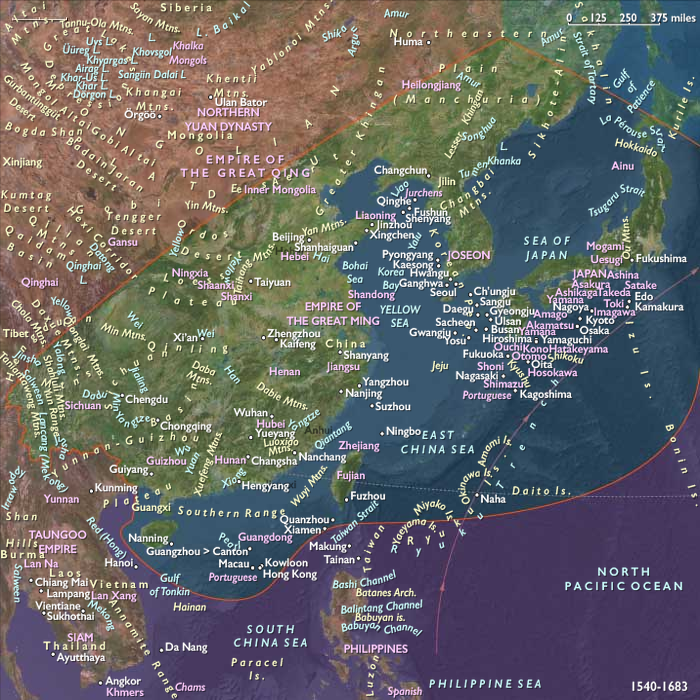
The powerful warlord Mōri Terumoto establishes Hiroshima on the river delta coastline of the Seto Inland Sea in 1589, making it his capital after leaving Koriyama Castle in Aki Province and quickly building Hiroshima Castle, thus essentially founding Hiroshima.
Today the capital of Hiroshima Prefecture, and the largest city in the Chūgoku region of western Honshū, the largest island of Japan, Hiroshima is also to become the first city in history destroyed by a nuclear weapon when the United States of America drops an atomic bomb on it at 8:15 AM on August 6, 1945, near the end of the Second World War.
Locations
People
Groups
Subjects
Regions

Subregions
Related Events
Filter results
Showing 10 events out of 34473 total
A monk, originally named Ioann, who has assumed the religious name of Job, had spent fifteen years in the cloister and finally became its abbot in 1566 with the help of Ivan the Terrible, who had made Staritsa his residence during the time of the Oprichnina.
Job was in 1571 transferred to Moscow and appointed abbot of the Simonov Monastery.
He became the abbot of the Novospassky Monastery in 1575, and in 1581 had been consecrated as Bishop of Kolomna.
Known as a person of mediocre mental abilities, he has nevertheless managed to draw the attention of Boris Godunov by his talent for reading the longest of prayers by heart in a very expressive manner.
He had been appointed archbishop of Rostov and Metropolitan of Moscow and All Russia in 1587.
Godunov, realizing the necessity of strengthening the ecclesiastic authority in Russia, has managed to persuade the Patriarch of Constantinople Jeremias II to establish a patriarchate in Russia.
Job is on January 26, 1589, elected the first Patriarch of Moscow and All Russia.
He will exercise all his influence and play a major part in Boris Godunov's ascension to the Russian throne.
Job does not approve, however, of Godunov's proposal to open a university in Moscow staffed with foreign professors because he believes their influence and non-Orthodox faith would spread heterodoxy and endanger the purity of the Russian Church.
Under Job's supervision, the Russians correct books for the divine services and prepare them for publication.
He assists in the canonization of some of the Russian saints, ordering the celebration of the memory of Basil Fool for Christ in 1588, as well as that of Joseph Volotsky and others.
As Patriarch, Job also favors the construction of new cathedrals and monasteries and Christian missionary activities in the recently conquered Astrakhan Khanate and Siberia.
The Ethiopian Emperor responds in 1589 to the Ottoman advance by sacking Ottoman-held Arkiko on the mainland across from the island of Massawa.
The rabbis of Jerusalem are said to have appealed in 1587 to the Jews of Italy, who possess great stature and wealth among world Jewry, to finance the restoration of the Nachmanides, or Ramban, synagogue, which had served for three hundred years as the center of the growing Jewish community, by now well established.
Due to Muslim incitement two years later, the city's governor, Abu Sufrin, turns the synagogue into a warehouse. (This according to Elizabeth T. Malissa’s Italy and the Jews -Timeline, found at jewishvirtuallibrary.org)
A group of refugees from the Abbey of Farfa, after its burning by Saracen invaders in 898, had settled in Rome, remaining in the city even after their abbot Ratfredus (934-936) rebuilt the abbey.
By the end of the tenth century, the Abbey of Farfa owned Roman churches, houses, windmills and vineyards.
A bull of Holy Roman Emperor Otto III in 998 had confirmed the property of three churches: Santa Maria, San Benedetto and the oratorio of San Salvatore.
When they ceded their property to the Medici family in 1480, the church of Santa Maria, a Roman Catholic minor basilica and titular church in Rome, not far from Piazza Navona, entitled to the Virgin Mary, to St. Dionigi Areopagita and to St. Louis IX, king of France, had become the church of Saint Louis of the French.
Cardinal Giulio di Giuliano de' Medici commissioned Jean de Chenevière to build a church for the French community in 1518.
Building was halted when Rome was sacked in 1527.
Designed by Giacomo della Porta and built by Domenico Fontana between 1518 and 1589, the work on the Church of St. Louis of the French, or San Luigi dei Francesi, has been completed through the personal intervention of Catherine de' Medici, who had donated to it some possessions in the area.
Della Porta had made the façade as a piece of decorative work entirely independent of the body of the structure, a method that is to be much copied.
Dam construction had resumed in Italy in the fifteenth and sixteenth centuries, and, on a larger scale, in Spain, where Roman and Moorish influence is still felt.
Of these dams, the Valencia region’s Tibi, constructed from 1579 to 1589 to detain the waters of the Verd river and irrigate the market gardens of Alicante, is an arch-gravity structure one-hundred and thirty-eight feet high; this height will not be surpassed in western Europe until the building of the Gouffre d'Enfer Dam in France almost three centuries later.
John Hawkins, now about fifty-seven, retires in 1589 from his post as Treasurer and comptroller of the Royal Navy.
Having made important improvements in ship construction and rigging, he is less well known for his inventiveness as a shipwright, but it had been his idea to add to the caulker's work by the finishing touch of sheathing the underside of his ships with a skin of nailed elm planks sealed with a combination of pitch and hair smeared over the bottom timbers, as a protection against the worms which attack a ship in tropical seas.
Hawkins has also introduced detachable topmasts that can be hoisted and used in good weather and stowed in heavy seas.
Masts are more forward, and sails flatter.
His ships are longer and the forecastle and sterncastle have been greatly reduced in size.
France is sinking into chaos despite the heroic efforts of Catherine's old age.
She dies at Blois on January 5, 1589, eight months before the murder of her son Henry III.
Her ultimate achievement is to have saved the kingdom just long enough to ensure the succession of the Bourbon Henry IV, by whom the royal authority will be restored.
Maximilian waives his right to the Polish crown in 1589.
The inactivity in this matter of his brother, Holy Roman Emperor Rudolf II, contributes to Rudolf's poor reputation.
James Stewart, a descendant of Henry VII of England through his great-grandmother Margaret Tudor, older sister of Henry VIII, had become King of Scots as James VI on July 24 1567, when he was just thirteen months old, succeeding his mother Mary, Queen of Scots.
Regents governed during his minority, which ended officially in 1578, though not until 1581 did he gain full control of his government.
Ably assisted by John Maitland of Thirlestane, who leads the government, James had pushed through the Black Acts to assert royal authority over the Kirk and from 1584 has established effective royal government and relative peace among the lords.
James had in 1586 signed the Treaty of Berwick with England.
That and the execution of his mother in 1587, which he denounced as a "preposterous and strange procedure", has helped clear the way for his succession south of the border.
James had assured Elizabeth of his support during the Spanish Armada crisis of 1588 as "your natural son and compatriot of your country", and as time passes and Elizabeth remains unmarried, securing the English succession becomes a cornerstone of his policy.
James had been praised throughout his youth for his chastity, since he had showed little interest in women; after the loss of Lennox, the first of James's powerful male favorites, he continued to prefer male company.
A suitable marriage, however, is necessary to reinforce his monarchy, and the choice falls on the fourteen-year-old Anne of Denmark, younger daughter of that country’s late Protestant king Frederick II.
Drake and Norreys’ 1589 Expedition to Spain: The Failed English Counterattack
After the defeat of the Spanish Armada in 1588, most of Philip II’s warships survived, but many merchant vessels were lost. The Spanish Atlantic fleet’s galleons, though intact, were undergoing refit in Spain’s Atlantic ports, leaving them temporarily vulnerable to attack.
In 1589, Queen Elizabeth I ordered an English counteroffensive, led by Francis Drake and Sir John Norreys, aiming to cripple Spain’s navy, incite a Portuguese uprising against Spanish rule, and capture treasure. However, this campaign ended in failure, with heavy English losses and no strategic gains.
The Attack on Corunna (May 1589)
- The original target was Santander, where Spain’s main naval refitting was taking place.
