
Filters:
The shift to colonialism is also facilitated …
Years: 1540 - 1683
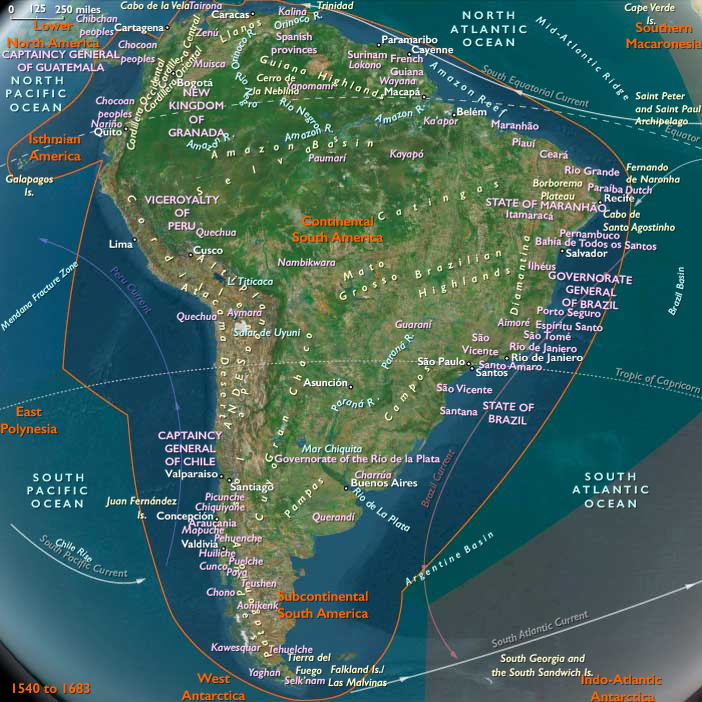
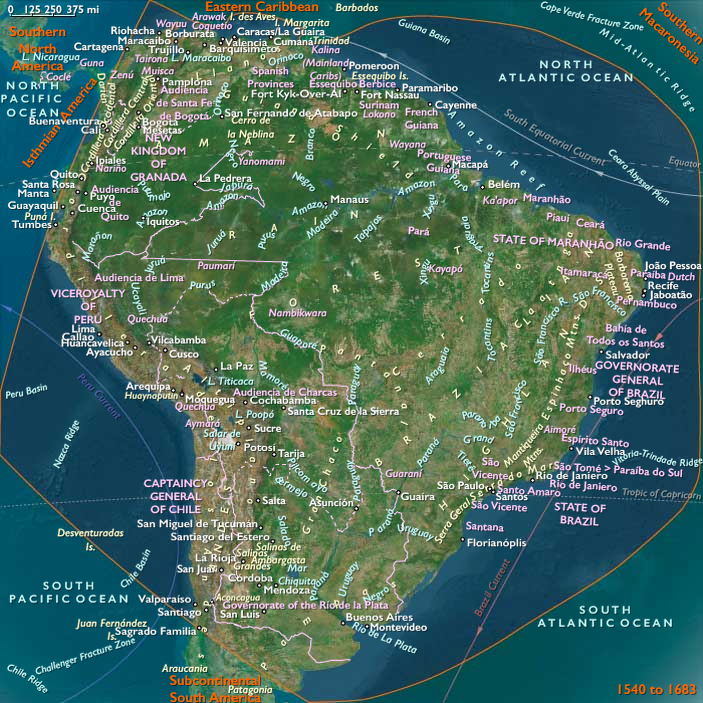
The shift to colonialism is also facilitated by the union of the Spanish and Portuguese crowns between 1580 and 1640.
Although the two governments on the Iberian Peninsula and in the Americas are kept separate, trade and travel controls becomes lax.
An active contraband trade develops between Brazilian settlements and Buenos Aires, and Portuguese moving overland appear in Asunción, Potosí, Lima, and even Quito.
Expansion along the Atlantic coast has been gradual.
Using the model of the Atlantic islands, the crown in 1536 had divided the Brazilian coast into fifteen donatory captaincies (donatários).
To induce settlement, the crown offers ten leagues of coastline as personal property, a percentage of the dyewood trade, control over trade of enslaved natives, as well as the exclusive right to build mills.
Although the two governments on the Iberian Peninsula and in the Americas are kept separate, trade and travel controls becomes lax.
An active contraband trade develops between Brazilian settlements and Buenos Aires, and Portuguese moving overland appear in Asunción, Potosí, Lima, and even Quito.
Expansion along the Atlantic coast has been gradual.
Using the model of the Atlantic islands, the crown in 1536 had divided the Brazilian coast into fifteen donatory captaincies (donatários).
To induce settlement, the crown offers ten leagues of coastline as personal property, a percentage of the dyewood trade, control over trade of enslaved natives, as well as the exclusive right to build mills.
People
Groups
- Dutch people
- Portuguese people
- Castillian people
- French people (Latins)
- English people
- Portugal, Avizan (Joannine) Kingdom of
- Portuguese Empire
- Brazil, Colonial
- Spaniards (Latins)
- Pernambuco, Captaincy of
- São Vicente, Captaincy General of
- Brazil, Colonial
Topics
Commodoties
Subjects
Regions
Subregions
Years: 1540 - 1683
People
Groups
- Dutch people
- Portuguese people
- Castillian people
- French people (Latins)
- English people
- Portugal, Avizan (Joannine) Kingdom of
- Portuguese Empire
- Brazil, Colonial
- Spaniards (Latins)
- Pernambuco, Captaincy of
- São Vicente, Captaincy General of
- Brazil, Colonial
Topics
Commodoties
Subjects
Regions
Subregions