
Emperor Pedro I inaugurates Brazil's first Assembleia …
Years: 1823 - 1823
May
Emperor Pedro I inaugurates Brazil's first Assembleia Geral, with fifty Senators and one hundred and two Deputies on May 5, 1823.
Locations
People
Groups
Subjects
Regions
Subregions
Related Events
Filter results
Showing 10 events out of 46 total
The language he developed in the 1780s, subsequently called bernoldkovcina, is based primarily on western Slovak dialects.
The language has been adopted by the Catholic clergy and disseminated in religious literature.
Bernolak and his followers, however, had remained loyal to the Kingdom of Hungary, and their movement never developed nationalist political implications.
The Protestant revival was more limited in scope, confined largely to the Slovak minority settled in urban centers.
Slovak Protestantism is characterized by an attachment to Czech culture.
The artificial and archaic language of the Czech Bible, known as biblictina, had served as the literary vehicle of the Protestant clergy since the sixteenth century.
In the early nineteenth century, two German-educated Protestant theologians, the poet Jan Kollar and Pavol Safarik, had endeavored to create a literary language that would combine Czech with elements of the central Slovak dialect.
They published a reader, Citanka, in 1825, and beginning in the 1830s they gain a following among the younger generation of students at Protestant secondary schools.
At this time, the Slovak national awakening splits into two factions
Kollar and Safarik are adherents of pan-Slavic concepts that stress the unity of all Slavic peoples.
They continue to view Czechs and Slovaks as members of a single nation, and they attempt to draw the languages closer together.
Other Slovaks break with the Czechs and proclaim the separate identity of the Slovak nation.
South America Major (1828–1839 CE): Early Republican Consolidation, Political Instability, and Nation-Building
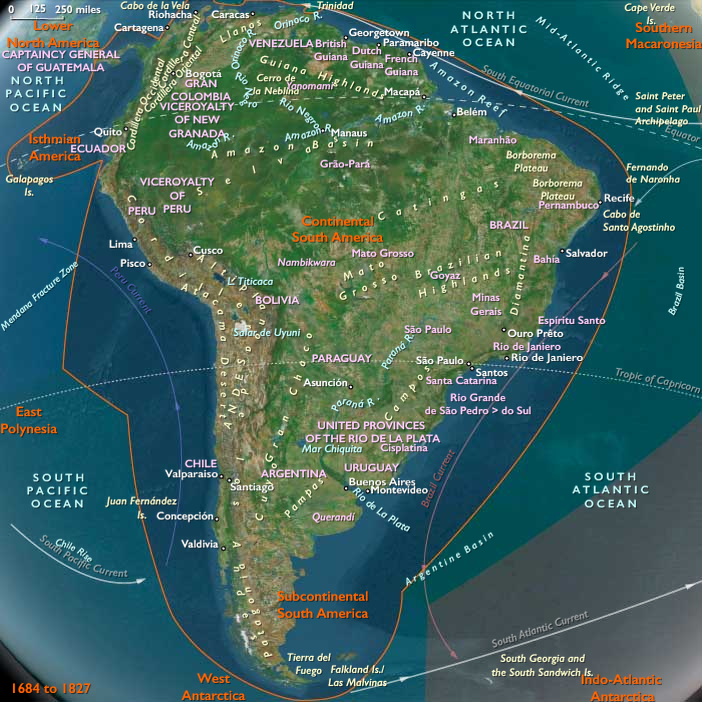
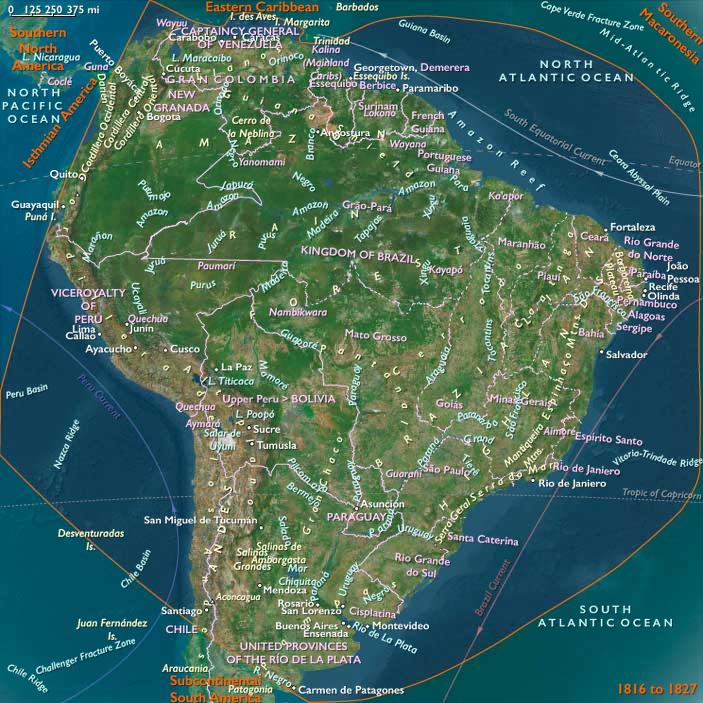
Between 1828 and 1839 CE, South America Major—encompassing Peru, Bolivia, Paraguay, Uruguay, Brazil, northern Argentina, northern and central Chile, Colombia (excluding Darién) and Ecuador (excluding the Ecuadoran capelands), Venezuela, Suriname, Guyana, and French Guiana—embarked on the complex task of building stable nations after achieving independence. This era was characterized by significant political instability, early republican experiments, ongoing economic challenges, and profound cultural and social redefinitions as newly independent states struggled to find cohesive national identities.
Political Developments
Fragile Republican Governments
The new South American republics faced immediate political instability:
-
Gran Colombia, the ambitious union of Venezuela, Colombia, Ecuador, and Panama under Simón Bolívar, fragmented definitively by 1830 into separate republics.
-
Peru and Bolivia struggled with factional rivalries, frequent coups, and short-lived governments.
-
Chile and Argentina faced internal conflicts and political competition between centralized authority and regional interests.
Brazil’s Unique Monarchic Path
Brazil maintained a relatively stable monarchy under Emperor Pedro I until his abdication in 1831. His successor, the child emperor Pedro II, assumed the throne under a regency marked by considerable instability and regional revolts (notably the Cabanagem and Farroupilha rebellions).
Paraguay’s Isolation and Stability
Paraguay continued its exceptional trajectory under dictator José Gaspar Rodríguez de Francia (until 1840). Francia’s policy of political isolation, autarky, and strict authoritarianism sharply distinguished Paraguay’s stability from regional turmoil.
Economic Developments
Economic Reconstruction and Early Struggles
Economic recovery from revolutionary destruction remained slow and challenging. Mining activities (silver in Bolivia, gold in Brazil, emeralds in Colombia) further declined, prompting economic diversification attempts into agriculture, ranching, trade, and small-scale manufacturing.
Export Economies and Dependency
Newly independent republics increasingly relied on agricultural exports—coffee in Brazil and Venezuela, sugar and cattle ranching in Argentina, Paraguay, and Uruguay. However, reliance on European markets perpetuated economic dependency, limiting long-term development.
Continued Dependence on Slave Labor
Brazil maintained extensive slave-based agriculture, particularly in coffee and sugar production. Despite independence, slavery remained entrenched, continuing to provoke deepening ethical debates and social tensions.
Cultural and Technological Developments
Forming National Identities
New nations vigorously promoted cultural projects fostering national identities, histories, and symbols. Education, literature, and art flourished as vehicles for defining distinct national characters separate from colonial traditions.
Urban Renewal and Development
Urban centers—Lima, Quito, Bogotá, Buenos Aires, Rio de Janeiro—began reorienting toward independent republican identities. Public buildings, plazas, universities, and national theaters symbolized new ideals of citizenship and national unity.
Social and Religious Developments
Social Reorganization and Ongoing Inequalities
Post-independence societies underwent gradual reorganization, with creole elites assuming power while indigenous populations, mestizos, and enslaved Africans continued to face marginalization. Social hierarchies, though challenged by independence, remained largely intact.
Catholic Church's Changing Role
The Catholic Church navigated complex adjustments, balancing traditional colonial influence with emerging republican demands for secularism and educational reforms. The Church continued as a vital cultural institution but faced increasing pressures toward reform and reduced privilege.
Indigenous Resistance and Frontier Dynamics
Indigenous communities continued to negotiate their roles within the new republics. Frontier tensions persisted, notably among the Mapuche in Chile and indigenous groups in Amazonian and Andean territories, influencing national policies and military strategies.
Long-Term Consequences and Historical Significance
The era from 1828 to 1839 CE marked critical formative years for South America's independent republics. Political instability, economic restructuring, ongoing inequalities, and profound cultural redefinitions underscored the challenges of nation-building. Despite internal divisions and regional differences—highlighted by Paraguay’s distinctive isolationism and Brazil’s unique monarchy—the era laid foundational patterns and tensions that defined subsequent political, social, and economic trajectories throughout the continent.
The population of Ecuador is divided during these years among three segments: those favoring the status quo, those supporting union with Peru, and those advocating autonomous independence for the former audiencia.
The latter group is to prevail following Venezuela's withdrawal from the confederation during an 1830 constitutional congress that had been called in Bogota in a futile effort to combat growing separatist tendencies throughout Gran Colombia.
A group of Quito notables meets in May of this year to dissolve the union with Gran Colombia, and in August a constituent assembly draws up a constitution for the State of Ecuador, so named for its geographic proximity to the equator, and places General Flores in charge of political and military affairs.
He remains the dominant political figure during Ecuador's first fifteen years of independence.
The comte d'Artois, brother to King Louis XVIII of France, who had been restored as the Bourbon monarch in 1814, had headed the ultra-royalist opposition, which had taken power in 1820 after the traumatic assassination of his son, the duc du Berry, with the ministry of the comte de Villèle.
Villèle continues as chief minister after Artois succeeds his brother in 1824 as Charles X.
Emotionally, Charles has never really recovered from his son's murder.
The Villèle government had voted the Anti-Sacrilege Act in January 1825, which punishes by death the theft of consecrated hosts.
Under pressure from the liberal press, including the Journal des débats, which hosts the articles of the influential François-René de Chateaubriand, the Villèle cabinet had resigned in 1827.
Chateaubriand, considered the founder of Romanticism in French literature, has become highly popular as a defender of press freedom and the cause of Greek independence.
After Villèle's downfall, Charles X appoints him ambassador to the Holy See.
Villèle’s successor, Jean-Baptiste Sylvère Gay, vicomte de Martignac, is on January 4, 1828, appointed minister of the interior, and, though not bearing the title of president, becomes the virtual head of the cabinet.
France’s liberal faction, gaining a majority in the Chamber of Deputies in the 1828 elections, begins working to repeal Charles’s ultraconservative laws prohibiting sacrilege and controlling the press, the church, supervision of schools, return of the Jesuits, dissolution of the national guard and compensation to the émigrés.
Martignac succeeds in passing the act abolishing press censorship, and in persuading the King to sign the ordinances of June 16, 1828 on the Jesuits and the small seminaries.
The first Catholic institution of higher learning in the Northwest Territory, today Xavier University, is founded in Cincinnati in 1831 as a men's college called the Athenaeum. (Bishop John Purcell will ask the Jesuits to take control of the school in 1840, and the name will be changed to Xavier, after the sixteenth century Spanish Jesuit Saint Francis Xavier.
Xavier is the fourth oldest Jesuit University and sixth oldest Catholic university in the United States.)
The Jesuits have now gained the upper hand in Bavaria; one by one, the liberal provisions of the constitution are modified or annulled; the Protestants are harried and oppressed; and a rigorous censorship forbids any free discussion of internal politics.
Following the death of Bavaria's King Maximilian, who had declared himself so on January 1, 1806, officially changing the Electorate of Bavaria to being the Kingdom of Bavaria, his son had ascended the throne in 1825 as Ludwig I.
An enlightened patron of the arts and sciences, Ludwig has transferred the University of Landshut to Munich, which, by his magnificent taste in building, he is to transform into one of the most beautiful cities of the continent.
The early years of his reign had been marked by a liberal spirit and the reform, especially, of the financial administration; but the revolutions of 1830 had frightened him into reaction, which had beenaccentuated by the opposition of the parliament to his expenditure on building and works of art.
In 1837, the Ultramontanes, who strongly support the Church, had come into power with Karl von Abel as prime minister.
Ludwig had forbidden the wearing of mustaches in his military in 1838.
Apolinario de la Cruz, a Tagalog who leads the 1839-41 Cofradía de San José (Confraternity of St. Joseph) revolt, embodies the religious aspirations and disappointments of the Filipinos.
A pious individual who sought to enter a religious order, he made repeated applications that were turned down by the racially conscious friars, and he was left with no alternative but to become a humble lay brother performing menial tasks at a charitable institution in Manila.
While serving in that capacity, he started the cofradia (confraternity or brotherhood), a society to promote Roman Catholic devotion among Filipinos.
From 1839 to 1840, Brother Apolinario sent representatives to his native Tayabas, south of Laguna de Bay, to recruit members, and the movement rapidly spread as cells were established throughout the southern Tagalog area.
Originally, the cofradia was apparently neither anti-Spanish nor nativist in religious orientation, although native elements were prevalent among its provincial followers.
Yet its emphasis on secrecy, the strong bond of loyalty its members felt for Brother Apolinario, and, above all, the fact that it barred Spanish and mestizos from membership aroused the suspicions of the authorities.
The cofradia was banned by the authorities in 1840.
Religious movements such as the cofradia and colorums express an inchoate desire of their members to be rid of the Spanish and discover a promised land that would reflect memories of a world that existed before the coming of the colonists.
Nationalism in the modern sense develops in an urban context, in Manila and the major towns and, perhaps more significantly, in Spain and other parts of Europe where Filipino students and exiles were exposed to modern intellectual currents.
Folk religion, for all its power, does not form the basis of the national ideology, yet the millenarian tradition of rural revolt will merge with the Europeanized nationalism of the ilustrados to spur a truly national resistance, first against Spain in 1896 and then against the Americans in 1899.
The Cofradía de San José insurrection effectively ends with the betrayal and capture of Brother Apolinario.
He is executed on November 5, 1841.
Survivors of the movement become remontados (those who go back into the mountains), leaving their villages to live on the slopes of the volcanic Mount San Cristobal and Mount Banahao, within sight of Alitao.
These mountains, where no friar ventures, will become folk religious centers, places of pilgrimage for lowland peasants, and the birthplace of religious communities known as colorums.
Brother Apolinario leaves Manila in the autumn of 1841 and gathers his followers, now numbering several thousands armed with rifles and bolos (heavy, single-bladed knives), at bases in the villages around the town of Tayabas; as a spiritual leader, he preaches that God will deliver the Tagalog people from slavery.
Although the rebel force, aided by Negrito hill tribesmen, is able to defeat a detachment led by the provincial governor in late October, a much larger Spanish force composed of soldiers from Pampanga Province—the elite of the Philippine military establishment and traditional enemies of the Tagalogs—take the cofradia camp at Alitao after a great slaughter on November 1, 1841.
Years: 1823 - 1823
May
Locations
People
Groups
Subjects
Regions
Subregions