The Portuguese crown assumes control of Príncipe …
Years: 1573 - 1573
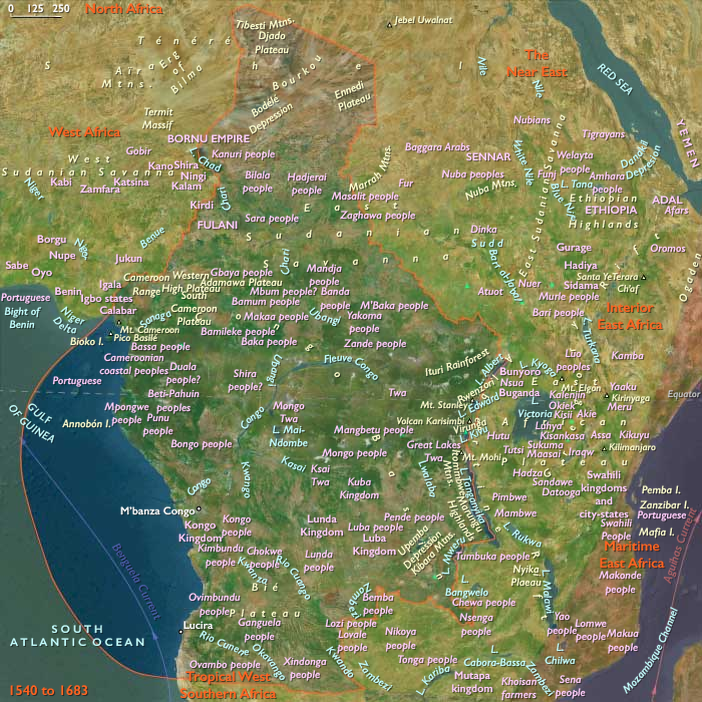
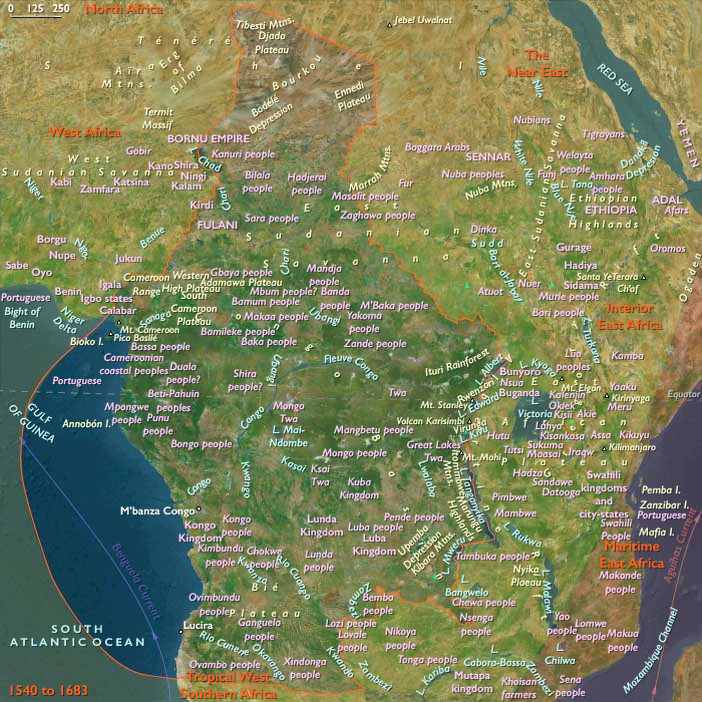
The Portuguese crown assumes control of Príncipe in 1573.
Locations
Groups
Topics
Regions
Subregions
Related Events
Filter results
Showing 10 events out of 35281 total
The Takeda forces retreat after the battle of Mikata ga Hara, as Shingen dies of illness (or perhaps, as it had been speculated, of aggravated wounds or at the hand of an assassin) in 1573.
This is a relief for Nobunaga, who can now focus on Yoshiaki, who has openly declared hostility more than once, despite the imperial court's intervention.
Nobunaga defeats Yoshiaki's weak forces and sends him into exile, bringing the Ashikaga shogunate to an end in the same year, during which Nobunaga also succeeds in destroying the Asakura and Azai clans.
Azai Nagamasa, isolated at Odani Castle after the Asakura had been routed in an ambush, sends Oichi and their three daughters back to Nobunaga and commits suicide along with his son.
Nobunaga, victorious after three years of civil war with is former allies, subdues the Kwanto in the northeast and the region between it and the five provinces around Kyoto, assuming personal control of the central provinces.
He does not trouble to have himself named shogun, as his power does not derive from the emperor.
This marks the end of the Ashikaga shogunate, even though it will nominally last until Yoshiaki's death in 1597.

Nineteen-year-old Dane Tycho Brahe had decided, upon the death of his guardian uncle in 1565, to travel throughout Europe, and has embarked on the study of science at several universities.
He returns in 1572 to Denmark and installs a chemical laboratory in the castle of a relative at Heridsvad Abbey, where he observes a "new star" (a supernova) in the constellation of Cassiopeia.
Brahe's detailed observations of the appearance of the supernova call into question the notion of immutability of the heavens.
In his first work, De Nova Stella, published in 1573, Brahe establishes that the nova he observed in Cassiopeia is a star beyond the Moon's orbit.
Olomouc (now Palacky) University is established in 1573 in Olomouc, as a public university led by the Jesuit order here which is at this time the capital of Moravia and the seat of the episcopacy.
The first German sugar cane refinery is established at Augsburg in 1573.
Sugar mill construction develops technological skills that will be needed for a nascent industrial revolution in the early seventeenth century.
Coffee is noted in Ottoman Aleppo by the German physician botanist Leonhard Rauwolf, the first European to mention it, as chaube, in 1573; Rauwolf is to be closely followed by descriptions from other European travelers.
Ahmadebad has been ruled since 1561 by one Hubboo or Nannu or Nathu (a pretender to the Muzaffarid throne according to Mughal historians).
Ahmedabad had grown under the Muzaffarid dynasty to become one of the world's largest and wealthiest cities.
The sultans have patronized a distinctive architecture that blends Islamic elements with Gujarat's indigenous Hindu and Jain architectural traditions. Gujarat's Islamic architecture presages many of the architectural elements later found in Mughal architecture, including ornate mihrabs and minarets, jali (perforated screens carved in stone), and chattris (pavilions topped with cupolas).
Akbar’s hostile relative, defeated at Sarnal in late 1572, lays siege to Ahmadabad the following summer, thinking that the monsoon rains will prevent Akbar from interfering.
The resolute imperial forces cover the more than five hundred miles in eleven days of difficult weather to defeat the two thousand rebel Indian troops, capturing and imprisoning Akbar’s rival.
Ahmadebad, with all of Gujurat, comes permannetly under imperial rule.
The Portuguese, who had backed the Gujaratis (by whose courtesy they occupy the island of Diu), make peace with Akbar following Akbar’s successful war against Gujarat and his subsequent suppression of a rebellious kinsman.
Akbar returns to his new capital of Fatehpur Sikri.
Subsequent invasions by Golconda result in the loss of a substantial amount of territory in the east.
Sarsa Dengel is the first emperor of Ethiopia to confront the encroachment of the Oromo, who had defeated Nur ibn Mujahid in 1550 as he returned home from killing his uncle Gelawdewos in battle.
Campaigning in the south in his tenth regnal year (1573), Sarsa Dengel defeats the Oromo in a battle near Lake Zway.
The Ottoman empire in 1573 ultimately secures its war aim—the acquisition of Cyprus from the Venetians.