The Portuguese Advance: The Conquest of Palmela, …
Years: 1158 - 1158
The Portuguese Advance: The Conquest of Palmela, Alcácer do Sal, and Sesimbra
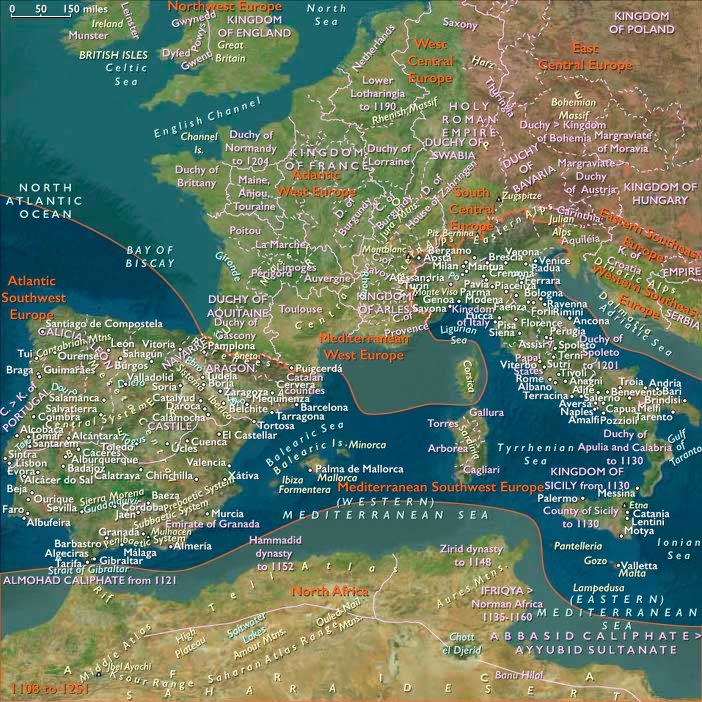
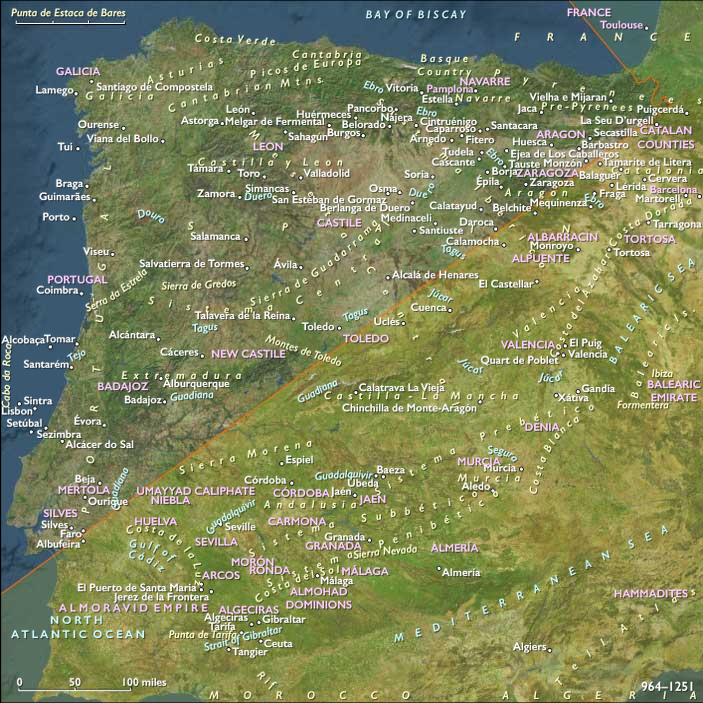
Following their victories at Santarém and Lisbon, the Portuguese forces continued their expansion, seizing key strongholds from the diminished Almoravids. In a series of successful campaigns, Palmela, ...
Locations
Groups
Topics
Commodoties
Subjects
Regions
Subregions
Related Events
Filter results
Showing 10 events out of 48565 total
Cities, states and duchies along the salt roads exact heavy duties and taxes for the salt passing through their territories.
This practice even causes the formation of cities, such as the city of Munich in 1158, when the Duke of Bavaria, Henry the Lion, decides that the bishops of Freising no longer needs their salt revenue.
The city of Munich, or München, whose name is derived from “Munichen,” which means "home of the monks," is established in 1158 when Henry the Lion, duke of Bavaria, grants trade, coinage, and customs privileges to the market center established by monks near their monastery.
The area around Lübeck had been settled after the last Ice Age.
Several Neolithic dolmens can be found in the area.
Slavic peoples started around CE 700 coming into the eastern parts of Holstein, which had previously been settled by Germanic inhabitants and were then evacuated in the course of the Migration Period.
In the early ninth century, Charlemagne, whose attempts to Christianize the area were opposed by the Saxons, had moved the Saxons out and brought in Polabian Slavs, allied to Charlemagne, in their stead.
Liubice ("lovely") had been founded on the banks of the river Trave about four kilometers north of the present-day city center of Lübeck.
In the tenth, century it became the most important settlement of the Obotrite confederacy and a castle had been built.
The settlement had been burned down in 1128 by the pagan Rani, a West Slavic tribe based on the island of Rugia (Rügen) and the southwestern mainland across the Strelasund in what is today northeastern Germany.
The modern town was founded by Adolf II, Count of Schauenburg and Holstein, in 1143 as a German settlement on the river island Bucu.
He has established a new castle which was first mentioned by Helmold in 1147.
Adolf has to cede the castle to Henry the Lion in 1158.
Vladislav, an adventurous youth with no possibility of reaching the throne of Bohemia during the reign of his uncle Soběslav I, had moved to Bavaria, returning at the death of Soběslav in 1140 and, with the help of his brother-in-law, the king of Germany, Conrad III, had been elected prince of Bohemia.
At first, he had had to contend with the claims of his cousin, the son of Sobeslav, also named Vladislav.
By Soběslav's request, the Emperor Lothair II had recognized the rights of his son at the Diet of Bamberg in May 1138, then, in June, the nobility had affirmed them at Sadská.
Another diet at Bamberg had confirmed the succession of the son of Vladislav, however, in April 1140.
The local dukes, Conrad II of Znojmo, Vratislaus II of Brno, and Otto III of Olomouc, had given him trouble and been excommunicated by Henry Zdik, bishop of Olomouc, who was then driven out of his diocese.
The territorial dukes then defeated Vladislav through treason at Vysoká on April 22, 1142, but their siege of Prague had failed.
Vladislav kept his throne through the help of Conrad III of Germany, whose half-sister Gertrude of Babenberg he married.
He had accompanied the king on the Second Crusade in 1147, but had halted his march at Constantinople.
On his way back to Bohemia, he passed through Kiev and Kraków.
Thanks to his friendship with Conrad's successor, the emperor Frederick Barbarossa, Vladislav is elected king of Bohemia on January 11, 1158, becoming the second Bohemian prince to boast such an imperial title after Vratislaus II.

William of Sicily’s Norman forces had ravaged the coasts of the Empire in 1157, forcing a peace upon Manuel in 1158.
The emperor now turns to the Latin East, asserting his authority over the crusader states established after the First Crusade.
Thoros had quickly established a friendly rapport with Kilij Arslan II, the new Seljuq sultan of Rüm; and in 1158 a peace treaty is concluded.
Kilij, engaged in a power struggle with rival Turkish groups in 1158, requests military aid from Constantinople.
Emperor Manuel Komnenos, complies, apparently reasoning that intertribal warring will weaken all the Turks and thus prevent any group from incorporating Anatolia into their domain.
Kilij, using the imperial aid to great advantage, kills his enemies and expands his territory.
Manuel I Komnenos launches his second assault on Thoros in the summer of 1158, marching at the head of an army down the usual routes leading to Seleucia.
There, with a small rapid deployment force of horsemen and Seleucian troops, he launches a surprise attack on Thoros.
Thoros is at Tarsus, suspecting nothing, when one day in late October, a Latin pilgrim whom he had entertained came suddenly rushing back to his Court to tell him that he had seen Imperial troops only a day’s march away.
Thoros collects his family, his intimate friends and his treasure and flees at once to the mountains.
Next day the Emperor enters the Cilician plain; within a fortnight all the Cilician cities as far as Anazarbus are in his power, but Thoros himself still eludes him.
Imperial detachments scour the valleys as he flees from hilltop to hilltop and at last finds refuge on a crag called Dadjog, near the sources of the river Cydnus; only his two most trusted servants know where he lies hidden.
Thus, much of Cilicia is restored to imperial control, but Thoros still holds the mountainous regions in the north.
Thoros survives by sheltering alone under rocks on a hillside, where an old shepherd brings him food to keep him alive.
Eventually, King Baldwin III of Jerusalem intervenes and successfully brokers a peace treaty between the Emperor and Thoros: Thoros has to walk barefoot and bareheaded to the camp of the emperor, where he prostrates himself in the dust before the imperial platform.
A pardon is then accorded to him for his transgressions both in Cilicia and Cyprus.
He is still allowed to hold partial possession in Cilicia.
Calatrava, the only important city in the Guadiana River valley, which thus guards the roads to Córdoba and Toledo, had been conquered in 1147 by Alfonso VII, becoming one of the farthest Christian outposts during this stage of the reconquista.
The castle had been placed under the protection of the Knights Templar, but this had proved unsatisfactory, and Sancho III of Castile had made an offer: he would grant the town and fortress of Calatrava to anyone who promised to defend it from the Moors.
Encouraged by a friar named Diego Velásquez, who had been a warrior before becoming a friar, Raymond, abbot of the Fitero Abbey, takes up the challenge.
Sancho grants them the privilege of defending Calatrava, and Raymond organizes an army, with the support of Juan II of Toledo, the Archbishop of Toledo, that successfully prevents the Moors from attacking this place in 1158.
It is the founding moment of the Order of Calatrava, the spearhead of the Iberian armies during the Reconquista.
...Sezimbra from the diminished Almoravids.
The Struggles of King Ferdinand II of León and the Succession Crisis in Castile (1157–1158)
Upon ascending the throne of León in 1157, Ferdinand II faced immediate challenges, both from his powerful nobility and from his elder brother, Sancho III of Castile, who sought to assert dominance over the recently divided kingdom. This period of unrest saw border tensions and internal disputes, as both monarchs maneuvered for influence over the legacy of their father, Emperor Alfonso VII.
The Meeting at Sahagún and Sancho’s Sudden Death (1158)
In an effort to resolve their inheritance disputes, Ferdinand II and Sancho III met at Sahagún in 1158, where they peacefully negotiated a settlement. However, later that same year, Sancho III unexpectedly died, leaving his throne to his young son, Alfonso VIII.
Seizing the opportunity, Ferdinand II occupied parts of Castile, exploiting the instability caused by the child king’s succession. His actions further complicated the fragile political landscape of the Iberian kingdoms, as various factions vied for control over the regency and the future of Castile.