
Filters:
Poland-Lithuania seeks ways to maintain control of …
Years: 1540 - 1683
Poland-Lithuania seeks ways to maintain control of the diverse kingdom in spite of two threatening circumstances in the mid-sixteenth century.
First, since the late 1400s a series of ambitious tsars of the house of Rurik has led Russia in competing with Poland-Lithuania for influence over the Slavic territories located between the two states.
Second, Sigismund II Augustus (r. 1548-72) has no male heir.
The Jagiellon Dynasty, the strongest link between the halves of the state, will end after his reign.
Accordingly, the Union of Lublin of 1569 transforms the loose federation and personal union of the Jagiellonian epoch into the Polish-Lithuanian Commonwealth, deepening and formalizing the bonds between Poland and Lithuania.
First, since the late 1400s a series of ambitious tsars of the house of Rurik has led Russia in competing with Poland-Lithuania for influence over the Slavic territories located between the two states.
Second, Sigismund II Augustus (r. 1548-72) has no male heir.
The Jagiellon Dynasty, the strongest link between the halves of the state, will end after his reign.
Accordingly, the Union of Lublin of 1569 transforms the loose federation and personal union of the Jagiellonian epoch into the Polish-Lithuanian Commonwealth, deepening and formalizing the bonds between Poland and Lithuania.
Locations
People
Groups
- Jews
- Lithuanians (Eastern Balts)
- Germans
- Poles (West Slavs)
- Belarusians (East Slavs)
- Russians (East Slavs)
- Ukrainians (East Slavs)
- Poland of the Jagiellonians, Kingdom of
- Lithuania, Grand Duchy of
- Russia, Tsardom of
- Polish-Lithuanian Commonwealth (Commonwealth of the Two Nations)
Subjects
Regions
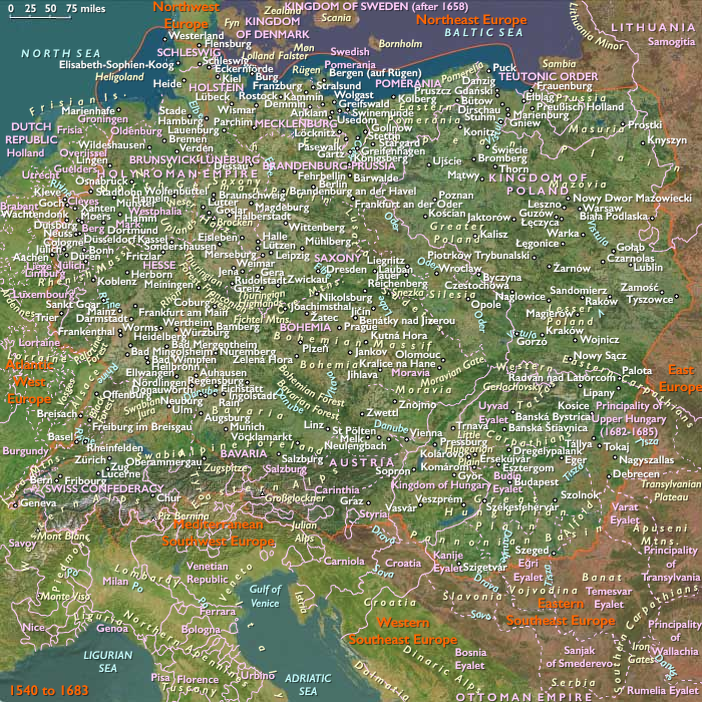
Subregions
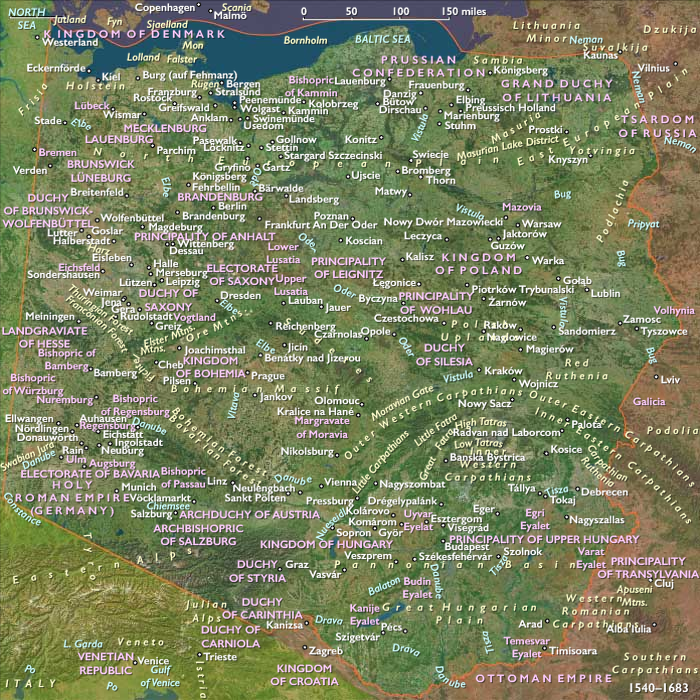
Years: 1540 - 1683
Locations
People
Groups
- Jews
- Lithuanians (Eastern Balts)
- Germans
- Poles (West Slavs)
- Belarusians (East Slavs)
- Russians (East Slavs)
- Ukrainians (East Slavs)
- Poland of the Jagiellonians, Kingdom of
- Lithuania, Grand Duchy of
- Russia, Tsardom of
- Polish-Lithuanian Commonwealth (Commonwealth of the Two Nations)
Subjects
Regions
Subregions