
Filters:
Ethiopia experiences a period of isolation between …
Years: 1684 - 1827
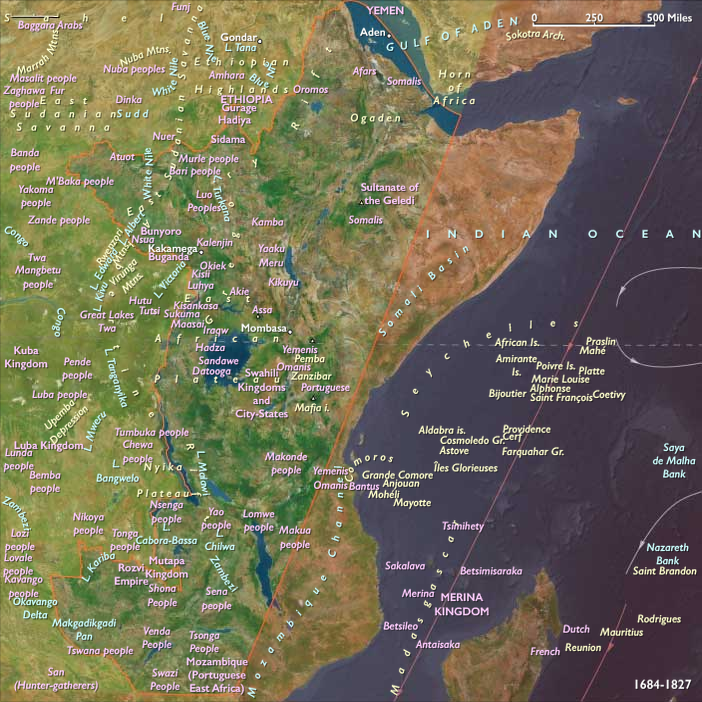
Ethiopia experiences a period of isolation between 1755 and 1855, referred to as the Zemene Mesafint or "Age of Princes".
The Emperors become figureheads, controlled by warlords like Ras Mikael Sehul of Tigray, Ras Wolde Selassie of Tigray, and by the Yejju Oromo dynasty, such as Ras Gugsa of Yejju, which later leads to nineteenth-century Oromo rule of Gondar, changing the language of the court from Amharic to Afaan Oromo.
Traditionally, the beginning of this period is set on the date Ras Mikael Sehul deposes Emperor Iyoas (May 7, 1769), and its end to Kassa's coronation as Emperor Tewodros II (February 11, 1855), having defeated in battle all of his rivals.
Some historians date the murder of Iyasu the Great (October 13, 1706), and the resultant decline in the prestige of the dynasty, as the beginning of this period.
Others date it to the beginning of Iyoas's reign (June 26, 1755).
During the Zemene Mesafint, various lords come to abuse their positions by making Emperors and encroach upon the succession of the dynasty, by candidates among the nobility itself: for example, on the death of Emperor Tewoflos in 1711, the chief nobles of Ethiopia fear that the cycle of vengeance that had characterized the reigns of Tewoflos and Tekle Haymanot I (1706–1708) will continue if a member of the Solomonic dynasty is picked for the throne, so they select one of their own, Yostos, to be King of Kings (nəgusä nägäst).
However, the tenure of Yostos from 1711 to 1716 is brief, and the throne comes into the hands of the Solomonic house once again.
The Emperors become figureheads, controlled by warlords like Ras Mikael Sehul of Tigray, Ras Wolde Selassie of Tigray, and by the Yejju Oromo dynasty, such as Ras Gugsa of Yejju, which later leads to nineteenth-century Oromo rule of Gondar, changing the language of the court from Amharic to Afaan Oromo.
Traditionally, the beginning of this period is set on the date Ras Mikael Sehul deposes Emperor Iyoas (May 7, 1769), and its end to Kassa's coronation as Emperor Tewodros II (February 11, 1855), having defeated in battle all of his rivals.
Some historians date the murder of Iyasu the Great (October 13, 1706), and the resultant decline in the prestige of the dynasty, as the beginning of this period.
Others date it to the beginning of Iyoas's reign (June 26, 1755).
During the Zemene Mesafint, various lords come to abuse their positions by making Emperors and encroach upon the succession of the dynasty, by candidates among the nobility itself: for example, on the death of Emperor Tewoflos in 1711, the chief nobles of Ethiopia fear that the cycle of vengeance that had characterized the reigns of Tewoflos and Tekle Haymanot I (1706–1708) will continue if a member of the Solomonic dynasty is picked for the throne, so they select one of their own, Yostos, to be King of Kings (nəgusä nägäst).
However, the tenure of Yostos from 1711 to 1716 is brief, and the throne comes into the hands of the Solomonic house once again.
Locations
People
Groups
Topics
- Interaction with Subsaharan Africa, Early European
- Sub-Saharan Africa, Modern
- Zemene Mesafint (Ethiopia's "Age of Princes")
Subjects
Regions
Subregions
Years: 1684 - 1827
Locations
People
Groups
Topics
- Interaction with Subsaharan Africa, Early European
- Sub-Saharan Africa, Modern
- Zemene Mesafint (Ethiopia's "Age of Princes")
Subjects
Regions
Subregions