
The Pope, making his return from the …
Years: 1460 - 1460
October
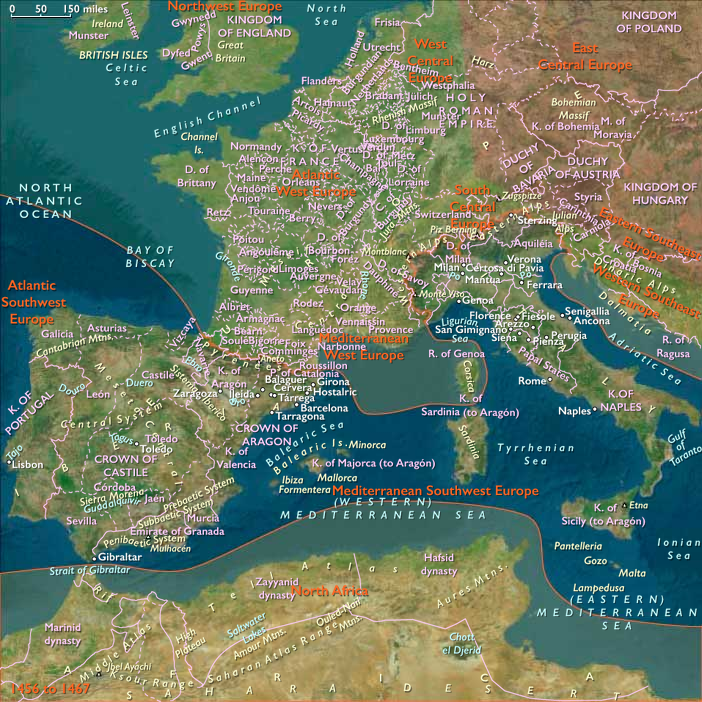
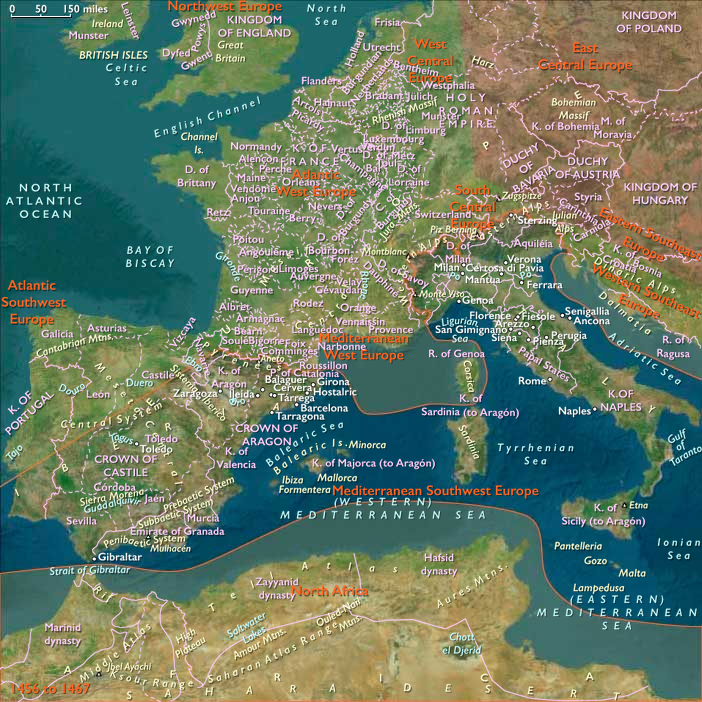
The Pope, making his return from the disappointing Council of Mantua, has spent a considerable time taking the waters for his gout in his native district of Siena, where he has been joined by his erstwhile host in Mantua, Ludovico Gonzaga.
In the tumultuous atmosphere of the revolt against Ferrante, the Aragonese King of Naples by the local lords who support the claims of the House of Anjou, which breaks out anew in 1460, Francesco Sforza has induced the Pope to support Ferrante in the Neapolitan War of 1460-61.
The strife in the Kingdom of Naples is reflected in Rome, where, in the absence of the Pope, two bands of youthful thugs compete for territory.
The Conservatori are inactive and the disturbances grow so great by the end of March that the Governor is forced to vacate the Lateran Palace and call on Pius for military support.
The perennial anti-Papal party in Rome, at this time headed by the Savelli, the Colonna and the Anguillara, have made overtures to the condottiero Jacopo Piccinino, son of the late Niccolò Piccinino, who is fighting for René d'Anjou.
Violence erupts in Rome over the rescue from the law of an abductor of a young woman, by a gang headed by the brothers Tiburzio and Valeriano di Maso, whose father, brother-in-law to Stefano Porcari, had been executed for his complicity in Porcaro's plot against Nicholas V in 1453.
The brothers, announcing that they are "throwing off the yoke of the priests" according to Stefano Infessura, and restoring the Roman Republic, barricade themselves in the Pantheon, and then, driven from stronghold to stronghold, fortify themselves in Palazzo Capranica.
Jacopo Piccinino is plundering in the Sabine Hills and is threatening Rome, according to an informant who identifies as Piccinino's supporters the Prince of Taranto, Everso di Anguillara, Jacopo Savelli and the Colonna, and that Tiburzio's gang will open the gates of Rome to the condottiero.
Pius finally leaves Siena; he gathers together at Orvieto representatives of the contending houses of Aragon and Anjou preparatory to making peace, collects five hundred horseman at Viterbo and sets out for Rome where he arrives on October 6, to public expressions of joy and relief.
In mid-October, with rumors rife of an assault on the city by Piccinino, Tiburzio makes an attempt to rescue a captured ally, calling fruitlessly on the city to rise up, and is captured with some of his comrades as they attempt to flee to Palombara.
On the scaffold he acknowledges that he had intended, with the aid of the Ghibelline barons and Piccinino, to overthrow the papal government, made bold by the predictions of a fortuneteller.
He is hanged on the Campidoglio on October 31, 1460.
Locations
People
- Ferdinand I of Naples
- Francesco I Sforza
- Jacopo Piccinino
- Ludovico III Gonzaga
- Pope Pius II
- René of Anjou
Groups
- Papal States (Republic of St. Peter)
- Christians, Roman Catholic
- Aragon, Crown of
- Naples, Aragonese Kingdom of
Topics
Commodoties
Subjects
Regions
Subregions
Years: 1460 - 1460
October
Locations
People
- Ferdinand I of Naples
- Francesco I Sforza
- Jacopo Piccinino
- Ludovico III Gonzaga
- Pope Pius II
- René of Anjou
Groups
- Papal States (Republic of St. Peter)
- Christians, Roman Catholic
- Aragon, Crown of
- Naples, Aragonese Kingdom of
Topics
Commodoties
Subjects
Regions
Subregions