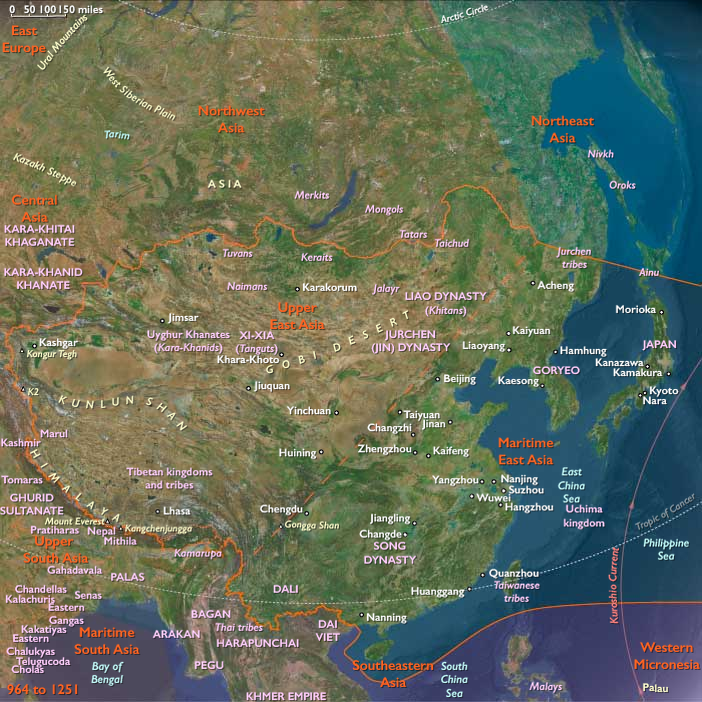
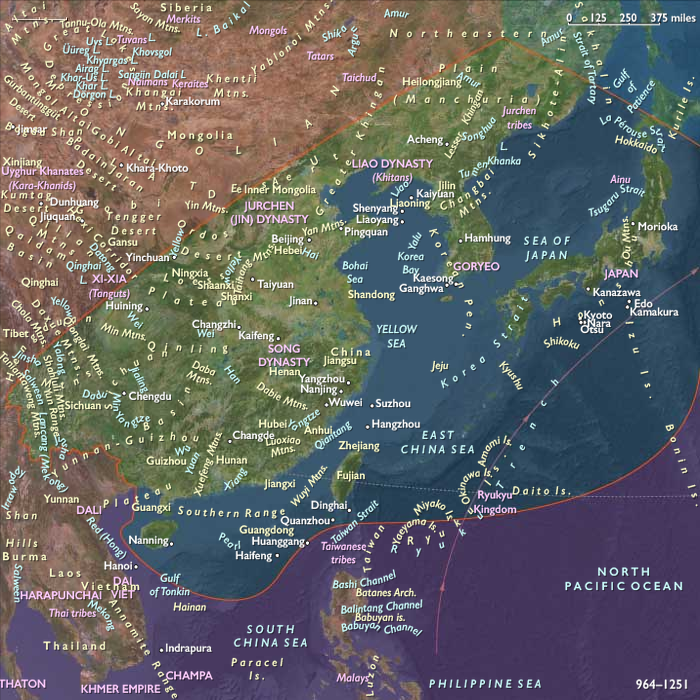
The astronomical clock tower in Kaifeng features …
Years: 1088 - 1088
The astronomical clock tower in Kaifeng features an escapement mechanism and the world's oldest known endless power-transmitting chain drive to operate the armillary sphere, opening doors, and mechanical-driven mannequins that rotate in shifts to announce the time on plaques.
Its construction in 1088 is based on a successful pilot model by polymath statesman and scientist Su Song.
Locations
People
Groups
Subjects
Regions
Subregions
Related Events
Filter results
Showing 10 events out of 50381 total
Chinese records show that Srivijaya had sent ambassadors from Jambi and Palembang between 1079 and 1088.
In 1079 in particular, ambassadors from Jambi and Palembang each visit China.
Jambi had sent two more ambassadors to China in 1082 and 1088.
This suggests that the center of Srivijaya frequently shifts between these two major cities during this period.
The initial movement of the capital to Jambi had been partly induced by the 1025 raid by pirates from the Chola region of southern India, which had destroyed much of Palembang.
The Dream Pool Essays represents the earliest known writing about the magnetic compass, movable type printing, experimentation with the camera obscura only decades after Ibn al-Haytham, and includes many different fields of study in essay and encyclopedic form, including geology, astronomy, botany, zoology, mineralogy, anatomy, pharmacology, geography, optics, economics, military strategy, philosophy, etc.
Published in this year by the polymath scientist and statesman Shen Kuo, the book features some of Shen's most advanced theories, including geomorphology and gradual climate change, while he improves Chinese astronomy by fixing the position of the pole star and correcting the lunar error by plotting its orbital course every night for a continuum of five years.
Shen's book is also the first to describe the drydock in China, and discusses the advantages of the relatively recent invention of the canal pound lock over the old flash lock.
Sviatopolk is the son of Iziaslav Iaroslavich by his wife Gertrude of Poland.
During his brother Yaropolk's life, Sviatopolk had not been not regarded as a potential claimant to the Kievan throne.
In 1069 he had been sent to Polotsk, a city briefly taken by his father from the local ruler Vseslav.
He has spent the past ten years (1078–88) ruling Novgorod.
Upon his brother's death, he succeeds him in Turov, which will remain in possession of his descendants until the seventeenth century.
Egbert II, Margrave of Meissen, had succeeded his father on the latter's death January 11, 1068 in Brunswick and Meissen when still a minor.
He is married to Oda, daughter of Count Otto of Meissen-Orlamünde, whose lands he has inherited, including the castle of Wanderslebener Gleichen.
In 1073, the Saxons, led by Duke Magnus and Otto of Nordheim, had rebelled against King Henry IV.
The insurrection had been crushed by Duke Vratislaus II of Bohemia in the First Battle of Langensalza on June 9, 1075.
Whether Egbert had participated in the Saxon rebellion remains unclear based on extant sources, but since he had nonetheless proved himself an opponent of the king, he had been deprived of Meissen, which was then given to Vratislaus.
However, Egbert had driven Vratislaus from Meissen the next year and was condemned.
A Frisian county then in his possession was confiscated and given to the Bishop of Utrecht.
Egbert had originally supported anti-king Rudolf of Rheinfeld, but eventually he and many other Saxon nobles withdrew their support and remained neutral.
Following the death of Otto of Nordheim in 1083, Egbert has become the most important, but also inconsistent, Saxon opponent of Henry IV.
In 1085, the two had been briefly reconciled and Egbert had entertained Henry in Saxony in July.
In September, the conflict had been resumed, but in 1087, Egbert and Henry made peace.
When Hermann of Salm dies in 1088, Egbert II, a longtime enemy of the Emperor, proclaims himself the successor of the antiking.
Henry has him condemned by a Saxon diet and then a national one at Quedlinburg and Regensburg respectively, but he is defeated by Egbert when a relief army comes to the margrave's rescue during the four-month siege of Gleichen; Egbert manages to escape during the confusion of battle on Christmas Eve, 1088.
Vratislaus covets the largely Slavic marches of Meissen and Lusatia, but, in spite of Henry's promises and Bohemian successes against the rebellious margraves, he never receives them.
He had held Lower Lusatia between 1075 and 1086, but in 1088, with the insurrection of Egbert II of Meissen, Henry had granted the region to Henry of Ostmark.
Vratislaus is from this point cool to Henry's military adventures.
He will never waver in his loyalty, but will abstain from giving the emperor martial aid.
Alexios, following the collapse of the rebel alliance due to intertribal disagreement about plunder, buys off the Bogomils and takes them into his army to fight the Pechenegs, the Cumans having removed to the north.
The University of Bologna will receive a charter from Frederick I Barbarossa in 1158, but in the nineteenth century, a committee of historians led by Giosuè Carducci will trace the founding of the University to 1088, which would make it the oldest continuously operating university in the world.
The University has arisen around mutual aid societies of foreign students called "nations" (as they are grouped by nationality) for protection against city laws that impose collective punishment on foreigners for the crimes and debts of their countrymen.
These students then hired scholars from the city to teach them.
In time the various "nations" had decided to form a larger association, or universitas—thus, the university.
The university will grow to have a strong position of collective bargaining with the city, since by then it derives significant revenue through visiting foreign students, who will depart if they are not well treated.
The foreign students in Bologna receive greater rights, and collective punishment is ended.
There is also collective bargaining with the scholars who serve as professors at the university.
By the initiation or threat of a student strike, the students can enforce their demands as to the content of courses and the pay professors will receive.
University professors are hired, fired, and have their pay determined by an elected council of two representatives from every student "nation" which governs the institution, with the most important decisions requiring a majority vote from all the students to ratify.
The professors can also be fined if they fail to finish classes on time, or complete course material by the end of the semester.
A student committee, the "Denouncers of Professors", keeps tabs on them and reports any misbehavior.
Professors themselves are not powerless, however: they form a College of Teachers, and secure the rights to set examination fees and degree requirements.
Eventually, the city will end this arrangement, paying professors from tax revenues, and making it a chartered public university.
The university is historically notable for its teaching of canon and civil law; indeed, it has been set up in large part with the aim of studying the Digest, a central text in Roman law, which had been rediscovered in Italy in 1070, and the university is central in the development of medieval Roman law.
Until modern times, the only degree granted at this university is the doctorate.

Alfonso appeals for help to the rest of Christendom in the face of the Almoravid threat, and a small expedition is organized as a result; these proto-crusaders’ do not reach Alfonso's lands, instead wasting their energies and resources in an unsuccessful siege of the Muslim outpost of Tudela.
Yusuf ibn Tashfin besieges Aledo but is forced to retreat by the arrival on the scene of the troops of King Alfonso VI.