
The political ban that had been placed …
Years: 1865 - 1865
June
The political ban that had been placed on Wagner in Germany after he had fled Dresden had been fully lifted in 1862.
The composer had settled in Biebrich in Prussia, where he had begun work on Die Meistersinger von Nürnberg, the idea for which had come during a visit he had made to Venice with the Wesendoncks.
This opera is his only mature comedy.
Wagner between 1861 and 1864 had tried to have Tristan und Isolde produced in Vienna.
Despite numerous rehearsals, the opera had remained unperformed, and had gained a reputation as being "impossible", which had further added to Wagner's financial woes.
Wagner had finally parted from Minna in 1862, though he will continue to give her financial support until her death in 1866.
Wagner's fortunes had taken a dramatic upturn in 1864, when King Ludwig II at the age of eighteen succeeded to the throne of Bavaria.
The young king, an ardent admirer of Wagner's operas since childhood, had had the composer brought to Munich.
He had settled Wagner's considerable debts, and had proposed to stage Tristan, Die Meistersinger, the Ring, and the other operas Wagner has planned.
Wagner has also begun to dictate his autobiography, Mein Leben, at the King's request.
To Wagner, it seems significant that his rescue by Ludwig coincided with his learning the news of the death of his earlier mentor, but later supposed enemy, Giacomo Meyerbeer, regretting ungratefully that "this operatic master, who had done me so much harm, should not have lived to see this day". (Wagner, Richard (tr. Andrew Gray) (1992), My Life, New York: Da Capo Press. ISBN 978-0-306-80481-6. Wagner's partly unreliable autobiography, covering his life to 1864, written between 1865 and 1880 and first published privately in German in a small edition between 1870 and 1880. The first (edited) public edition appeared in 1911. Gray's translation is the most comprehensive available.)
After grave difficulties in rehearsal, Tristan und Isolde premiers at the National Theater in Munich on June 10, 1865, the first Wagner opera premiere in almost fifteen years. (The premiere had been scheduled for May 15, but had been delayed by bailiffs acting for Wagner's creditors, and because the Isolde, Malvina Schnorr von Carolsfeld, was hoarse and needed time to recover.)
The conductor of this premiere is Hans von Bülow, whose wife, Cosima, had given birth in April this year to a daughter, named Isolde, the child not of von Bülow but of Wagner.
Cosima is twenty-four years younger than Wagner and is herself illegitimate, the daughter of the Countess Marie d'Agoult, who had left her husband for Franz Liszt.
Liszt disapproves of his daughter seeing Wagner, though the two men are friends.
The indiscreet affair scandalizes Munich and, to make matters worse, Wagner falls into disfavor among members of the court, who are suspicious of his influence on the king.
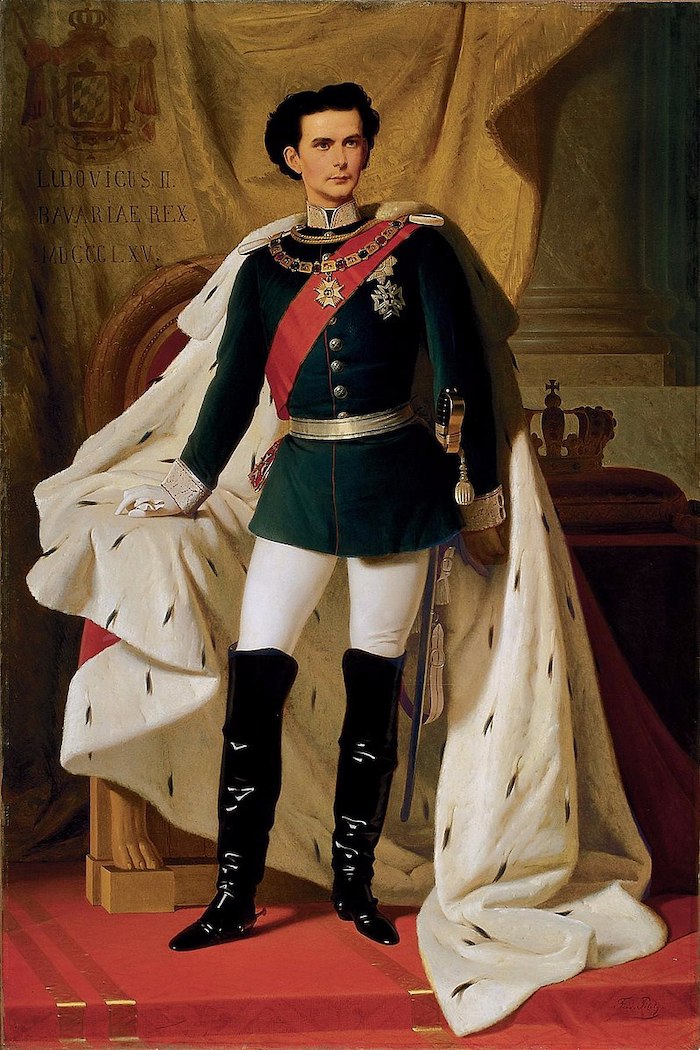
Portrait of Ludwig II of Bavaria in generals' uniform and coronation robe about the time when he first met Wagner, by Ferdinand von Piloty, 1865 (Bayerische Staatsgemaldesammlungen, Munich)
Locations
People
Groups
Topics
Subjects
Regions
Subregions
Related Events
Showing 10 events out of 13564 total
Years: 1865 - 1865
June
Portrait of Ludwig II of Bavaria in generals' uniform and coronation robe about the time when he first met Wagner, by Ferdinand von Piloty, 1865 (Bayerische Staatsgemaldesammlungen, Munich)
Locations
People
Groups
Topics
Subjects
Regions
Subregions