
Austria, Prussia, and Russia decide, following the …
Years: 1795 - 1795
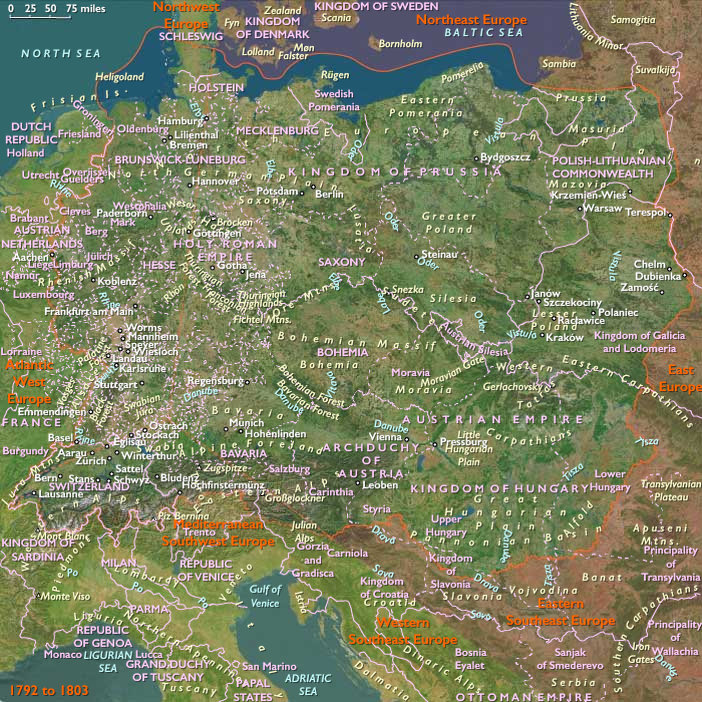
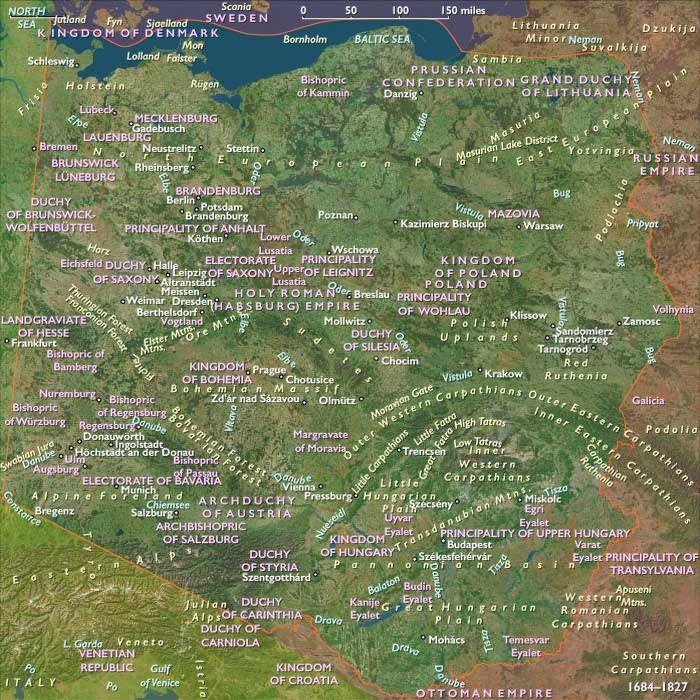
On October 24, 1795, the representatives of the Russian Empire, Austria, and the Kingdom of Prussia assembled to write the treaty formally dissolving the Polish–Lithuanian Commonwealth and all of her institutions, though the conquering powers will not sign the treaty until January 26, 1797, in St. Petersburg.
The Third Partition of Poland ends the existence of an independent Polish state for the next hundred and twenty-three years.
Locations
People
Groups
- Poles (West Slavs)
- Austria, Archduchy of
- Polish-Lithuanian Commonwealth (Commonwealth of the Two Nations)
- Habsburg Monarchy, or Empire
- Prussia, Kingdom of
- Russian Empire
Topics
Subjects
Regions
Subregions
Related Events
Filter results
Showing 10 events out of 23345 total
Santa Cruz de Nuca remains under the control of New Spain until 1795, when it is abandoned under the terms of the third Nootka Convention.
The Nootka Crisis, which had grown into an international incident and the threat of war between Britain and Spain, had ended with the Nootka Convention of 1789.
Three separate Nootka Conventions are signed: it has taken over five years to resolve the many outstanding problems.
Among other things, Spain has agreed to restore the captured ships to their owners and pay them an indemnity.
Britain and Spain have agreed not to establish any permanent base at Nootka Sound, but ships from either nation can visit.
The two nations also agree to prevent any other nation from establishing sovereignty.
Kamehameha's dreams include far more than the island of Hawaiiʻi; with the counsel of his favorite wife Kaʻahumanu, who becomes one of Hawaiiʻi's most powerful figures, he sets about planning to conquer the rest of the Hawaiian Islands.
Help comes from British and American traders, who sell guns and ammunition to Kamehameha.
Two westerners who live on Hawaiiʻi island, Isaac Davis and John Young, have become advisors of Kamehameha and have trained his troops in the use of firearms.
With the expansion of European settlement large amounts of land is cleared for farming, which results in the destruction of Aboriginal food sources.
This, combined with the introduction of new diseases such as smallpox, causes resentment within the Aboriginal clans against the British and results in violent confrontations, coordinated by men such as Pemulwuy.
Whether Pemulwuy is actively resisting European settlement, or is only attempting to uphold Aboriginal law, which often involve revenge acts, is debated by historians.
Regardless, the British believe the attacks made against them are acts of war.
Martin H. Klaproth makes the actual identification of titanium’s oxide from Hungarian rutile deposits.
A German chemist working independently in 1795, he names its metal constituent titanium after the Titans, the giants of Greek mythology.
In 1792, Gudovich told Heraclius that he would receive only diplomatic support in the advent of any Iranian onslaught.
Despite being left to his own devices, Heraclius still cherishes a dream of establishing, with Russian protection, a strong and united monarchy, into which the western Georgian Kingdom of Imereti and the lost provinces under Ottoman rule will all eventually be drawn.
The consequences of these events come a few years later, when a new dynasty, the Qajars, emerge victorious in the protracted power struggle in Persia.
Their head, Agha Mohammad Khan, as his first objective, has resolved to bring the Caucasus again fully under the Persian orbit.
For Agha Mohammah Khan, the resubjugation and reintegration of Georgia into the Iranian Empire is part of the same process that has brought Shiraz, Isfahan, and Tabriz under his rule.
He views, like the Safavids and Nader Shah before him, the territories no different than the territories in mainland Iran.
Georgia is a province of Iran the same way Khorasan is.
As the Cambridge History of Iran states, its permanent secession was inconceivable and had to be resisted in the same way as one would resist an attempt at the separation of Fars or Gilan.
It is therefore natural for Agha Mohammad Khan to perform whatever necessary means in the Caucasus in order to subdue and reincorporate the recently lost regions following Nader Shah's death and the demise of the Zands, including putting down what in Iranian eyes is seen as treason on the part of the wali of Georgia.
Finding an interval of peace amid their own quarrels and with northern, western, and central Persia secure, the Persians demand Heraclius II to renounce the treaty with Russia and to reaccept Persian suzerainty, in return for peace and the security of his kingdom.
The Ottomans, Iran's neighboring rival, recognize Iran's rights over Kartli and Kakheti for the first time in four centuries.
Heraclius appeals now to his theoretical protector, Empress Catherine II of Russia, pleading for at least three thoisand Russian troops, but he is not listened to, leaving Georgia to fend off the Persian threat alone.
Nevertheless, Heraclius II still rejects the Khan’s ultimatum.
Cagliostro had left England to visit Rome, where he had met two people who prove to be spies of the Inquisition.
Some accounts hold that his wife is the one who had initially betrayed him to the Inquisition.
He had been arrested on December 27, 1789, and imprisoned in the Castel Sant'Angelo.
Soon afterwards he had been sentenced to death on the charge of being a Freemason.
The Pope had changed his sentence, however, to life imprisonment in the Castel Sant'Angelo.
After attempting to escape he had been relocated to the Fortress of San Leo where he died not long after.
Portuguese author Camilo Castelo Branco credits to Balsamo the creation of the Egyptian Rite of the Freemasons and intensive work in the diffusion of Freemasonry, by opening lodges all over Europe and by introducing the acceptance of women into the community.
Cagliostro is an extraordinary forger.
Giacomo Casanova, in his autobiography, narrated an encounter in which Cagliostro was able to forge a letter by Casanova, despite being unable to understand it.
Occult historian Lewis Spence comments in his entry on Cagliostro that the swindler put his finagled wealth to good use by starting and funding a chain of maternity hospitals and orphanages around the continent.
He carried an alchemistic manuscript The Most Holy Trinosophia among others with him on his ill-fated journey to Rome and it is alleged that he wrote it.
The king of Prussia had retired from any active part in the war even before the close of 1794, and on April 5, 1795, he concludes with France the Peace of Basel, which recognizes France's occupation of the left bank of the Rhine.
The new French-dominated Dutch government buys peace by surrendering Dutch territory to the south of that river.
A treaty of peace between France and Spain follows in July.
The grand duke of Tuscany had been admitted to terms in February.
The allied coalition thus falls into ruin and France proper will be free from invasion for many years.
Britain attempts to reinforce the rebels in the Vendée by landing French Royalist troops at Quiberon, but fails, and attempts to overthrow the government at Paris by force are foiled by the military garrison led by Napoleon Bonaparte, leading to the establishment of the Directory.
On the Rhine frontier, General Pichegru, negotiating with the exiled Royalists, betrays his army and forces the evacuation of Mannheim and the failure of the siege of Mainz by Jourdan.
French armies under General Jean Charles Pichegru complete their conquest of the Low Countries in 1795.
The Dutch republic becomes a French dependency called the Batavian Republic.
Pichegru begins contacting royalist exiles.
Operations east of the Rhine are less successful, with the French capturing, then losing Mannheim.
France concludes treaties with Spain and the Netherlands.
Jean Victor Marie Moreau is given the command of the Army of the Rhine-and-Moselle, with which he crosses the Rhine and advances into Germany in 1795.
He is at first completely successful and wins several victories and penetrates to the Isar, but at last has to retreat before the Archduke Charles of Austria.
The skill he displays in conducting his retreat—which is considered a model for such operations—greatly enhances his own reputation, however, the more so as he manages to bring back with him more than five thousand prisoners.
Moreau was born at Morlaix in Brittany.
His father, a successful lawyer, had insisted on Moreau studying law at the University of Rennes instead of allowing him to enter the army, as he attempted to do.
Young Moreau, showing no inclination for law, had reveled in the freedom of student life: instead of taking his degree, he had continued to live with the students as their hero and leader, and formed them into a sort of army, which he commanded as their provost.
When 1789 came, he had commanded the students in the daily affrays that took place at Rennes between the young noblesse and the populace.
Moreau in 1791 had been elected a lieutenant colonel of the volunteers of Ille-et-Vilaine.
With them he had served under Charles François Dumouriez, and the good order of his battalion, coupled with own martial character and republican principles, had secured his promotion in 1793 as general of brigade.
Lazare Carnot early in 1794 had promoted Moreau to be general of division, and had given him command of the right wing of the army under Charles Pichegru, in Flanders.
The Battle of Tourcoing (1794) had established Moreau's military fame.
Years: 1795 - 1795
Locations
People
Groups
- Poles (West Slavs)
- Austria, Archduchy of
- Polish-Lithuanian Commonwealth (Commonwealth of the Two Nations)
- Habsburg Monarchy, or Empire
- Prussia, Kingdom of
- Russian Empire
