
Origen, a Platonist, emphasizes Bible study as …
Years: 215 - 215
Origen, a Platonist, emphasizes Bible study as essential to the proper understanding of Christianity.
Master of Alexandria’s Christian Catechetical School from 203, he continues to draw large numbers of students through his manner of life as much as through his teaching.
According to the church historian Eusebius of Caesarea, Origen took the command in Matthew 19:12 to mean that he should castrate himself.
This story will be accepted during the Middle Ages and in the twelfth century will be cited by Abelard in his letters to Heloise.
Scholars within the past century have questioned this, surmising that this may have been a rumor circulated by his detractors.
The 1903 Catholic Encyclopedia does not report this.
However, Peter Brown, a renowned historian of late antiquity, will find no reason to deny the truth of Eusebius' claims.
Origen during the reign of emperor Caracalla had paid a brief visit to Rome in about 211-212, but the relative laxity during the bishopric of Zephyrinus seems to have disillusioned him, and on his return to Alexandria he had resumed his teaching with zeal increased by the contrast.
The school has far outgrown the strength of a single man, however; the catechumens press eagerly for elementary instruction, and the baptized seek interpretation of the Bible.
Under these circumstances, Origen entrusts the teaching of the catechumens to Heraclas, the brother of the martyr Plutarch, his first pupil.
His own interests become increasingly centered in exegesis, and he accordingly studies Hebrew, though there is no certain knowledge concerning his instructor in that language.
From about this period (212-213) dates Origen's acquaintance with Ambrose of Alexandria, whom he is instrumental in converting from Valentinianism to orthodoxy.
Later (about 218) Ambrose, a man of wealth, will make a formal agreement with Origen to promulgate his writings, and all the subsequent works of Origen (except his sermons, which were not expressly prepared for publication) will be dedicated to Ambrose.
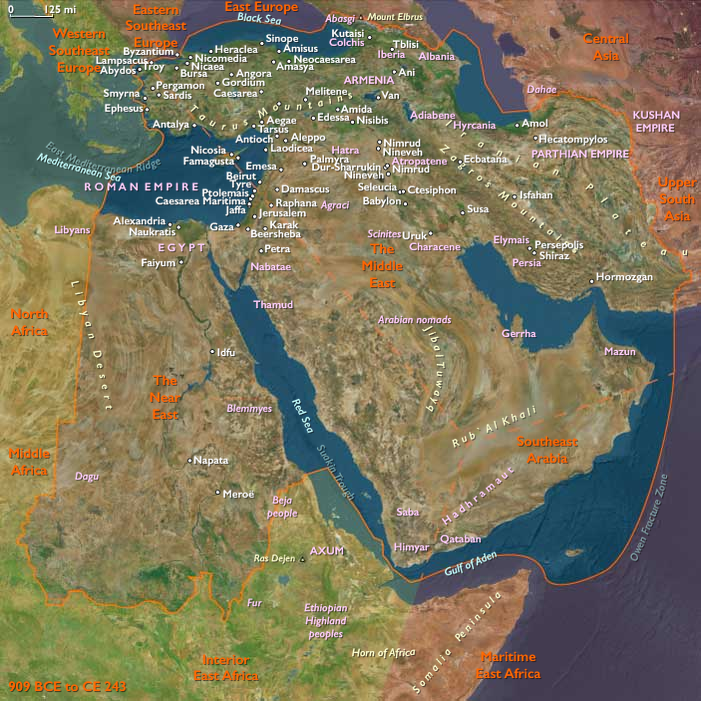
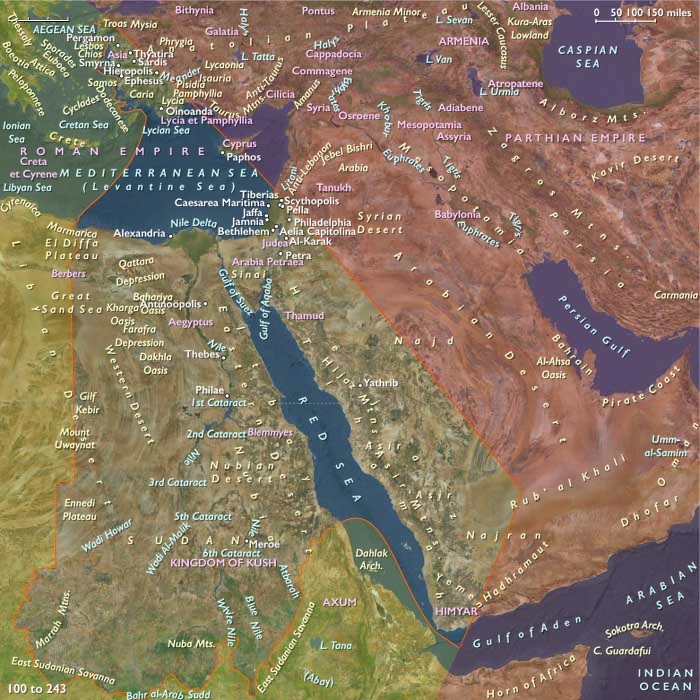
In 213 or 214, Origen had visited Arabia at the request of the prefect, who wished to have an interview with him; and Origen accordingly spent a brief time in Petra, after which he returned to Alexandria.
When the inhabitants of Alexandria heard Caracalla's claims that he had killed his brother Geta in self-defense, they had produced a satire mocking this as well as Caracalla's other pretensions.
Caracalla savagely responds to this insult in 215 by slaughtering the deputation of leading citizens who have unsuspectingly assembled before the city to greet his arrival, and then unleashes his troops for several days of looting and plunder in Alexandria.
According to historian Cassius Dio, over twenty thousand people were killed.
The schools are shut and foreigners expelled.
Locations
People
Groups
Topics
Subjects
Regions
Subregions
Years: 215 - 215
Locations
People
Groups
Topics
Subjects
Regions
Subregions