
Danzig, at this time a largely autonomous, …
Years: 1709 - 1709
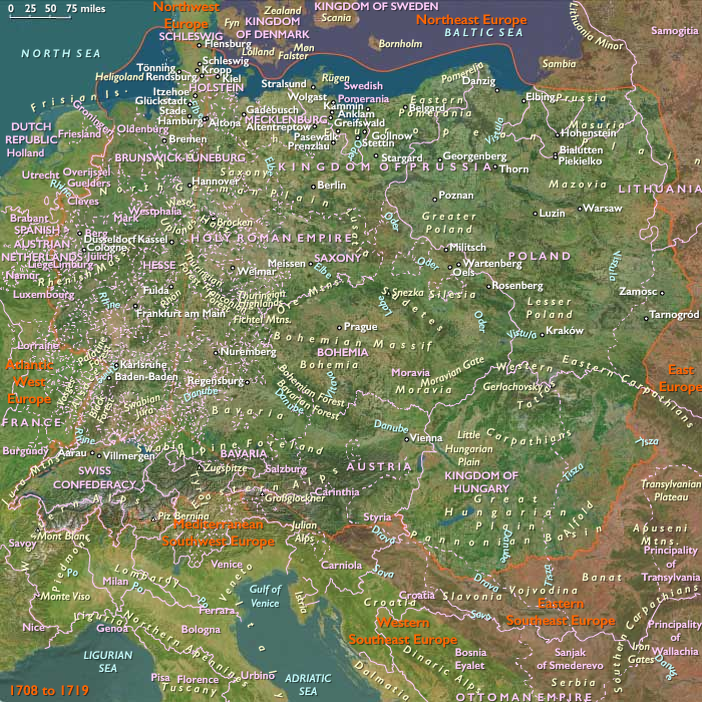
Danzig, at this time a largely autonomous, Protestant and German-speaking town in Polish Royal Prussia, has become one of the greatest towns in the circum-Baltic area due to its position as a hub between Polish trade (via the Vistula) and international trade (via the Baltic Sea).
While it has so far avoided participation in the war, the conflict has affected it indirectly by a reduction of its trade volume, rising taxes and food shortages.
The city council adopts a dual strategy of actively downplaying the plague to the outside world, especially Danzig's trading partners, thus keeping the city open and allowing international and local trade to continue with few restrictions, while at the same time the restrictions on burials are eased due to a coffin shortage and the deaths of many grave diggers, plague (pest) houses and new graveyards are designated, and a "health commission" to organize the anti-plague measures is implemented to, for example, collect weekly reports from the physicians and provide the plague victims with food.
Until the end of May, it seems that the plague will not be as severe, and the health commission's reports are openly accessible.
However, the plague is not contained and spreads from the plague houses to the poorer suburbs and surrounding countryside, and starting in early June the death toll rises significantly.
The health commission's reports are now declared secret.
When the plague fades out by December 1709, never to return to Danzig, the town has lost about half of its inhabitants.
While it has so far avoided participation in the war, the conflict has affected it indirectly by a reduction of its trade volume, rising taxes and food shortages.
The city council adopts a dual strategy of actively downplaying the plague to the outside world, especially Danzig's trading partners, thus keeping the city open and allowing international and local trade to continue with few restrictions, while at the same time the restrictions on burials are eased due to a coffin shortage and the deaths of many grave diggers, plague (pest) houses and new graveyards are designated, and a "health commission" to organize the anti-plague measures is implemented to, for example, collect weekly reports from the physicians and provide the plague victims with food.
Until the end of May, it seems that the plague will not be as severe, and the health commission's reports are openly accessible.
However, the plague is not contained and spreads from the plague houses to the poorer suburbs and surrounding countryside, and starting in early June the death toll rises significantly.
The health commission's reports are now declared secret.
When the plague fades out by December 1709, never to return to Danzig, the town has lost about half of its inhabitants.
Locations
Groups
- Protestantism
- Polish-Lithuanian Commonwealth (Commonwealth of the Two Nations)
- Prussia, Royal (Polish province)
Topics
Subjects
Regions
Subregions
Related Events
Showing 10 events out of 28587 total
Years: 1709 - 1709
Locations
Groups
- Protestantism
- Polish-Lithuanian Commonwealth (Commonwealth of the Two Nations)
- Prussia, Royal (Polish province)
Topics
Subjects
Regions
Subregions