
Hamburg is hit much more severely. When …
Years: 1712 - 1712
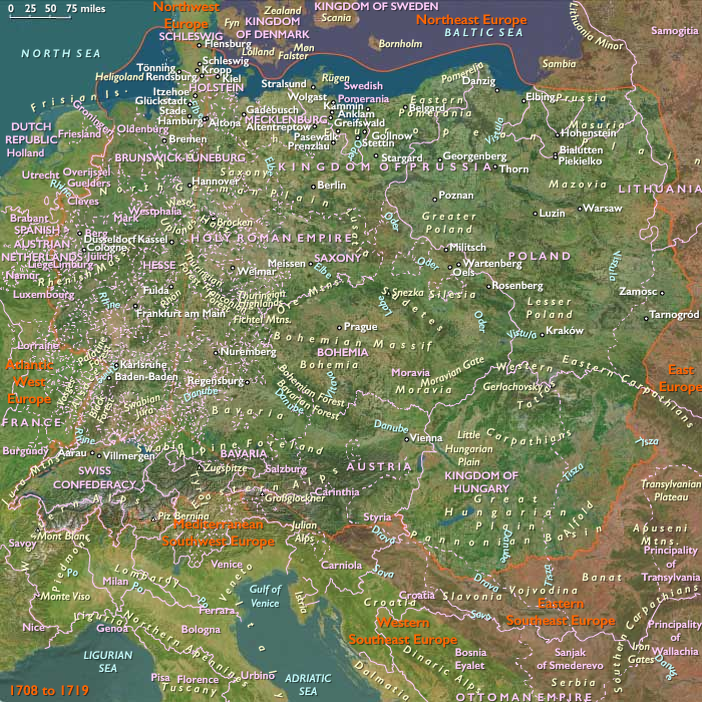
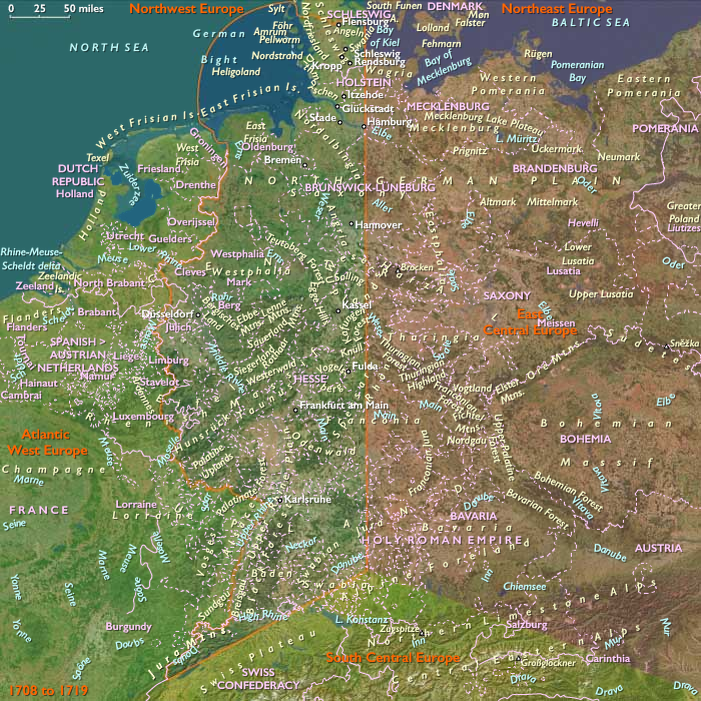
When the plague reaches Pinneberg and Rellingen just north of the Hamburg territory in the summer of 1712, Hamburg restricts travel to the town, which the Danish king uses as a pretext to encircle Hamburg with his forces and confiscate Hamburg vessels on the River Elbe, demanding five hundred thousand thalers (later reduced to two hundred and forty-six thousand thalers) to make up for this alleged discrimination against his subjects in Altona.
Twelve thousand Danish soldiers are moved before Hamburg's gates.
When the plague breaks out in Hamburg less than three weeks later, it is carried there from the Danish troops by a prostitute from Hamburg's Gerkenshof lane, where out of fifty-three people thirty-five fall ill and eighteen die.
The lane is blocked and isolated; however, the quarantine cannot prevent the disease from spreading through the densely built-up neighborhoods.
Among the dead is the plague doctor Majus, who belongs to those physicians who wear a beak-shaped mask containing a vinegar-soaked sponge to protect him against the miasma.
In December, the plague fades out.

Gerhart Altzenbach, Kleidung widder den Todt: Anno 1656 (Habitus Contra Mortem / Un habit contre la Morte), c.1656. The engraving depicts a Roman plague doctor wearing protective clothing – including glass goggles and beak-shaped mask – typical of its time and place. The attire and its purpose are described in Latin, French and German. The image is discussed in G. L. Townsend, ‘The Plague Doctor’, J Hist Med Allied Sci, 20 (1965), 276.
Locations
Groups
Topics
Subjects
Regions
Subregions
Years: 1712 - 1712
Gerhart Altzenbach, Kleidung widder den Todt: Anno 1656 (Habitus Contra Mortem / Un habit contre la Morte), c.1656. The engraving depicts a Roman plague doctor wearing protective clothing – including glass goggles and beak-shaped mask – typical of its time and place. The attire and its purpose are described in Latin, French and German. The image is discussed in G. L. Townsend, ‘The Plague Doctor’, J Hist Med Allied Sci, 20 (1965), 276.
Locations
Groups
Topics
Subjects
Regions
Subregions