
The Annulment of Louis VII and Eleanor …
Years: 1152 - 1152
March
The Annulment of Louis VII and Eleanor of Aquitaine’s Marriage (1152 CE)
The marriage between King Louis VII of France and Eleanor of Aquitaine, once seen as a political triumph for the Capetian dynasty, had long been doomed due to their fundamental incompatibility. Their relationship was further strained by Eleanor’s strong-willed personality, Louis’ deep piety, and their failure to produce a male heir.
Despite Pope Eugenius III’s intervention and an attempt to force reconciliation, the union ultimately collapsed in 1152, ending in an annulment granted at Beaugency.
Papal Efforts to Reconcile the Royal Couple
- Eleanor had hoped for a divorce, but Pope Eugenius III refused, instead confirming the legality of their marriage and proclaiming that it could not be dissolved under any pretext.
- In an effort to repair their fractured relationship, the Pope arranged for Eleanor and Louis to share a bed specially prepared by him, an act that resulted in the conception of their second daughter, Alix of France.
- However, the birth of another daughter instead of a male heir only deepened the tensions between them.
The Road to Annulment
By 1152, their marriage was irreparably broken due to:
-
Lack of a Male Heir
- With only two daughters (Marie and Alix), Louis VII feared that he would die without a son, leaving the Capetian dynasty vulnerable.
- This concern was exacerbated by opposition from many of his barons, who disliked Eleanor’s influence at court.
-
Political and Personal Incompatibility
- Eleanor was free-spirited, politically ambitious, and accustomed to the lively culture of Aquitaine.
- Louis VII, originally trained for monastic life, was deeply pious, reserved, and uncomfortable with courtly excess.
-
Pressure from the Nobility
- Many of Louis’ barons resented Eleanor, especially after the failure of the Second Crusade (1147–1149), where rumors of her alleged affair with Raymond of Poitiers had circulated.
- A growing faction of the French nobility saw Eleanor as a disruptive influence, making the annulment a politically expedient solution.
The Annulment at Beaugency (March 11–21, 1152)
-
On March 11, 1152, Louis VII and Eleanor met at the royal castle of Beaugency to formally dissolve their marriage.
-
The Council of Beaugency was presided over by:
- Archbishop Hugh of Sens, Primate of France (who led the proceedings).
- Archbishops of Bordeaux and Rouen.
- Archbishop Samson of Reims, representing Eleanor.
-
On March 21, 1152, the four archbishops, with the approval of Pope Eugenius III, granted an annulmenton the grounds of consanguinity within the fourth degree.
-
Eleanor and Louis were third cousins, once removed, both descending from Robert II of France, a fact that had not previously prevented their union but was now used as a legal basis for dissolution.
Key Terms of the Annulment
- Their two daughters, Marie and Alix, were declared legitimate and placed under the custody of King Louis VII.
- Eleanor’s vast lands, including Aquitaine, were restored to her, ensuring that she remained an independent and powerful ruler.
- Louis VII swore not to interfere with Eleanor’s lands, as secured by Archbishop Samson of Reims.
The Immediate Consequences
- Eleanor regained full control over Aquitaine, immediately becoming one of the most sought-after heiresses in Europe.
- Louis VII was left without a male heir, which would lead to dynastic instability in France.
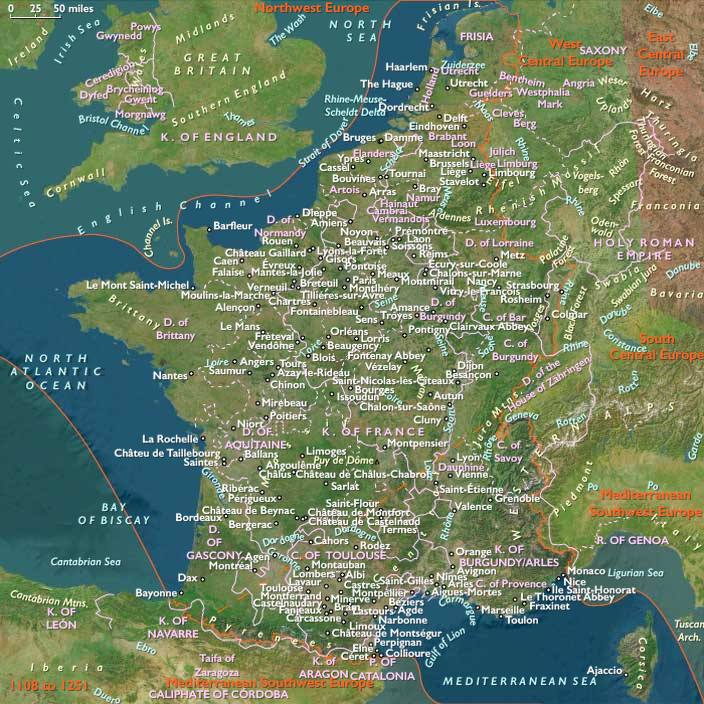
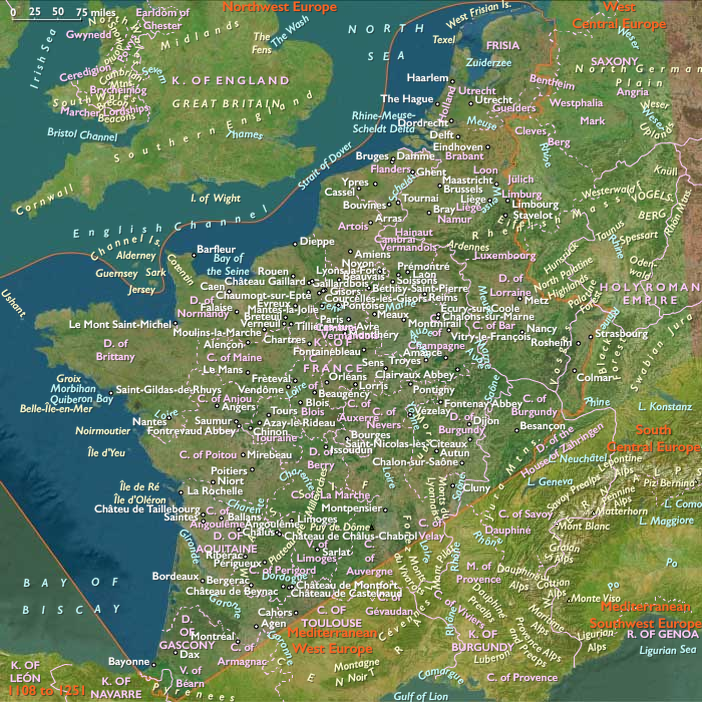
- Just two months later, on May 18, 1152, Eleanor married Henry Plantagenet, Duke of Normandy and Count of Anjou, the future King Henry II of England.
- This marriage united England and Aquitaine, creating the vast Angevin Empire, and placing France in a prolonged conflict with the Plantagenets.
Long-Term Impact
- The annulment reshaped the balance of power in Western Europe, shifting Aquitaine from Capetian to Angevin control.
- It set the stage for the Anglo-French rivalry, which would define European politics for the next three centuries.
- Louis VII eventually remarried, but his failure to secure Aquitaine weakened the Capetian monarchy, forcing his successors to confront the growing dominance of the Plantagenets.
What began as a personal dispute between an ill-matched royal couple ultimately led to one of the most significant political shifts in medieval Europe, influencing the course of English and French history for generations to come.
Locations
People
Groups
- Anjou, County of
- Normandy, Duchy of
- Aquitaine, (Angevin) Duchy of
- France, (Capetian) Kingdom of
- Christians, Roman Catholic
- England, (Norman) Kingdom of
Topics
Commodoties
Subjects
Regions
Subregions
Related Events
Showing 10 events out of 48687 total
Years: 1152 - 1152
March
Locations
People
Groups
- Anjou, County of
- Normandy, Duchy of
- Aquitaine, (Angevin) Duchy of
- France, (Capetian) Kingdom of
- Christians, Roman Catholic
- England, (Norman) Kingdom of
Topics
Commodoties
Subjects
Regions
Subregions