A cuneiform script is in use in …
Years: 3213BCE - 3070BCE
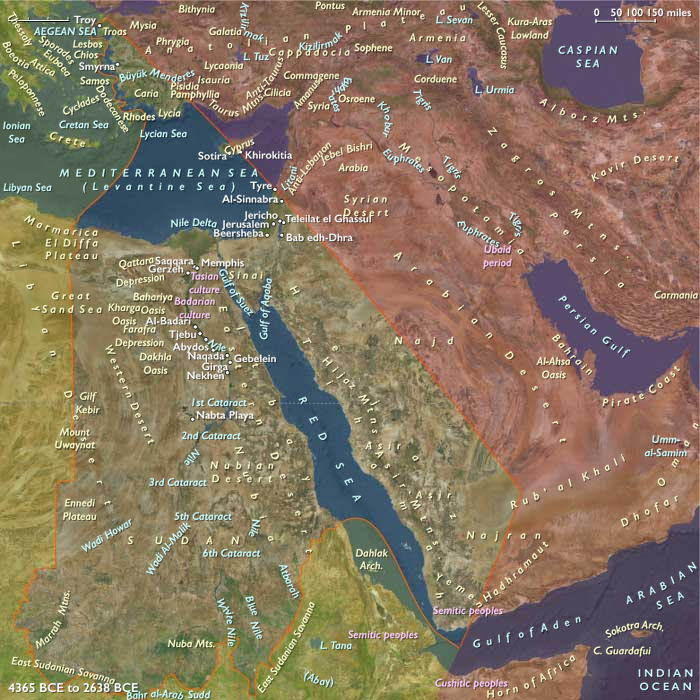
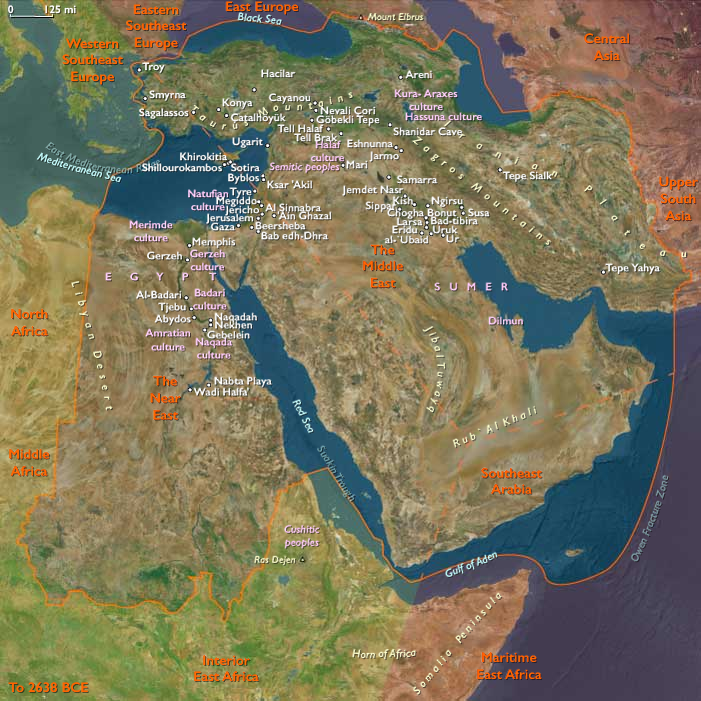
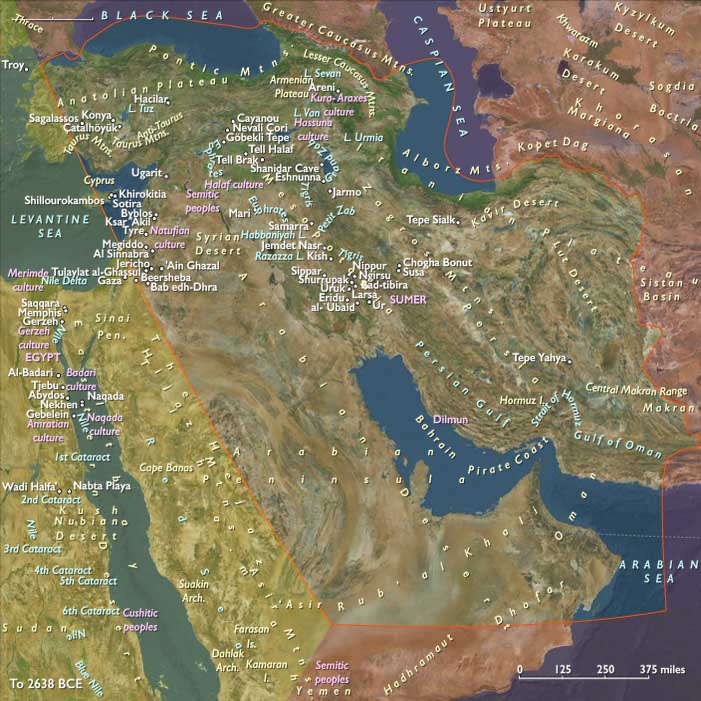
A cuneiform script is in use in Sumer by 3200 BCE, by which time writing has spread from Mesopotamia to the Egyptians in the west and to the Elamites of southwestern Iran.
Groups
- Mesopotamia
- Egyptians
- Egypt (Ancient), Predynastic
- Sumer
- Proto-Elamite period
- Egypt (Ancient), Protodynastic or Semainian (Naqada III)
- Egypt (Ancient), Early Dynastic
Topics
- Subboreal Period during the Neolithic Subpluvial
- Early Bronze Age I (Near and Middle East)
- Piora Oscillation ending the Neolithic Subpluvial
- Subboreal Period
Commodoties
Subjects
- Watercraft
- Sculpture
- Environment
- Faith
- Government
- Technology
- Invention
- Metallurgy
- Anthropology
- Archaeology
- Theology
Regions
Subregions
Related Events
Filter results
Showing 10 events out of 68717 total
The Piora Oscillation: A Sudden Cold and Wet Event in the Holocene (c. 3200–2900 BCE)
The Piora Oscillation was an abrupt cold and wet climatic event occurring between c. 3200 BCE and 2900 BCE, marking one of the most significant climate disruptions of the late Neolithic and early Bronze Age.
Discovery and Alpine Evidence
- Named after Val Piora (Piora Valley) in Switzerland, where it was first detected.
- Some of the most dramatic evidence comes from the Alps, where:
- Glaciers advanced for the first time since the Holocene Climatic Optimum.
- The Alpine tree line dropped by 100 meters, signaling a shift to colder conditions.
Global Climatic Impact
The Piora Oscillation was not confined to Europe—it had far-reaching consequences across multiple continents:
- North America:
- The New England region saw a dramatic decline in hemlock and elm trees, suggesting environmental stress.
- California and Other Regions:
- Similar changes in flora occurred, with some shifts proving permanent.
- Near East:
- The Dead Sea’s water level rose by nearly 100 meters (300 feet) before receding to a more usual level, indicating major hydrological fluctuations in the region.
Potential Effects on Human Societies
- Agricultural Disruptions – Cooler, wetter conditions may have affected early farming communities, altering crop yields and settlement patterns.
- Migration and Cultural Shifts – The climate instability may have triggered human migrations or cultural adaptations, particularly in early Bronze Age societies.
- Flooding and Hydrological Changes – Rising water levels in key regions could have influenced river-based civilizations, such as those in Mesopotamia and the Levant.
The Piora Oscillation serves as an example of how abrupt climate change events have historically shaped human and environmental development, demonstrating the complex interplay between climate, ecosystems, and civilization.
The first hints to the existence of skis are on forty-five hundred to five thousand year old rock drawings, e.g., at Rødøy in Norway (discovered 1933) or at Steinkjer (discovered 2001), which depict a man on skis holding a stick.
The oldest known ski, Kalvträskskidan was found in 1924 in a mire near the village of Kalvträsk in the municipality of Skellefteå, Sweden, and has been carbon dated to roughly 3200 BCE.
The earliest people to ski in Fennoscandia were the distant ancestors of modern day Sami.
Chalcolithic technology has spread from the Middle East into Central Europe.
The relics contained within the burial site known as the Varna Necropolis, accidentally discovered in October 1972 in the western industrial part of Varna (approximately half a kilometer from Lake Varna), Bulgaria, are believed to be the oldest examples of worked gold in the world.
Many of the two hundred and ninety-four graves found in the necropolis contain sophisticated examples of metallurgy (gold in particular).
The graves have been dated to 3200-3000 BCE.
The corpses within were found in various positions: on their sides with knees bent, on their backs, and others being merely a symbolic cenotaph.
Interestingly, the symbolic (empty) graves are the richest in gold artifacts.
Three thousand golden artifacts were found, with a weight of approximately six kilograms.
One grave contained more gold than has been found in the entire rest of the world for this epoch.
The Middle East (3213–3070 BCE): Cuneiform Script and Urban Peak at Uruk
Development and Spread of Cuneiform Writing
By 3200 BCE, the development of cuneiform script marked a significant advancement in Sumerian society, transforming administrative, economic, and cultural practices. This innovative writing system rapidly spread beyond Mesopotamia, influencing cultures such as the Egyptians to the west and the Elamites in southwestern Iran, highlighting a critical phase in the early history of written communication.
Theocratic Governance and Social Organization
During the Uruk period, Sumerian cities likely operated under a theocratic form of governance, typically headed by a priest-king known as an ensi. These leaders were assisted by councils of elders comprising both men and women, suggesting a relatively inclusive governance structure. Scholars propose that the later Sumerian pantheon may have been modeled after these political and social arrangements, reflecting the societal values and organizational principles of the time.
Absence of Institutionalized Violence
Notably, archaeological evidence indicates minimal institutionalized violence or standing armies during this era, with few towns showing evidence of defensive walls. This lack of militarization suggests that the period was characterized more by peaceful urban development and communal stability rather than by military aggression.
Uruk’s Urban Apex
Uruk reached unprecedented levels of urbanization during this time, becoming the most populous city in the world, surpassing fifty thousand inhabitants for the first time. Its growth was underpinned by advanced agricultural techniques, efficient administration, and robust trade networks, firmly establishing Uruk as a preeminent center of civilization in ancient Mesopotamia.
Continuing Technological Advancements
Technological advancements continued to flourish, particularly in metallurgy, where improved bronze manufacturing enhanced economic productivity and craftsmanship, further strengthening urban economies and facilitating regional trade.
This era highlights critical advancements in writing, governance, urbanization, and technology, underscoring a significant moment in the cultural and societal evolution of the ancient Middle East.
Sumerian cities during the Uruk period are probably theocratic and are most likely headed by a priest-king (ensi), assisted by a council of elders, including both men and women.
It is quite possible that the later Sumerian pantheon was modeled upon this political structure.
There is little evidence of institutionalized violence or professional soldiers during the Uruk period, and towns are generally not walled.
Uruk becomes the most urbanized city in the world during this period, surpassing fifty thousand inhabitants for the first time.
Elam, an ancient name for the region of southwestern Iran known today as Khuzestan, leads a more or less independent cultural existence in the fourth millennium BCE.
The Proto-Elamite period is the time of about 3200 BCE to 2700 BCE, when Susa, the later capital of the Elamites, began to receive influence from the cultures of the Iranian plateau.
In archaeological terms, this corresponds to the late Banesh period.
This civilization is recognized as the oldest in Iran and was largely contemporary with the neighboring Sumerian civilization, the oldest in the world, which began around 3400 BCE.
The Proto-Elamite script is an Early Bronze Age writing system briefly in use for the ancient Elamite language before the introduction of Elamite Cuneiform.
Texts in the undeciphered Proto-Elamite script found in Susa are dated to the late fourth millennium.
It is thought that the Proto-Elamites were in fact Elamites (Elamite speakers), because of the many cultural similarities (for example, the building of ziggurats), and because no large-scale migration to this area seems to have occurred between the Proto-Elamite period and the later Elamites.
Because their script is yet to be deciphered, this theory remains uncertain.
Land transport vehicles in Sumer include sledges and the earliest known wheeled carts, which appear around 3150, representing the first use of the wheel for transportation.
A clay tablet from the period 3200—3100 (found by twentieth century archaeologists in the courtyard of the Eanna Temple in Uruk) contains a pictograph of a wheeled cart.
The Sumerians in the fourth millennium BCE develop the interior courtyard, leaving bare the outer walls of the mudbrick courtyard houses; the interior of the enclosure contains a square courtyard.
The use of a courtyard indicates that the Sumerians now consider a house to be a place of privacy as well as of shelter.
The Uruk period proper corresponds to the layers Uruk XIV–IV, with the late phase Uruk IV lasting from about 3300 BCE to about 3100 BCE.
The end of the Uruk period coincides with the Piora oscillation, a dry period from about 3200 BCE to around 2900 BCE that marks the end of a long wetter, warmer climate period from about nine thousand to five thousand years ago, called the Holocene climatic optimum.
Mesopotamian peoples worship nature gods in human form, each god having a city temple consecrated to him, or her.
The gods of the cities form a democratic council, or pantheon, and reflect political relations between the nation-states.
Mesopotamia’s four main gods are Anu, the supreme god of heaven; Enlil, god of the winds; Ninhursag, goddess of earth and mother goddess, and Enki, or Ea, god of the waters.
Inanna, who can be considered the most prominent female deity in ancient Mesopotamia, was associated with the city of Uruk as early as the Uruk period (around 4000 to 3100 BCE).
Years: 3213BCE - 3070BCE
Groups
- Mesopotamia
- Egyptians
- Egypt (Ancient), Predynastic
- Sumer
- Proto-Elamite period
- Egypt (Ancient), Protodynastic or Semainian (Naqada III)
- Egypt (Ancient), Early Dynastic
Topics
- Subboreal Period during the Neolithic Subpluvial
- Early Bronze Age I (Near and Middle East)
- Piora Oscillation ending the Neolithic Subpluvial
- Subboreal Period
Commodoties
Subjects
- Watercraft
- Sculpture
- Environment
- Faith
- Government
- Technology
- Invention
- Metallurgy
- Anthropology
- Archaeology
- Theology