
The picture is less clear on the …
Years: 533 - 533
August
The picture is less clear on the Vandal side.
The Vandal army is not a professional and mostly volunteer force like the East Roman army, but comprises every able-bodied male of the Vandal people.
Hence, modern estimates on the available forces vary along with estimates on the total Vandal population, from a high of between thirty thousand and forty thousand men out of a total Vandal population of at most two hundred thousand people (Diehl and Bury), to as few as twenty-five thousand men—or even twenty thousand, if their losses against the Moors are taken into account—for a population base of one hundred thousand (Hughes).
Despite their martial reputation, the Vandals have grown less warlike over time, having come to lead a luxurious life amid the riches of Africa.
In addition, their mode of fighting is ill suited to confronting Belisarius' veterans: the Vandal army is composed exclusively of cavalry, lightly armored and armed only for hand-to-hand combat, to the point of neglecting entirely the use of bows or javelins, in stark contrast to Belisarius' heavily armored cataphracts and horse archers.
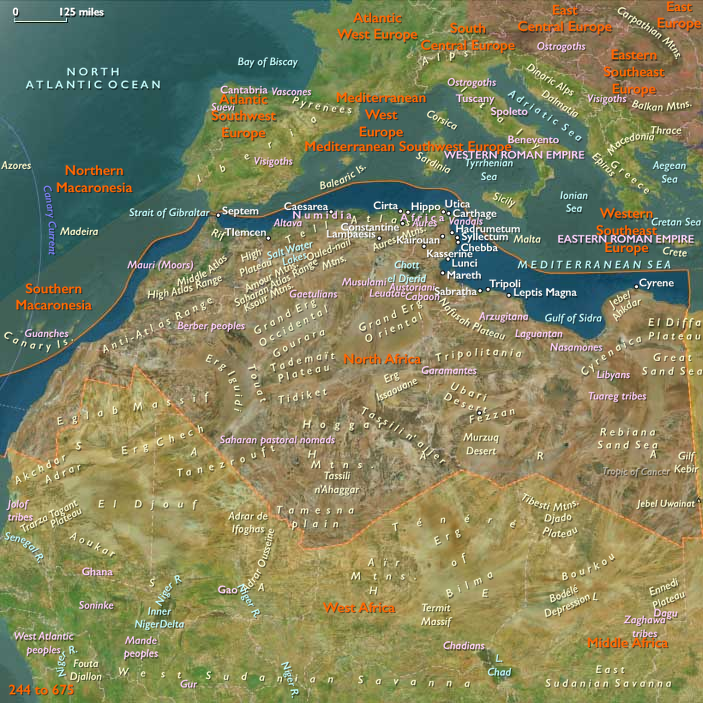
The Vandals are also weakened by the hostility of its Roman subjects, the continued existence among the Vandals of a faction loyal to Hilderic, and by the ambivalent position of the Moorish tribes, who watch the oncoming conflict from the sidelines, ready to join the victor and seize the spoils.
Locations
People
Groups
- Goths (East Germanic tribe)
- Heruli (East Germanic tribe)
- Christianity, Arian
- Moors
- Vandals and the Alans, Kingdom of the
- Christianity, Chalcedonian
- Ostrogoths, Italian Kingdom of the
- Roman Empire, Eastern: Justinian dynasty
Topics
Commodoties
Subjects
- Commerce
- Watercraft
- Environment
- Labor and Service
- Conflict
- Faith
- Government
- Scholarship
- Custom and Law
- Technology
- Movements
Regions
Subregions
Years: 533 - 533
August
Locations
People
Groups
- Goths (East Germanic tribe)
- Heruli (East Germanic tribe)
- Christianity, Arian
- Moors
- Vandals and the Alans, Kingdom of the
- Christianity, Chalcedonian
- Ostrogoths, Italian Kingdom of the
- Roman Empire, Eastern: Justinian dynasty
Topics
Commodoties
Subjects
- Commerce
- Watercraft
- Environment
- Labor and Service
- Conflict
- Faith
- Government
- Scholarship
- Custom and Law
- Technology
- Movements
Regions
Subregions