
De Materia Medica is the premiere historical …
Years: 64 - 75
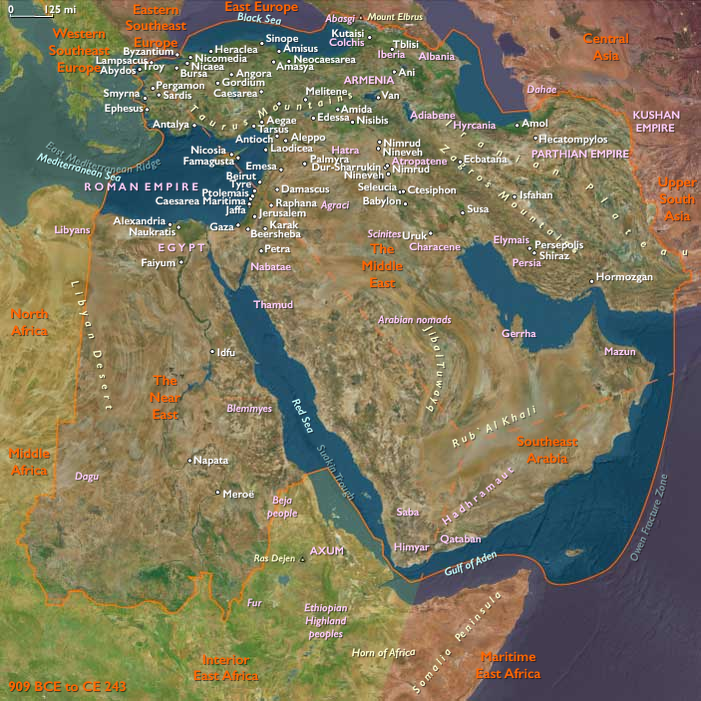
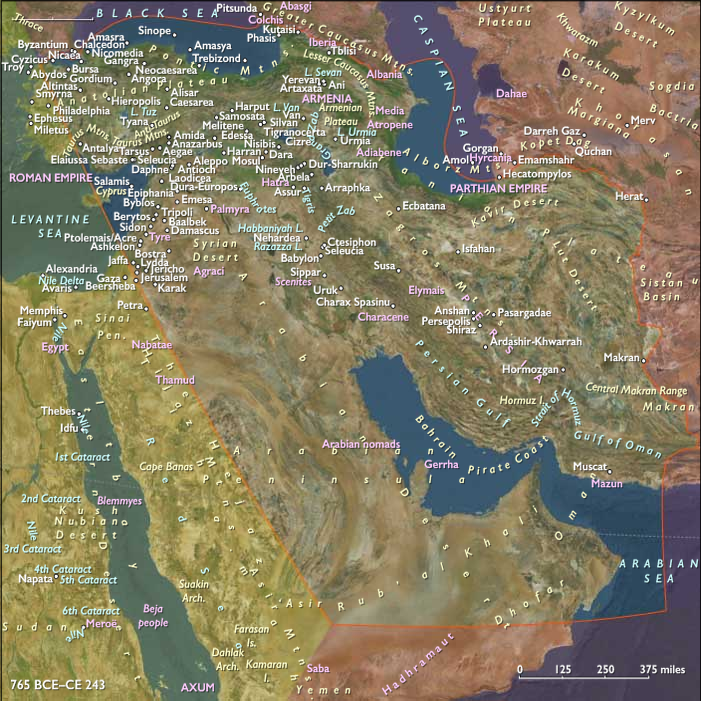
Complied between 50 and 70 CE by the physician Pedanius Dioscorides, a native of Anazarbus, Cilicia, Asia Minor, he has written a five-volume book in his native Greek, known in English by its Latin title De Materia Medica ("Regarding Medical Materials").
The oldest surviving text on drugs and their use, the work also records the Dacian and Thracian names for some plants, which otherwise would have been lost.
Dioscorides describes drugs of plant, animal, and mineral origin and give information on drug dosage, administration, and specific uses.
Locations
People
Groups
Topics
Commodoties
Subjects
Regions
Subregions
Related Events
Filter results
Showing 10 events out of 202 total
The Migration Period (c. 300–700 CE): The Transition from Late Antiquity to the Early Middle Ages
The Migration Period, also known as the Völkerwanderung ("wandering of peoples"), was a major human migration that took place in Europe between roughly 300 and 700 CE, marking the transition from Late Antiquity to the Early Middle Ages. From the Roman and Greek perspective, it is often referred to as the "Barbarian Invasions."
Causes of the Migration
Several factors contributed to the mass movement of peoples across Europe:
-
The Hunnic Incursions (4th–5th centuries)
- The Huns, a nomadic people possibly of Turkic or Mongolic origin, swept into Eastern Europe from Central Asia.
- Their advance forced Germanic and other tribes to flee westward, triggering further migrations.
-
Turkic and Steppe Migrations
- The early Turkic expansion and shifting power dynamics in Central Asia contributed to displacements among nomadic groups.
-
Population Pressures and Climate Change
- Environmental changes and resource depletion in certain regions may have compelled migrations.
- Overpopulation or crop failures in northern Europe might have prompted tribes to seek new lands.
Key Migratory Groups and Their Impact
- Goths – Split into Visigoths and Ostrogoths, they played key roles in the fall of the Western Roman Empire.
- Vandals – Migrated through Gaul and Spain, eventually sacking Rome in 455 CE before establishing a kingdom in North Africa.
- Suebi – Settled in northwestern Iberia, forming the Kingdom of Galicia (modern Portugal and Spain).
- Franks – Established the Frankish Kingdom, which evolved into modern France and Germany.
- Bulgars, Slavs, and Alans – Entered the Balkans and Eastern Europe, reshaping its ethnic and linguistic landscape.
Continuation of Migrations Beyond 700 CE
Migrations did not stop in 700 CE; instead, successive waves of nomadic and Slavic peoples continued reshaping Europe:
- Slavs – Expanded across Central and Eastern Europe, influencing later Slavic nations.
- Avars, Bulgars, and Hungarians – Established powerful steppe empires in Eastern Europe.
- Pechenegs, Cumans, and Tatars – Continued nomadic invasions into Byzantium and Kievan Rus’ in the medieval period.
Significance of the Migration Period
- Led to the decline of the Western Roman Empire (476 CE) and the foundation of early medieval European kingdoms.
- Marked the cultural and linguistic transformation of Europe, laying the groundwork for medieval political structures.
- Accelerated the fusion of Roman, Germanic, and steppe influences, which defined the social, legal, and economic systems of medieval Europe.
The Migration Period was a defining era in European history, setting the stage for feudal societies, the rise of new kingdoms, and the shaping of modern European nations.
East Europe (244–387 CE): Gothic Migration and the Rise of New Powers
Political and Military Developments
Migration and Settlement of the Goths
Between 244 and 387 CE, the Goths, originally from northern Europe, migrated southeastward into the territories of East Europe, significantly impacting regional power dynamics. This migration introduced new military and cultural pressures, profoundly reshaping existing Sarmatian and local tribal structures.
Decline of Sarmatian Influence
The arrival and expansion of Gothic tribes significantly challenged and reduced the dominance of the Sarmatians in the Pontic–Caspian steppe. Military confrontations led to territorial shifts, ultimately resulting in diminished Sarmatian political control.
Economic and Technological Developments
Shift in Trade Networks
The Goths actively participated in existing Eurasian trade networks, leading to shifts in trade routes and economic interactions. Commerce continued, though increasingly influenced by Gothic demands and territorial realignments.
Adaptations in Military Technology
Military encounters between Goths, Romans, and local tribes drove continued innovations in warfare, particularly in infantry and cavalry tactics. Gothic forces effectively combined traditional northern European methods with adapted Roman and Sarmatian techniques.
Cultural and Artistic Developments
Rise of Gothic Artistic Traditions
Gothic migrations introduced northern European artistic styles into East Europe, blending with established Sarmatian and Roman traditions. This fusion resulted in distinctive Gothic metalwork, jewelry, and ceremonial artifacts, characterized by bold geometric patterns and animal motifs.
Continued Roman Cultural Influence
Interactions with the Roman Empire continued to shape regional cultural expressions, evident in architectural influences, urban planning, and burial practices. The exchange of artistic traditions between Goths, Romans, and local populations enriched regional diversity.
Settlement Patterns and Urban Development
Gothic Settlement and Urban Expansion
The Goths established new settlements and revitalized existing urban centers, promoting growth in areas previously underdeveloped or marginal. Cities and fortified settlements grew along strategic locations and trade corridors.
Flourishing of Chernyakhov Culture
The Chernyakhov culture flourished during this period, marking extensive Gothic and local tribal settlements across large areas of present-day Ukraine, Moldova, and adjacent regions. The culture represented a peak of socio-economic complexity, integrating diverse populations and traditions.
Social and Religious Developments
Emerging Gothic Social Structures
Gothic society exhibited distinct hierarchical structures, influenced by interactions with Roman and Sarmatian traditions. Leaders and warrior elites were prominently recognized through lavish burials, ornate personal adornments, and ceremonial weaponry.
Religious Shifts and Syncretism
The religious landscape became more diverse, with the introduction of Gothic pagan practices alongside existing syncretic traditions influenced by Roman, Greek, and Iranian beliefs. Gradual Christianization began to affect Gothic tribes, further diversifying religious practices in East Europe.
Long-Term Consequences and Historical Significance
The era from 244 to 387 CE marked a major transformation in East Europe's historical narrative, driven by Gothic migrations and interactions with existing powers. The resulting cultural, economic, and political shifts laid essential groundwork for subsequent historical developments, significantly influencing the region's evolution into the late antique and early medieval periods.
The Growth of Christianity in the Roman Empire and Its Relationship with Judaism
During the early centuries of the Common Era, Christianity gradually gained a foothold in the Roman Empire, evolving from a small sect of Judaism into a distinct religious movement. As Christianity spread, its leaders sought to establish a universal message that appealed to a wider audience beyond the Jewish community.
Christianity’s Interpretation of the Hebrew Bible
-
Early Christian theologians reinterpreted the Hebrew Bible (which they termed the “Old Testament”) as a precursor to the New Testament, claiming that:
- The laws and prophecies of the Old Testament were fulfilled through Jesus Christ.
- Christian believers—both Jews and Gentiles—represented the new Israel, spiritually and physically.
-
This reinterpretation positioned Christianity as the continuation and fulfillment of Jewish tradition, differentiating it from Judaism, which maintained its adherence to Mosaic Law and awaited a different messianic fulfillment.
Christian Views on Jewish Exile and Survival
-
Many early Christians interpreted the Jewish exile as a divine punishment, believing it was a consequence of:
- The Jews’ rejection of Jesus as the Messiah.
- Their perceived role in his crucifixion, an accusation that contributed to Christian anti-Judaism in later centuries.
-
At the same time, the continued survival of Judaism, despite exile and persecution, puzzled many early Christians.
- Some saw Jewish endurance as stubborn defiance of divine will.
- Others, such as Augustine of Hippo, later argued that the Jewish people were preserved by God as “witnesses” to the validity of Christian prophecy, even in their dispersion.
Impact on Christian-Jewish Relations
-
As Christianity became the dominant religion of the Roman Empire, tensions with Jewish communities intensified.
-
Christian leaders sought to differentiate their faith from Judaism, leading to:
- Theological disputes over the interpretation of scripture.
- Legal restrictions on Jewish practices under Christianized Roman rule.
- The development of Christian supersessionism, the belief that Christianity had replaced Judaism in God’s covenant.
-
Despite opposition, Judaism survived and continued to develop, leading to a complex and often strained relationship between the two religious traditions throughout Late Antiquity and the Middle Ages.
Conclusion: Christianity’s Rise and Its Effects on Jewish Identity
The early growth of Christianity in the Roman Empire involved reinterpretations of Jewish scripture, shaping its self-identity as the “new Israel”. However, Jewish persistence despite exile challenged Christian theological narratives, leading to centuries of debate, tension, and periodic persecution. This dynamic profoundly influenced religious thought and interfaith relations throughout history.
The Roman Empire is plagued by internal strife and economic crisis in the third century CE. Two ethnic Illyrian emperors, both born in Southeastern Europe, take decisive steps to prolong the empire’s survival.
- Emperor Diocletian, born in Dalmatia, implements strong central control, establishes a bureaucratic system, and abolishes the last remnants of Roman republican institutions. In an effort to strengthen loyalty to the state, he launches a persecution of Christians, seeking to reduce their allegiance to the church.
- Emperor Constantine, born near Naissus (modern Niš, Serbia), reunites the empire after years of turmoil, introduces dynastic succession, and in 330 CE, founds a new capital at Byzantium, later named Constantinople. He also legalizes Christianity, marking a pivotal shift in Roman religious policy.
Eastern Southeast Europe (244–387 CE): Imperial Challenges and Transformations
Settlement and Migration Patterns
Intensified Migration and Border Conflicts
Between 244 and 387 CE, Eastern Southeast Europe experienced increased migration pressures and border conflicts. Gothic tribes, notably under leaders such as Cniva, increasingly tested the region’s northern borders, dramatically impacting settlement patterns. In 251 CE, Cniva conquered Philippopolis (modern-day Plovdiv) and killed Roman Emperor Decius and his son at the Battle of Abritus—the first Roman emperor to fall in combat against barbarians. Emperor Aurelian, facing ongoing invasions, ordered a strategic withdrawal from Roman Dacia in 271 CE, relocating Roman troops, officials, and colonists south of the Danube. Many Dacian peasants, however, remained, preserving cultural continuity and influencing future settlement patterns.
Urban Fortification and Adaptation
In response to these increasing pressures, urban centers intensified their fortification efforts. Key cities such as Byzantium (Constantinople), Philippopolis, and especially Serdica (modern-day Sofia) fortified extensively. Serdica flourished as a significant administrative and trading center. The division of the Roman Empire in 395 CE, enacted by Emperor Theodosius’ sons, further solidified regional defense strategies, marking a permanent administrative and cultural separation between Greek-speaking Constantinople and Latin-speaking Rome, profoundly affecting future regional identities.
Economic and Technological Developments
Economic Resilience Amidst Disruptions
Despite external disruptions from frequent invasions, regional economic activities exhibited notable resilience. Agricultural productivity, mining (particularly gold and silver), and trade networks continued functioning effectively, though occasionally compromised by migration and conflict. The Romans actively maintained critical infrastructure, sustaining roads connecting fortresses, mining centers, and trade hubs, thereby ensuring economic continuity.
Defensive Infrastructure and Military Adaptation
Technological advancements primarily focused on military defense and infrastructure development. Enhanced fortifications, improved roads, and robust logistical networks were maintained and expanded to secure military effectiveness. Strategic adjustments such as the abandonment of northern provinces (Dacia) signaled a shift toward consolidating defensible frontiers along the Danube, laying the groundwork for subsequent Byzantine military strategies.
Cultural and Artistic Developments
Cultural Continuity and Artistic Adaptation
Despite disruptions, artistic and cultural traditions endured, adapting to reflect contemporary themes of imperial resilience, spirituality, and stability. Urban centers preserved Greco-Roman heritage through continued patronage of public art, architecture, and monuments, gradually blending these traditions with emerging Christian iconography, notably within urban centers such as Constantinople and Philippopolis.
Intellectual Vitality and the Preservation of Learning
Intellectual and educational pursuits flourished in major cities. The establishment of a university at Constantinople by Theodosius II in 425 (though slightly after this age, its roots lie in this period's intellectual environment) emphasized the ongoing commitment to classical and philosophical learning, fostering scholarly activities and laying foundations for Byzantine intellectual life.
Social and Religious Developments
Administrative Reorganization and Governance Shifts
The empire underwent significant governance shifts due to ongoing external pressures. Diocletian’s administrative reorganization in 285 CE created distinct spheres of jurisdiction between the Greek-speaking East and the Latin-speaking West, fundamentally reshaping regional governance. The relocation of the imperial capital by Emperor Constantine to Byzantium (renamed Constantinople) in 330 CE further strengthened administrative control, making Constantinople a pivotal center for regional governance and military command.
Spread and Institutionalization of Christianity
Christianity’s influence expanded significantly during this era, particularly following official toleration under the Edict of Milan (313 CE). Churches, monastic communities, and theological institutions proliferated throughout Eastern Southeast Europe, embedding Christianity deeply within the region’s social fabric. Constantinople emerged as a central religious hub, where an established patriarchate exercised ecclesiastical authority over the Greek East, laying essential groundwork for future religious developments and theological debates.
Long-Term Consequences and Historical Significance
The period from 244 to 387 CE proved transformative for Eastern Southeast Europe. Intensified migrations, strategic territorial adjustments, administrative reorganizations, and the growing dominance of Christianity deeply impacted regional development. These changes established critical frameworks and traditions that significantly influenced the subsequent historical evolution of the Byzantine Empire, leaving a lasting imprint on regional identity, governance, and culture.
The land now known as Bulgaria had attracted human settlement as early as the Bronze Age.
Almost from the first, however, existing civilizations had been challenged by powerful neighbors.
The first known civilization to dominate the territory of present- day Bulgaria was that of the Thracians, an Indo-European group.
Although politically fragmented, Thracian society is considered to have been comparable to that of Greece in the arts and economics; these achievements had reached a peak in the sixth century BCE.
Because of political disunity, however, Thrace then had been successively occupied and divided by the Greeks, the Persians, the Macedonians, and the Romans.
After the decline of the Macedonian Empire of Alexander the Great, a new Thracian kingdom had emerged in the third century BCE.
Occupied by the Romans, it had remained a kingdom within the Roman Empire until the emperor Vespasian incorporated it as a district in the first century CE.
Roman domination has brought orderly administration and the establishment of Serditsa (on the site of modern Sofia) as a major trading center in the Balkans.
In the fourth century CE, when the Roman Empire splits between Rome and Constantinople, Thrace becomes part of the Eastern, or Byzantine, Empire.
Christianity is introduced to the region at this time.
Both the Latin culture of Rome and the Greek culture of Constantinople will remain strong influences on ensuing civilizations.
Christianity had been introduced to Anatolia through the missionary activity of Saint Paul, a Greek-speaking Jew from Tarsus in Cilicia, and his companions.
Christians possibly even constitute a majority of the population in most of Anatolia by the time Christianity is granted official toleration under the Edict of Milan in CE 313.
A patriarchate is established before the end of the fourth century in Constantinople, with ecclesiastical jurisdiction over much of the Greek East.
The emperor Diocletian undertakes the reorganization of the Roman Empire in 285, dividing jurisdiction between its Latin-speaking and Greek-speaking halves.
Diocletian's successor, Constantine, establishes his capital in 330 at the Greek city of Byzantium, a "New Rome" strategically situated on the European side of the Bosporus at its entrance to the Sea of Marmara.
The city, embellished and renamed Constantinople, will for nearly twelve centuries remain the capital of the Roman Empire—better known in its continuous development in the East as the Byzantine Empire.
The Middle East: 244–387 CE
Rise of the Sassanid Empire and Persistent Roman Rivalries
The period from 244 to 387 CE in the Middle East is marked by the decline of the Parthian Empire and the rise of the Sassanid Empire, reshaping the political, cultural, and religious landscape. Ardashir I, son of the priest Papak and claiming descent from the legendary hero Sasan, overthrows the last Parthian king in 224 CE and establishes the Sassanid dynasty, which endures for four centuries. Ardashir and his successors reassert Iranian cultural traditions, deliberately distancing themselves from previous Greek influences by fostering a national Persian renaissance.
Under Sassanid rule, the empire approximates the frontiers of the ancient Achaemenid Empire, with its capital established at Ctesiphon. Sassanian rulers adopt the title shahanshah (king of kings), governing numerous local rulers (shahrdars). Persian society is rigidly structured into four primary classes: priests, warriors, secretaries, and commoners, with powerful priests (led by the mobadan mobad), military leaders (eran spahbod), and bureaucratic officials reinforcing this social stratification.
Military Confrontations with Rome
The Roman Empire remains Persia's principal western adversary, inheriting the rivalry from the Greeks. Emperor Shapur I (241–272) conducts successful military campaigns against Rome, culminating in the capture of Emperor Valerian in 260 CE at the Battle of Edessa, symbolizing a high point of Persian military achievement.
However, the fortunes of war fluctuate significantly over this period. Roman Emperor Carus sacks Ctesiphon in 283, temporarily weakening Persian dominance. Under Emperor Diocletian, Roman forces achieve a decisive victory in 298 at the Battle of Satala, reclaiming extensive territories and exerting renewed control over Armenia. Despite these setbacks, the Sassanians retain substantial power, sustaining intermittent hostilities with Rome, notably under Shapur II (309–379), who captures Armenia and repeatedly confronts Emperor Constantius II.
The drawn-out Roman–Sassanian confrontations, epitomized by engagements at Singara and multiple sieges of the fortress city of Nisibis, underscore the sustained strategic rivalry. A notable truce occurs in 387 CE with the Peace of Acilisene, partitioning Armenia into Roman and Persian spheres of influence, temporarily stabilizing the contested frontier.
Religious Transformations and Christianity’s Spread
Religious and cultural transformations are equally significant during this era. Armenia, influenced by early Christian centers like Antioch and Edessa, officially adopts Christianity as its state religion in approximately 306 CE under King Tiridates III, credited to the miracles performed by Saint Gregory the Illuminator. This conversion precedes Emperor Constantine’s legalization of Christianity within the Roman Empire. Similarly, Georgian King Mirian III converts in 330 CE, aligning Georgia culturally and politically with the Byzantine Empire.
Christianity also thrives in Cyprus, bolstered by the legacy of apostles like Paul and Barnabas. Roman rule brings economic prosperity and infrastructure advancements to the island, despite periodic devastation from earthquakes that continually diminish the grandeur of cities like Salamis.
Sassanian Cultural Influence and Economic Expansion
Sassanian Persia’s influence extends significantly across the Persian Gulf, reaching its apex during this period. Persian authorities establish agricultural colonies in Oman, employing local nomadic tribes as border guards against Roman incursions, promoting Persian agricultural practices, irrigation techniques, and Zoroastrian beliefs. Zoroastrianism, Persia's state religion, reinforces Sassanian rule, elevating the priestly class to a powerful political force.
Urban Prosperity and Cultural Exchange
The people of Greater Syria, notably in cities such as Damascus, Palmyra, and Busra ash Sham, maintain economic vitality, leveraging advanced irrigation, alphabetic writing, and astronomical knowledge predating Roman annexation. Emperor Constantine’s relocation of the Roman capital to Byzantium (Constantinople) in 324 reorients regional administrative structures, dividing Greater Syria into provinces Syria Prima and Syria Secunda, enhancing Roman administrative efficiency and economic integration.
Meanwhile, powerful Arab civilizations like the Nabataeans and the Palmyrenes exert economic influence, with Palmyra flourishing as a vital trade hub along caravan routes.
Thus, from 244 to 387 CE, the Middle East undergoes transformative geopolitical, cultural, and religious shifts. The ascendancy of the Sassanid Empire, sustained Roman–Persian confrontations, and the profound spread of Christianity collectively redefine regional dynamics, laying foundational patterns that endure into subsequent eras.
Armenia, after contact with centers of early Christianity at Antioch and Edessa, accepts Christianity as its state religion in 306 (the traditional date—the actual date may have been as late as 314), following miracles said to have been performed by Saint Gregory the Illuminator, son of a Parthian nobleman.
Thus Armenians claim that Tiridates III (238- 314) was the first ruler to officially Christianize his people, his conversion predating the conventional date (312) of Constantine the Great's legalization of Christianity on behalf of the Roman Empire.
Years: 64 - 75
Locations
People
Groups
Topics
Commodoties
Subjects
Regions
Subregions