
The Phrygian kingdom, with its capital at …
Years: 717BCE - 706BCE
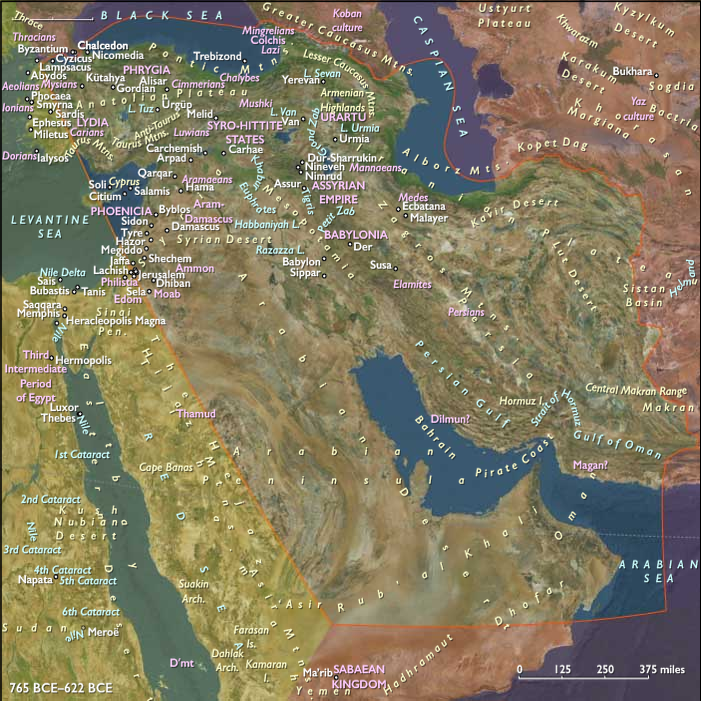
The Phrygian kingdom, with its capital at Gordium in the upper Sakarya River valley, has expanded during the eighth century BCE into an empire dominating most of central and western Anatolia and encroaching upon the larger Assyrian Empire to its southeast and the kingdom of Urartu to the northeast.
A distinctive Phrygian pottery called Polished Ware appears, and a system of writing in the Phrygian language develops and flourishes in Gordium, using a Phoenician-derived alphabet similar to the Greek one.
The powerful kingdom founded by the Phrygians is to last until the Lydian ascendancy in the early seventh century BCE.
Under kings alternately named Gordias and Midas, the independent Phrygian kingdom maintains close trade contacts with her neighbors in the east and the Greeks in the west.
Phrygia seems to have been able to coexist with whatever power is dominant in eastern Anatolia at the time.
The Assyrians had detached the eastern part of the Phrygian confederation by about 730, and the locus of power has shifted to Phrygia proper.
According to the classical historians Strabo Eusebius and Julius Africanus, the king of Phrygia during this time was another Midas.
This historical Midas is believed to be the same person named as Mita in Assyrian texts from the period and identified as king of the Mushki.
Scholars figure that Assyrians called Phrygians "Mushki" because the Phrygians and Mushki, an eastern Anatolian people, were at that time campaigning in a joint army.
This Midas is thought to have reigned Phrygia at the peak of its power from about 720 BCE to about 695 BCE (according to Eusebius) or 676 BCE (according to Julius Africanus).
In 716, Sargon of Assyria suppresses a rebellion in Cilicia fomented by Mita; an Assyrian inscription mentioning "Mita" as an ally, dated to 709 BCE, suggests Phrygia and Assyria had struck a truce by that time.
This Midas appears to have had good relations and close trade ties with the Greeks, and reputedly married an Aeolian Greek princess.
Locations
People
Groups
- Mushki
- Aeolians
- Phrygia, Kingdom of
- Greece, classical
- Assyrian people
- Assyria, (New) Kingdom of (Neo-Assyrian Empire)
Topics
- Younger Subboreal Period
- Iron Age, Near and Middle East
- Iron Age Cold Epoch
- Classical antiquity
- Assyrian Wars of c. 745-609 BCE
Commodoties
Subjects
Regions
Subregions
Years: 717BCE - 706BCE
Locations
People
Groups
- Mushki
- Aeolians
- Phrygia, Kingdom of
- Greece, classical
- Assyrian people
- Assyria, (New) Kingdom of (Neo-Assyrian Empire)
Topics
- Younger Subboreal Period
- Iron Age, Near and Middle East
- Iron Age Cold Epoch
- Classical antiquity
- Assyrian Wars of c. 745-609 BCE
Commodoties
Subjects
Regions
Subregions