
The Pharisees (despite the unflattering portrayal of …
Years: 63 - 63
The Pharisees (despite the unflattering portrayal of them in the New Testament) are for the most part intensely religious Jews and adhere to a strict though non-literal observance of the Torah.
Politically, however, the Pharisees have no sympathy with the intense Jewish nationalism of such sects as the military patriotic Zealots and are willing to submit to Roman rule if only the Jews could maintain their religious independence.
The Roman-supported Sadducees, drawn mainly from the conservative and aristocratic priestly class, have engaged in an ongoing power struggle with the Pharisees, who tend to be middle class and open to religious innovation.
The struggle has led to rancor and, in some instances, violence.
The Sadducees reject the Pharisee's markedly fatalistic emphasis on divine providence, as well as their belief in resurrection and elaborate angelology.
The Pharisees also differ from the Sadducees in their use of oral legal tradition to supplement the Torah.
However, all scrupulously adhere to the Pharisaic interpretations of the law, once given.
Locations
Groups
- Jews
- Pharisees
- Sadducees
- Galilee, Roman province of
- Zealots
- Judea (Roman province)
- Roman Empire (Rome): Julio-Claudian dynasty
Topics
Commodoties
Subjects
Regions
Subregions
Related Events
Filter results
Showing 10 events out of 61685 total
Vologases had been prevented from attacking the vassal king of Adiabene by an invasion of the eastern nomads, according to Josephus.
At last, a peace is concluded, by which the Parthians sign a treaty with Corbulo acknowledging Tiridates as king of Armenia, but he has to become a vassal of the Romans; he goes to Rome, where Roman emperor Nero gives him back the diadem; from this time forward, an Arsacid dynasty rules in Armenia under Roman supremacy.
Vologases is satisfied with this result, and will honor the memory of Nero (Suetonius Nero, 57).
Pallas does not elude Nero's wrath forever: he is killed on Nero's orders in 63—possibly to gain access to his large fortune, part of which was his by right as Pallas' official patron.
Some money must have gone to Pallas' family, as a descendant of his became consul in 167.
According to Suetonius, Nero "showed neither discrimination nor moderation in putting to death whomsoever he pleased" during this period.
Roman satirist Aulus Persius Flaccus has ignored Nero’s outrages, instead directing his intensely metaphorical style to six brief satires on familiar, timeless stoic topics.
According to the Life contained in the manuscripts, Persius was born into an equestrian family at Volterra, a small Etruscan city in the province of Pisa, of good stock on both parents' side.
When six years old he lost his father; his stepfather died a few years later.
At the age of twelve, Persius came to Rome, where he was taught by Remmius Palaemon and the rhetor Verginius Flavus.
During the next four years he developed friendships with the Stoic Lucius Annaeus Cornutus, the lyric poet Caesius Bassus, and the poet Lucan.
Lucan would become a generous admirer of all Persius wrote.
He also became close friends with Thrasea Paetus, the husband of Arria, a relative of Persius's; over the next ten years Persius and Thrasea Paetus share many travels together.
Later, he had met Seneca, but was not impressed by his genius.
In his boyhood, Persius had written a tragedy dealing with an episode in Roman history, and another work, probably on travel (although this would have been before the travels with Thrasea Paetus).
Reading the satires of Lucilius made Persius want to write like him, and he set to work on a book of his own satires.
But he writes seldom and slowly; a premature death (uitio stomachi) prevented him from completing the book; he died on November 24, 62 at 27.
He has been described as having "a gentle disposition, girlish modesty and personal beauty", and is said to have lived a life of exemplary devotion towards his mother Fulvia Sisenna, his sister and his aunt.
To his mother and sister he left his considerable fortune.
Cornutus suppresses all his work except the satires, to which he makes some slight alterations before handing it over to Bassus for editing.
It proves an immediate success.
Herculaneum, now enjoying modest prosperity as a Roman resort in the first century CE, suffers a serious earthquake in CE 62 or 63, which destroys parts of the town and …
…nearby Pompeii.
The Romans regard Mount Vesuvius, which dominates the two seaside towns, as an extinct volcano, and do not interpret the quake as a sign of its renewed activity.
The Scandinavians make open boats, both of hollowed-out logs and planked lumber, such as the Nydam boat (now preserved at Kiel and dated, by coins found near the boat, as between CE 69 and 217).
About eighty-two feet (twenty-five meters) long, the boat, which has fourteen pairs of oars and a rudder, but no sail, is made of planks fitted clinker style (each plank overlapping the one beneath it), rather than carvel-built, with the planks fitted edge to edge.
The Conspiracy of Piso and the Fall of Nero (65–68 CE)
The conspiracy of Gaius Calpurnius Piso in 65 CE marked a turning point in Emperor Nero’s reign, reflecting the widespread dissatisfaction among the Roman elite over his increasingly despotic and erratic rule.
- Piso, a prominent senator, sought to overthrow Nero, rallying support from senators, equestrians, military officers, and even some of Nero’s inner circle.
- The plot was discovered, leading to mass executions, including the deaths of the philosopher Seneca, the poet Lucan, and the general Faenius Rufus.
- Paranoia consumed Nero, as he increasingly alienated the Senate, the Praetorian Guard, and provincial governors, accelerating his downfall.
By 68 CE, multiple governors and legions revolted, and the Senate declared Nero an enemy of the state (hostis publicus). Facing certain execution, Nero committed suicide on June 9, 68 CE, famously lamenting:
"Qualis artifex pereo!" (What an artist dies in me!).
The Year of the Four Emperors (68–69 CE): Rome in Chaos
Following Nero’s death, Rome was plunged into civil war, as multiple generals vied for the throne. Over a tumultuous eighteen months, the empire saw the rise and fall of four emperors:
-
Galba (June 68 – January 69 CE)
- The Senate declared Galba emperor, but he alienated the Praetorian Guard by refusing to pay them a promised donative.
- His harsh governance led to his assassination by supporters of Otho.
-
Otho (January – April 69 CE)
- Otho quickly seized power, but his reign was challenged by Vitellius, who had the backing of the German legions.
- After losing the Battle of Bedriacum, Otho committed suicide rather than prolong the civil war.
-
Vitellius (April – December 69 CE)
- Initially victorious, Vitellius' reign was marred by extravagance, incompetence, and brutality.
- His rule was challenged by Vespasian, the commander of the eastern legions, who had secured the loyalty of Syria, Egypt, and Judea.
- Vitellius was captured and killed by Vespasian’s forces.
-
Vespasian (July 69 – 79 CE)
- Vespasian consolidated power, bringing an end to the civil war and establishing the Flavian dynasty.
Broader Consequences of the Political Anarchy
The instability of 69 CE had far-reaching effects, extending beyond Rome:
-
The Batavian Rebellion (69–70 CE)
- The Batavi, a Germanic auxiliary people in Germania Inferior (modern Netherlands), led a major revolt against Roman rule.
- Led by Julius Civilis, they exploited Rome’s civil war to briefly expel Roman forces from the Rhine frontier.
- Vespasian’s general, Petillius Cerialis, eventually crushed the rebellion, restoring Roman authority.
-
The Jewish Revolt (66–73 CE)
- The Jewish Revolt in Judea, which had begun in 66 CE, remained unresolved during the Roman civil war.
- After securing the throne, Vespasian left the final suppression of the revolt to his son, Titus, who would capture and destroy Jerusalem in 70 CE.
Legacy of the Year of the Four Emperors
- The chaos of 68–69 CE revealed the fragility of imperial succession, demonstrating that power lay in the hands of the legions rather than the Senate.
- The Flavian dynasty, established by Vespasian, marked the beginning of a more stable and militarized Rome, ensuring that future emperors would need strong military backing to maintain power.
- The pattern of civil wars and contested successions would repeat throughout Roman history, particularly during the Crisis of the Third Century (235–284 CE).
The Piso Conspiracy, Nero’s downfall, and the Year of the Four Emperors signified the end of the Julio-Claudian dynasty and the beginning of a new era, where military loyalty determined imperial legitimacy.
The Iranian-speaking Sarmatians, a combination of tribes who have overwhelmed and replaced the Scythians, their distant kinsmen, in eastern Europe, penetrate the Roman province of Lower Moesia (present Bulgaria) during the time of Nero's rule (54-68).
Like the Scythians, the Sarmatians are highly developed in horsemanship and warfare.
Their administrative capability and political astuteness contribute to their gaining widespread influence.
Owing to their common nomadic and Central Asian heritage, Sarmatian society parallels that of the Scythians, but there are many differences.
The Scythian gods are those of nature, while the Sarmatians venerate a god of fire to whom they offer horses in sacrifice.
In contrast to the reclusive, domestic role of Scythian women, unmarried Sarmatian females, especially in the society's early years, take arms alongside men.
Sarmatian female warriors may have inspired the Greek tales of the Amazons.
The disorders of 69, the so-called year of the four emperors ushered in by the death of Nero, take troops away from the Rhine and Danube frontiers.
Sarmatians thereupon raid the Danubian lands.
The assailants are repelled without undue difficulty; but the Sarmatian Iazyges, now firmly in control of the region between the Tisza and Danube rivers, pose a threat for the future.
They present the Roman army with a new and formidable challenge along the Danube frontier, since at least some of the Sarmatian cavalrymen are armored in the Parthian fashion.
However, such warriors are comparatively few in number, big horses and armor being always expensive, and the Sarmatian feudal polity makes them unable to organize large-scale raids.
As a result, the Roman limes will hold for another two centuries.
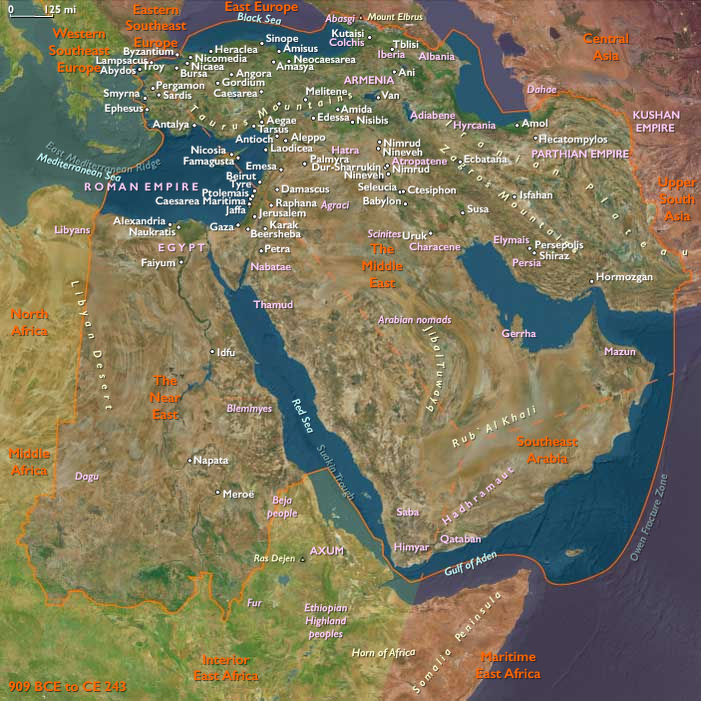
The Middle East: 64–75 CE
Parthian Cultural Revival and Roman Diplomacy
The reign of Vologases I of the Parthian Empire marks a deliberate departure from the Hellenistic influences that had permeated the region since Alexander’s conquests. Vologases spearheads a significant cultural revival, reasserting traditional Iranian customs and reintroducing ancient Persian traditions rooted in the Achaemenid dynasty. As part of this deliberate policy, he restores original Iranian names to cities previously renamed by Greek rulers, underscoring his commitment to Iran’s native heritage.
In a move of profound cultural significance, Vologases commissions the collection and preservation of the ancient Avestan texts, fundamental scriptures of the Zoroastrian religion. Coins minted under his authority depict fire temples, emphasizing his devotion to the traditional Persian religion—a symbolic tradition sustained throughout the subsequent Sassanian dynasty.
Vologases also demonstrates considerable initiative as an urban planner and builder. He establishes the city of Vologesocerta (variously known as Balashkert, Balashgerd, or Balashkard), strategically located near the Parthian capital, Ctesiphon, in an effort to draw residents away from the Hellenistic stronghold of Seleucia on the Tigris. He further founds the city of Vologesias, situated near a canal branching from the Euphrates River south of Babylon, close to the future site of Hirah.
Diplomatic relations between Parthia and Rome remain cordial under Vologases, exemplified by his offer of 40,000 Parthian archers to the Roman Emperor Vespasian to support him in his conflict against Vitellius. However, relations are later tested when the Alans, a powerful nomadic tribe from beyond the Caucasus, invade Media and Armenia. Vologases’ plea for assistance from Vespasian is denied, reflecting the pragmatic limits of Roman support.
Despite Vologases’ considerable efforts, Parthia struggles to regain control of lost territories in its eastern dominions. The kingdom of Hyrcania, in particular, maintains its autonomy, signaling the continued fragility and complexity of Parthian political control.
Dioscorides and the Legacy of Medical Knowledge
This era is also notable for the enduring contributions of Pedanius Dioscorides, a physician from Anazarbus in Cilicia, Asia Minor, who compiles his seminal work De Materia Medica between 50 and 70 CE. Written in Greek, this comprehensive five-volume treatise meticulously documents drugs of plant, animal, and mineral origin, providing detailed descriptions of their dosage, application, and medicinal properties. It becomes the foremost medical reference across both the Greco-Roman and Islamic worlds, continuously used and referenced for over 1,500 years.
Notably, Dioscorides recognizes the association between zinc ores and brass production, observing the mineral cadmia (zinc oxide) deposited in metal-smelting furnaces. His documentation preserves not only medical and botanical knowledge but also historical linguistic records, including rare Dacian and Thracian plant names that might otherwise have been lost to history.
Thus, the era from 64 to 75 CE sees significant cultural realignment under Parthian rule, alongside the establishment of a lasting scientific and medicinal legacy through Dioscorides’ influential writings.
The reign of Vologases I of Parthia, ruler of the Parthian Empire, is marked by a decided reaction against Hellenism.
He is influential in reverting Hellenization by returning to Iranian customs and traditions of the Achamenids’ time.
He reverts the Greek names of Iranian cities to Iranian names.
According to Zoroastrian texts, Vologases ordered the collection of the ancient Avestan texts.
On some of his coins a fire temple can be seen; this tradition will continue for several hundred years to the end of the Sassanian dynasty.
He builds cities, including Vologesocerta (Balashkert or Balashgerd or Balashkard, literally Balash built it) in the neighborhood of Ctesiphon, with the intention of drawing to this new town the inhabitants of Seleucia on the Tigris.
Another town founded by him is Vologesias on a canal of the Euphrates, south of Babylon (near Hirah).
Vologases has good relations with Vespasian, to whom he offers an army of forty thousand archers in the war against Vitellius.
Soon afterwards the Alans, a great nomadic tribe beyond the Caucasus, invade Media and Armenia; Vologases applies in vain for help to Vespasian.
It appears that the Persian losses in the east also cannot be repaired; Hyrcania remains an independent kingdom.
Years: 63 - 63
Locations
Groups
- Jews
- Pharisees
- Sadducees
- Galilee, Roman province of
- Zealots
- Judea (Roman province)
- Roman Empire (Rome): Julio-Claudian dynasty
