
Lorraine, after after the War of the …
Years: 1766 - 1766
The Lorraine duke Francis Stephen, betrothed to the Emperor's daughter Archduchess Maria Theresa, had been compensated with the Grand Duchy of Tuscany, where the last Medici ruler had recently died without issue.
France also had promised to support Maria Theresa as heir to the Habsburg possessions under the Pragmatic Sanction of 1713.
Leszczyński had received Lorraine with the understanding that it will fall to the French crown on his death.
The title of Duke of Lorraine is of course given to Stanisław, but also retained by Francis Stephen, and it figures prominently in the titles of his successors (as a non-claimant family name), the House of Habsburg-Lorraine.
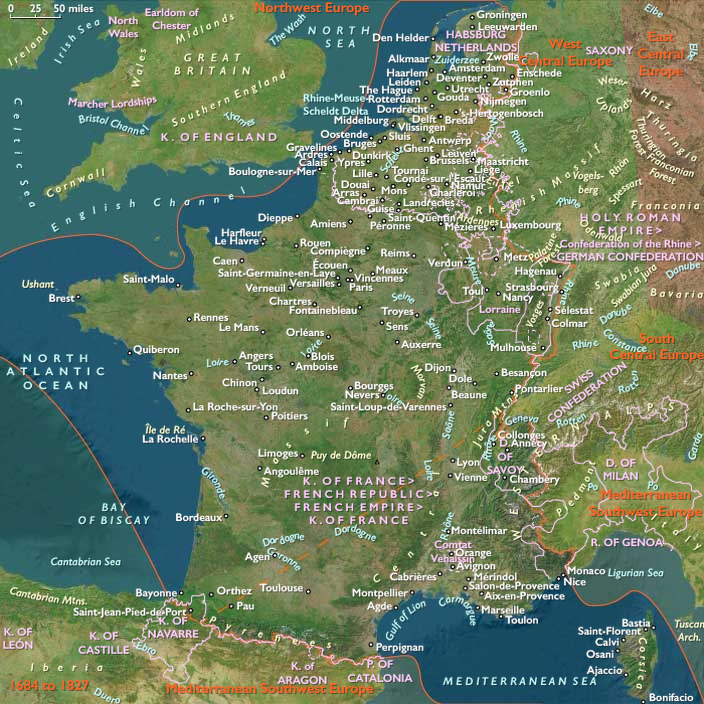
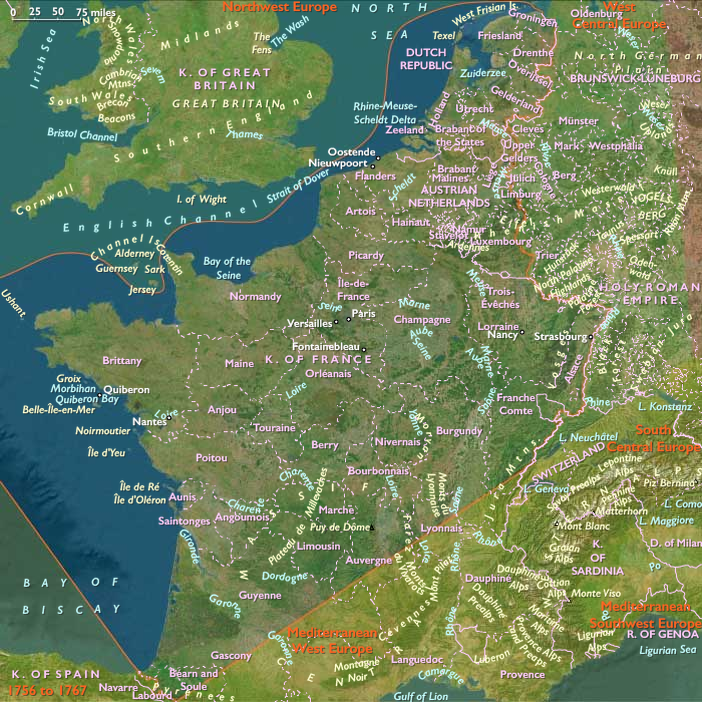
When Stanisław dies on February 23, 1766, Lorraine is annexed by France and reorganized as a province by the French government.
Locations
People
Groups
- Austria, Archduchy of
- Lorraine, (second) Duchy of
- Holy Roman Empire
- Tuscany, Grand Duchy of
- France, (Bourbon) Kingdom of
Commodoties
Subjects
Regions
Subregions
Related Events
Filter results
Showing 10 events out of 26172 total
A conflict between the Russian fur traders and the Unalaska Natives occurs between 1763 and 1766; in the Fox Islands revolt of 1762, the Aleuts, in a coordinated attack, had attacked four Russian ships and and several shore parties, during which over three hundred Russians had been killed.
Evstratii Delarov's career in Russian America dates to at least 1764, when he is in the Aleutian Islands on board the Petr i Pavel under Ivan Maksimovich Solov'ev.
Delarov participates in Solov'ev's 1764 attacks on the Umnak-Unalaska Aleut alliance, carried out in revenge for the Fox Islands revolt.
Solov'ev directs the massacre of many natives.
Unalaska is temporarily used in the 1760s as a Russian fur trading post.
He was baptized a few hours later the same day.
His godparents are King Frederick V (his father), Queen Dowager Sophie Magdalene (his paternal grandmother), Princess Louise (his aunt) and Princess Charlotte Amalie (his grand-aunt).
A former heir to the throne, also named Christian, had died in infancy in 1747; therefore, hopes were high for the future of the new heir presumptive.
Christoph Willibald Gluck, who was conductor for King Frederick V's opera troupe in Copenhagen between the years 1748-49, composed the scene La Contesa dei Numi (The Contention of the Gods), where the Olympian Gods gather at the banks of the Great Belt and discuss who in particular should protect the new prince.
His mother Queen Louise died in 1751, two years after his birth.
The following year his father married to Juliane Marie of Brunswick-Wolfenbüttel.
Early historians state that he had a winning personality and considerable talent, but that he was poorly educated and systematically terrorized by a brutal governor, Christian Ditlev Frederik Reventlow, the Count of Reventlow.
He seems to have been intelligent and had periods of clarity, but suffers from severe emotional problems, possibly schizophrenia as argued in doctor Viggo Christiansen's book Christian VII's mental illness (1906).
After a long period of infirmity, Frederick V dies on January 14, 1766, just forty-two years old.
Later the same day, Christian is proclaimed king from the balcony of Christiansborg Palace, weeks before his seventeenth birthday.
Christian's reign will be marked by mental illness, which affects government decisions, and for most of his reign Christian will be only nominally king.
His court physicians are especially worried by his frequent masturbation.
His royal advisers will change depending on who wins power struggles around the throne.
At the start of the tour the children had been aged eleven and seven respectively.
Their extraordinary skills had been demonstrated during a visit to Vienna in 1762, when they had played before the Empress Maria Theresa at the Imperial Court.
Sensing the social and pecuniary opportunities that might accrue from a prolonged trip embracing the capitals and main cultural centers of Europe, Leopold had obtained an extended leave of absence from his post as deputy Kapellmeister to the Prince-Archbishop of Salzburg.
Throughout the subsequent tour, the children's Wunderkind status was confirmed as their precocious performances consistently amazed and gratified their audiences.
The first stage of the tour's itinerary took the family, via Munich and Frankfurt, to Brussels and then on to Paris where they stayed for five months.
They then departed for London, where during a stay of more than a year Wolfgang made the acquaintance of some of the leading musicians of the day, heard much music, and composed his first symphonies.
The family then moved on to the Netherlands, where the schedule of performances was interrupted by the illnesses of both children, although Wolfgang continued to compose prolifically.
The homeward phase incorporated a second stop in Paris and a trip through Switzerland, before the family's return to Salzburg in November 1766.
The material rewards of the tour, though reportedly substantial, have not transformed the family's lifestyle, and Leopold continues in the Prince-Archbishop's service.
However, the journey has enabled the children to experience to the full the cosmopolitan musical world, and has given them an outstanding education.
In Wolfgang's case this will continue through further journeys in the following six years, prior to his appointment by the Prince-Archbishop as a court musician.
'Abd al-Wahhab moves some forty miles from 'Uyaynah to ...
...Ad-Dir'iyah, since 1726 the seat of the local chief Muhammad ibn Sa'ud, head of the Al-A'nnza tribe and a member of the prominent Al-Saud family, allegedly an enemy of the Ottomani Khilafah (the Islamic State).
The people flock to the teaching of the innovative preacher, and in 1747 he and the Sa'udi chief soon seal their alliance by mutual oaths of loyalty.
The expansion-minded Muhammad ibn Sa'ud embarks on a war of conquest against the enemies of the new dispensation, bringing 'Uyaynah and portions of Al-Hasa under Wahhabi control.
He had managed by the time of his death to bring a few parts of central and eastern Arabia under more or less effective Wahhabi rule, but Riyadh stubbornly resists the Wahhabi movement.
Muhammad ibn Sa'ud's son and successor, 'Abd al-'Aziz, who had been largely responsible for this extension of his father's realm by his exploits as commander in chief of the Wahhabi forces, continues after 1765, to work in complete harmony with Muhammad ibn 'Abd al-Wahhab, who virtually controls the Saudi realm's civil administration.
He will become the fourteenth navigator, and the first Frenchman, to sail around the world.
Completion of his mission will bolster the prestige of France following its defeats during the Seven Years' War.
This is the first expedition to circumnavigate the globe with professional naturalists and geographers aboard.
The expedition receives the support of such prominent figures of the time as Charles de Brosses (1709–1777), Comte de Buffon (1707–1788), and Jérôme Lalande (1732–1807).
The purpose of the expedition is to discover new territories available for settlement, to open a new route to reach China, to found new outlets for the French East India Company and, finally, discover acclimatable spices for the Isle de France (now Mauritius).
Bougainville leaves Nantes on November 15, 1766, with two ships: Boudeuse (captain: Nicolas Pierre Duclos-Guyot) and the Étoile (commanded by François Chenard de la Giraudais).
This is a large expedition, with a crew of two hundred and fourteen aboard Boudeuse and one hundred and sixteen aboard Étoile.
Included in the party is the botanist Philibert Commerçon, who will name the flower Bougainvillea, and his valet.
The ship's surgeon will later reveal this person as Jeanne Baré, possibly Commerçon's mistress; she will become the first woman known to circumnavigate the globe.
Other notable people on this expedition are Count Jean-François de Galaup de la Pérouse (member of the crew); the astronomer Pierre-Antoine Veron; the surgeon of Boudeuse Dr. Louis-Claude Laporte; the surgeon of the Étoile Dr. François Vives; the engineer and cartographer aboard the Étoile Charles Routier de Romainville; and the writer and historian Louis-Antoine Starot de Saint-Germain.
The discovery and description of Tahiti by Bougainville in his trip will have a very significant impact on the philosophers of the Enlightenment, including Jean-Jacques Rousseau (1712–1778).
From his manner of expression, it is possible he may have lived his early life in foreign countries along time, possibly in France, but he was not born there.
In 1741 he was staying in London, where he had made preparations to go to Jamaica.
He had cancelled those plans because, as he wrote "having met with something more advantageous which engages me to stay in England", Mills married a French women, and they had two children; one baptized in Paris on April 27, 1742, and another born in May 1743.
In 1743 Mills was in Paris for the purpose of bringing out, in concert with Gottfried Sellius, a German historian, a French edition of Ephraim Chambers's Cyclopaedia; but Lebreton, the printer commissioned by him to manage the undertaking, had cheated him out of the subscription money, assaulted him, and ultimately obtained a license in his own name.
This was the origin of the famous Encyclopédie.
Mills, unable to obtain redress, had returned to England.
In 1755 Mills had started translation The History of the Roman Emperors, from Augustus to Constantine by Jean-Baptiste Louis Crévier from the French, and in 1763 Mills had continued and completed the Memoirs of the Court of Augustus, by Thomas Blackwell the younger.
In the 1760s he finds his true vocation as a writer on agriculture, which had started with his translation in 1762 of Duhamel du Monceau's Practical Treatise of Husbandry.
In 1766 he publishes an Essay on the Management of Bees.
The A New System of Practical Husbandry, (1767) treats all branches of agriculture, and contains the first mention of the potato as grown in fields.
On February 13, 1766, Mills had been elected a Fellow of the Royal Society with Benjamin Franklin as one of his sponsors.
He is the first foreign associate of the French Agricultural Society, on whose list his name, with London as his residence, will appear from 1767 to 1784.
He is also member of the Royal Societies of Agriculture of Rouen, the Mannheim Academy of Sciences, and the Economical Society of Bern.
The design of the auditorium has traditionally been taken to have been based, with some variations, on that of the Theatre Royal, Drury Lane in London.
Although Bristol architect Thomas Paty has supervised construction, the theater has been built to designs by James Saunders, David Garrick's carpenter at Drury Lane.
Saunders had provided drawings for the theater in Richmond, Surrey, built in 1765.
A long section (1790, at Harvard University Theater Collection) and a survey plan (1842, at the Local Studies Library) of the Richmond theater show close similarities with the Bristol theater in the proportions and in the relationship between the actors on stage and the spectators surrounding them on three sides.
The site chosen was Rackhay Yard, a roughly rectangular empty site behind a row of medieval houses and to one side of the Coopers' Hall.
Two (and possibly three) new passageways built through the ground floor of the houses fronting King Street give access to Rackhay Yard and the "New Theatre" inside it.
The theater opens on May 30, 1766, with a performance that includes a prologue and epilogue given by David Garrick.
As the proprietors are not able to obtain a Royal Licence, productions are announced as "a concert with a specimen of rhetorick" to evade the restrictions imposed on theatrers by the Licensing Act 1737.
This ruse will be soon abandoned, but a production in the neighboring Coopers' Hall in 1773 will fall foul of this law.
Benjamin Franklin testifies in Parliament in 1766 that Americans already contribute heavily to the defense of the Empire.
He says that local governments had raised, outfitted, and paid twenty-five thousand soldiers to fight France—as many as Britain itself had sent—and spent many millions from American treasuries doing so in the French and Indian War alone.
London has to deal with fifteen hundred politically well-connected British Army soldiers.
The decision is to keep them on active duty with full pay, but they have to be stationed somewhere.
Stationing a standing army in Great Britain during peacetime is politically unacceptable, so the decision is made to station them in America and have the Americans pay them.
The soldiers have no military mission; they are not there to defend the colonies because there is no threat to the colonies.
Benjamin Franklin explains that further taxes to pay for theses troops are unjust and might bring about a rebellion.
Parliament agrees and repeals the tax (February 21, 1766), but insists in the Declaratory Act of March 1766 that they retain full power to make laws for the colonies "in all cases whatsoever".
The repeal nonetheless causes widespread celebrations in the colonies.
The British Parliament is now faced with colonies who refuse to comply with their Act.
This, combined with protests that have occurred in the colonies and, perhaps more importantly, protests which have arisen in Great Britain from manufacturers who are suffering from the colonies' non-importation agreement, all lead to the repeal of the Stamp Act.
Normally the economic activity in the colonies would not have caused such an outcry, but the British economy is still experiencing a post-war depression from the Seven Years' War.
Another reason for repeal of the Stamp Act is the replacement of George Grenville, the Prime Minister who had enacted the Stamp Acts, by Charles Watson-Wentworth, 2nd Marquess of Rockingham.
Rockingham is more favorable towards the colonies and furthermore he is antagonistic towards policies that Grenville had enacted.
Rockingham invites Benjamin Franklin to speak to Parliament about colonial policy and he portrays the colonists as in opposition to internal taxes (which are derived from internal colonial transactions) such as the Stamp Act had called for, but not external taxes (which are duties laid on imported commodities).
Parliament now agrees to repeal the Stamp Act on the condition that the Declaratory Act is passed.
On March 18, 1766, Parliament repeals the Stamp Act and passes the Declaratory Act.
The Declaratory Act proclaims that Parliament "had hath, and of right ought to have, full power and authority to make laws and statutes of sufficient force and validity to bind the colonies and people of America ... in all cases whatsoever".
The phrasing of the act is intentionally unambiguous.
In other words, the Declaratory Act of 1766 asserts that Parliament has the absolute power to make laws and changes to the colonial government, "in all cases whatsoever", even though the colonists are not represented in the Parliament.
Years: 1766 - 1766
Locations
People
Groups
- Austria, Archduchy of
- Lorraine, (second) Duchy of
- Holy Roman Empire
- Tuscany, Grand Duchy of
- France, (Bourbon) Kingdom of
