
Caesar, after ensuring victory in his civil …
Years: 45BCE - 34BCE
Caesar, after ensuring victory in his civil war, had planned a campaign into the Parthian Empire in 44 BCE to avenge the earlier defeat of a Roman army led by Marcus Licinius Crassus at the Battle of Carrhae.
Caesar's plan had been, after a brief pacification of Dacia, to continue east into Parthian territory.
Caesarian rule over the Republic had been effectively ensured by the defeat of Caesar's assassins at the Battle of Philippi.
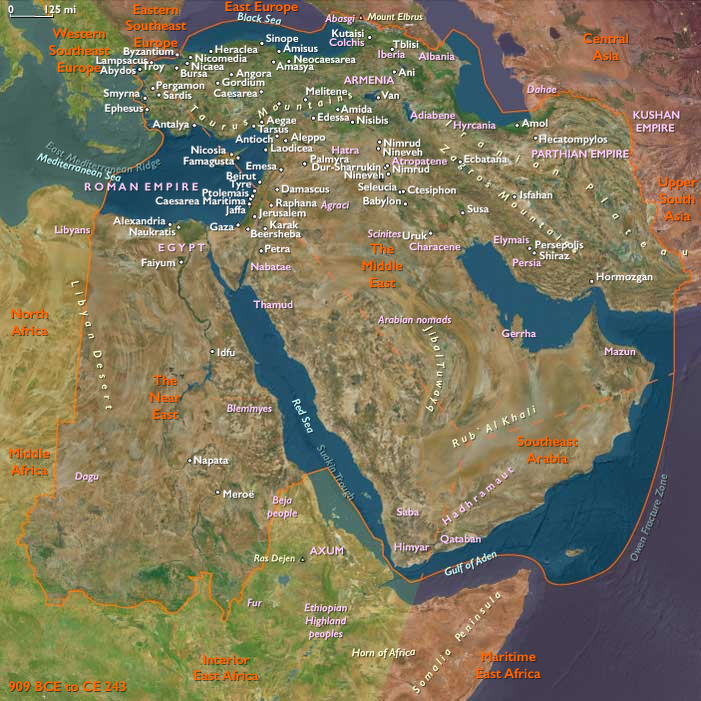
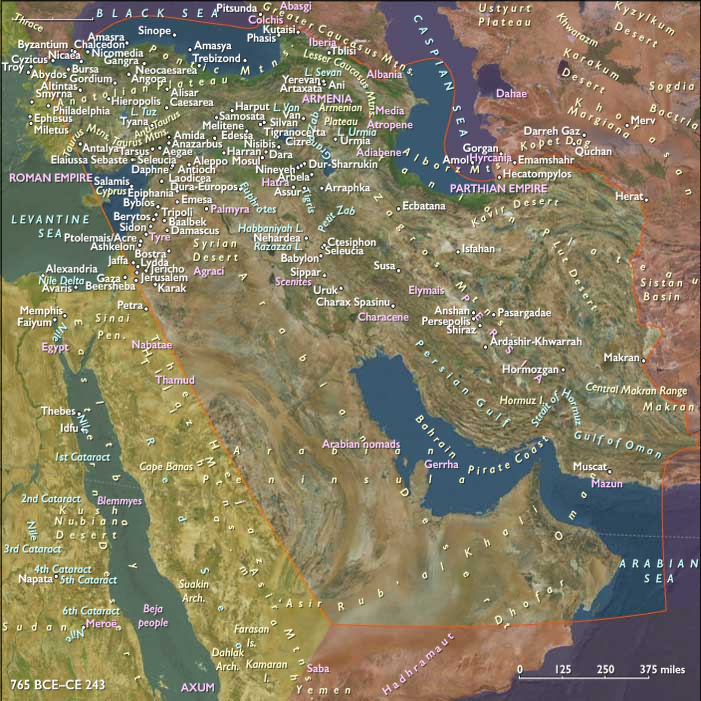
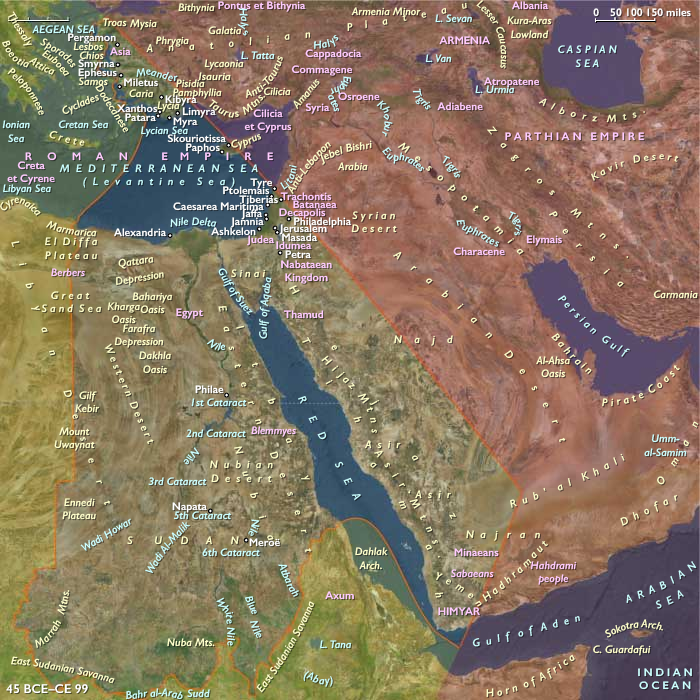
Shortly after, however, with the triumvirs preoccupied with the revolt of Sextus Pompey in Sicily, Parthia attacks Roman-controlled Syria and the client kingdom of Judea.
The Judean high priest and puppet Roman ruler, Hyrcanus II, is overthrown and sent as prisoner to Seleucia, and the pro-Parthian Hasmonean Antigonus is installed in his place.
Antigonus is the only remaining son of former king Aristobulus II, who the Romans had deposed when they installed the weaker Hyrcanus II as high priest (but not king) in 63 BCE.
Antigonus, upon capturing Hyrcanus II, bites off his uncle's ears to disqualify him from ever again serving as high priest.
The Parthians ally with Quintus Labienus, son of Caesar's former general and later antagonist Titus Labienus, penetrating deep into the western Anatolia and defeating a Roman army under Decidius Saxa.
They are, however, defeated in turn by a veteran army led by Publius Ventidius Bassus, who drives the invaders from Roman territory.
Herod, the son-in-law of Hyrcanus, returns in 37 BCE to Judea with the aid of Mark Antony, Triumvir and lover of Egyptian Ptolemaic Queen Cleopatra VII, and recaptures Jerusalem.
The Sicilian revolt ends the following year in a Triumvirate victory.
Antony now goes on to attack the Parthian Empire itself, marching into Atropatene (present-day Iranian Azerbaijan) with some one hundred thousand legionaries, aided by the Roman client kings in Armenia, Galatia, Cappadocia and sovereign Pontus.
The campaign proves a disaster, however, after a Roman slip-up at Phraaspa, capital of Atropatene, and thousands of Romans and auxiliaries die during the retreat due to the cold winter.
Antony’s army loses more than a quarter of its strength in the course of the campaign.
Antony invades Armenia, gain with Egyptian money, this time successfully.
On his return in 34 BCE, a mock Roman Triumph is celebrated in the streets of Alexandria: the parade through the city is a pastiche of Rome's most important military celebration.
The whole city is summoned for the finale to hear a very important political statement by Antony, who, surrounded by Cleopatra and her children, ends his alliance with Octavian.
People
- Antigonus II Mattathias
- Augustus
- Cleopatra VII
- Fulvia
- Herod the Great
- Hyrcanus II
- Julius Caesar
- Lucius Antonius
- Marcus Aemilius Lepidus (triumvir)
- Mark Antony
- Publius Ventidius Bassus
- Sextus Pompey
- Titus Atius Labienus
Groups
- Persian people
- Roman Republic
- Cappadocia, Kingdom of
- Atropatene, (Media) Kingdom of
- Pontus, Kingdom of
- Egypt, Ptolemaic Kingdom of
- Galatia, Kingdom of
- Parthian Empire
- Armenia, Kingdom of Greater
- Judea, Roman client kingdom of
Topics
- Roman Republic, Crisis of the
- Roman-Parthian War of 55-36 BCE
- Sicilian Revolt
- Roman Civil War of 44-31 BCE
- Antony's Parthian War
Subjects
Regions
Subregions
Years: 45BCE - 34BCE
People
- Antigonus II Mattathias
- Augustus
- Cleopatra VII
- Fulvia
- Herod the Great
- Hyrcanus II
- Julius Caesar
- Lucius Antonius
- Marcus Aemilius Lepidus (triumvir)
- Mark Antony
- Publius Ventidius Bassus
- Sextus Pompey
- Titus Atius Labienus
Groups
- Persian people
- Roman Republic
- Cappadocia, Kingdom of
- Atropatene, (Media) Kingdom of
- Pontus, Kingdom of
- Egypt, Ptolemaic Kingdom of
- Galatia, Kingdom of
- Parthian Empire
- Armenia, Kingdom of Greater
- Judea, Roman client kingdom of
Topics
- Roman Republic, Crisis of the
- Roman-Parthian War of 55-36 BCE
- Sicilian Revolt
- Roman Civil War of 44-31 BCE
- Antony's Parthian War
Subjects
Regions
Subregions