
The Persian province of Yehud continues to …
Years: 417BCE - 406BCE
The Persian province of Yehud continues to be administered by high priests who strike their own coins.
Locations
Groups
Topics
Commodoties
Subjects
Regions
Subregions
Related Events
Filter results
Showing 10 events out of 65105 total
Astrology, which originated in ancient Babylonia, has spread from there to China, India, and the West, where different but related traditions have evolved.
The earliest known horoscope (incorporating the principles of mature occidental, or Western, astrology) dates from 409 BCE.
The Spartans had appointed one of their own, Clearchus, as governor of Byzantium; he rules Byzantium with such tyranny that the people open the city to Alcibiades' Athenian forces in 408, but Sparta regains possession in 405.
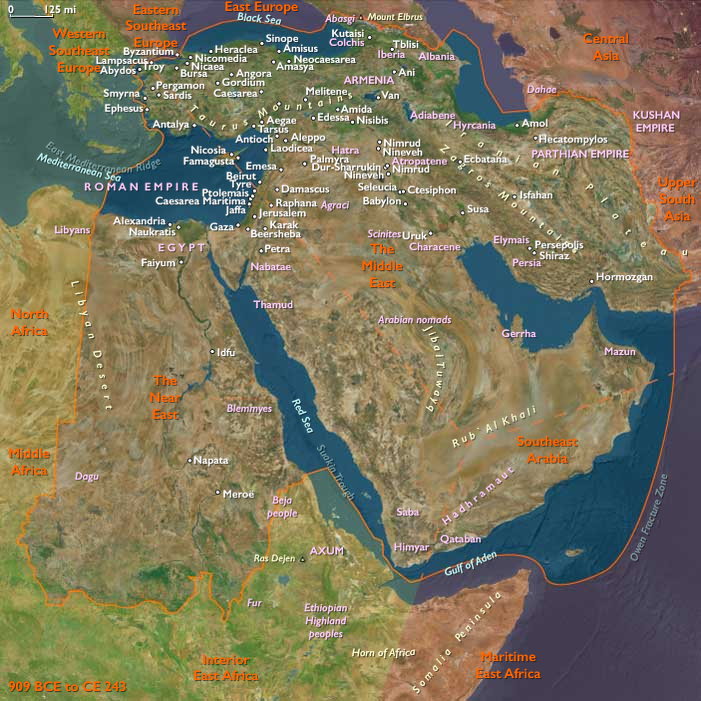
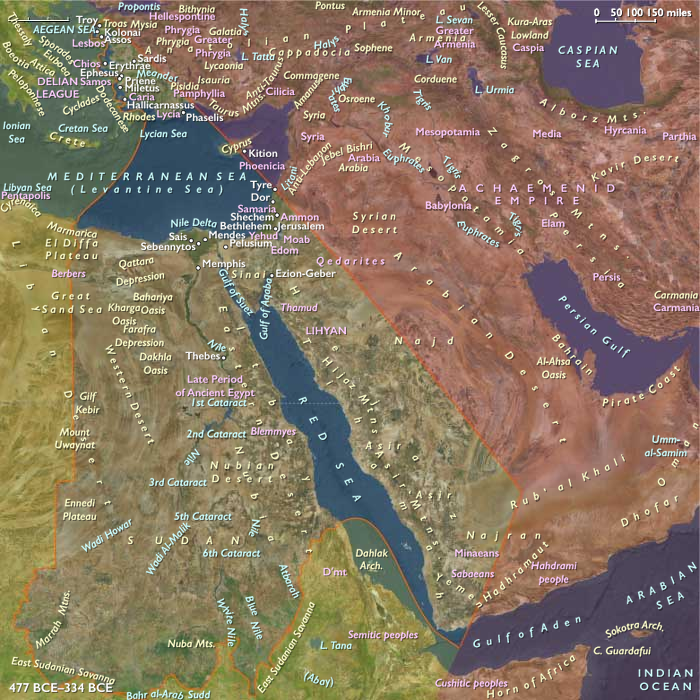
The Middle East: 417–406 BCE
Revolts in Cyprus and Anatolia
During this era, Cyprus sees significant political change as Evagoras, a descendant of Salamis' traditional Greek ruling family, rises to power around 411 BCE after overthrowing Phoenician control. Once established on the throne, Evagoras aligns his city-state with Athens, actively opposing Persian dominance. His reign signifies a resurgence of Greek influence in Cyprus and signals persistent resistance against Achaemenid rule in the region.
Meanwhile, in Anatolia, the strategically crucial city of Cyzicus, a longtime loyal member of the Delian League under Athenian hegemony, revolts against Athenian control in 411 BCE. This revolt illustrates the growing instability and shifting allegiances within Greek-held territories and Persian borderlands, reflecting broader geopolitical realignments during this tumultuous period.
Evagoras, a member of the traditional ruling family of the Greek city of Salamis in Cyprus, gains the throne in 411 after a period of Phoenician domination and allies his city with Athens against the Persians.
Cyzicus, which had joined the Delian League after the defeat of Xerxes and has remained loyal to Athens, revolts in 411 BCE.
Near East (417–406 BCE): Persian Administration of Yehud
Between 417 and 406 BCE, the Persian province of Yehud (formerly the kingdom of Judah) continues to be administered under Persian authority, marking a period of relative stability for the Jewish community. High priests, acting as regional governors under Persian oversight, manage local affairs, reflecting a balance of religious and political power.
A notable indication of local autonomy is the issuance of distinct coinage by the high priests of Yehud. These coins symbolize both a degree of administrative independence and the ongoing integration of Yehud within the broader Persian economic framework. The authority to mint their own coins allows the high priests not only to facilitate local commerce but also to reinforce their spiritual and secular leadership among the Jewish population.
This administrative and economic activity highlights the evolution of Yehud as a stable and structured province, maintaining its distinct cultural and religious identity while operating effectively within the expansive Persian Empire.
Although the virus seems to have caused epidemics throughout human history, historical data on influenza are difficult to interpret, because the symptoms can be similar to those of other respiratory diseases.
An overall lack of data up until 1500 precludes meaningful search for the influenza outbreaks in the more distant past.
Possibly the first influenza pandemic occurred around 6000 BCE in China. (E. Mordini, M. Green, eds. (2013). Internet-Based Intelligence in Public Health Emergencies: Early Detection and Response in Disease Outbreak Crises. IOS Press. p. 67)
The second phase of the Peloponnesian War begins in 414 BCE, when Sparta repulses a massive Athenian invasion of Sicily; Persia gives support to the Spartan cause.
By 411, the Athenian's Syracusan debacle and the subsequent renewal of war with Sparta as occasioned revolts in the Athenian empire and serious political turmoil at home.
Aided by Persian resources, Sparta becomes a naval power, and foments the rebellion of Athens's allies.
The Spartans move north from Chios to the Hellespont, gradually overcoming the Athenian navy despite effective countermeasures taken by Alcibiades and others. (This stage of the Peloponnesian war is called "Decelean" from the name of a town in Attica, Decelea, which Sparta fortifies—to the enormous cost of the Athenians.)
The Syracusan Greeks control southern Italy and eastern Sicily, while the Greeks of Massilia control the French coast.
Carthage has conquered the northern fertile half of modern day Tunisia, and strengthened and founded new colonies in North Africa, such as Leptis and Oea, modern Tripoli, while the Greeks cities in Sicily have bickered and prospered for seventy years after the Battle of Himera, in which Syracuse defeated Carthage to remain the dominant power in Sicily.
Carthage has also sponsored the journey of Mago Barca across the Sahara Desert to Cyrenaica, and Hanno the Navigator's journey down the African coast.
However, the Iberian colonies had seceded in that year with the help of the Iberians, cutting off Carthage's major supply of silver and copper.
