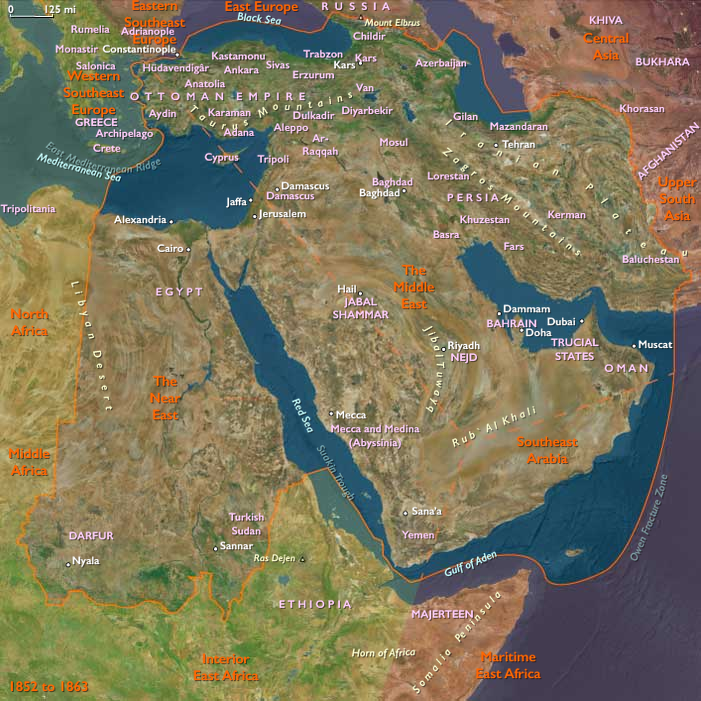
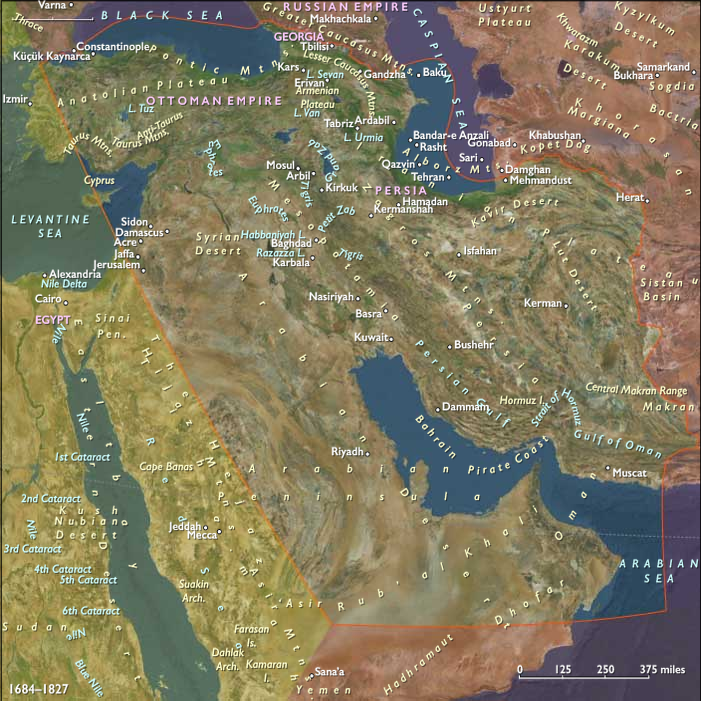
...Suhar in 1743.
Years: 1743 - 1743
Locations
People
Groups
- Arab people
- Persian people
- Muslims, Shi'a
- Muslims, Ibadi
- Turkmen people
- Oman, Second Imamate of
- Persia, Afsharid Kingdom of
Commodoties
Subjects
Regions
Subregions
Related Events
Filter results
Showing 10 events out of 27267 total
Russian maritime fur trading in the northern Pacific begins after the exploration voyages of Bering and Chirikov in 1741 and 1742, which have demonstrated that Asia and North America are not connected but that sea voyages are feasible, and that the region is rich in furs.
Private fur traders, mostly promyshlenniki, launch fur trading expeditions from Kamchatka, at first focusing on nearby islands such as ...
...the Commander Islands.
These maritime expeditions, unlike fur trading ventures in Siberia, require more capital than most promyshlenniki can obtain.
Merchants from cities such as Irkutsk, Tobolsk, and others in European Russia, become the principal investors.
An early trader is Emilian Basov, who trades at Bering Island in 1743, collecting a large number of sea otter, fur seal, and blue arctic fox furs.
Basov mounts four expeditions to Bering Island, which is the largest of the Commander Islands, and nearby Medny Island.
He makes a fortune, inspiring many other traders.
Dresden's Baroque Frauenkirche has been built between 1726 and 1743, designed by Dresden's city architect, George Bähr, who had not lived to see the completion of his greatest work.
Bähr's distinctive design for the church has captured the new spirit of the Protestant liturgy by placing the altar, pulpit, and baptismal font directly centered in view of the entire congregation.
Famed organ maker Gottfried Silbermann in 1736 had built a three-pedal, forty-three-stop instrument for the church.
The organ was dedicated on November 25 and Johann Sebastian Bach had given a recital on the instrument on 1 December.
The church's most distinctive feature is its unconventional ninety-six meter-high dome, called die Steinerne Glocke or "Stone Bell".
An engineering feat comparable to Michelangelo's dome for St. Peter's Basilica in Rome, the Frauenkirche's twelve thousand-ton sandstone dome stands high, resting on eight slender supports.
Dresden’s first Kirche zu unser liuben Vrouwen had been built in the eleventh century in romanesque style, outside the city walls and surrounded by a grave yard.
The Frauenkirche had been the seat of an archbishop in the Meißen Diocese until the Reformation, when it had become a Protestant church.
This first Frauenkirche had been torn down in 1727 and replaced by a new church due to the need for increased capacity.
The modern Frauenkirche is built by the citizenry as a Lutheran (Protestant) parish church.
Even though Saxony's Prince-elector, Frederick August I, had reconverted to Roman Catholicism to become King of Poland, he had supported the construction so that the Dresden townscape would feature an impressive cupola.
Attempts to ratify the treaty ending the Ottoman-Afsharid War are impeded by Persia's insistence that a small Shiite sect, the Ja'fari, be declared orthodox, and by Ottoman haughtiness in torturing the ambassadors of Nadir Shah.
Nader Shah in 1743 declares war on the Turks and, after demanding the surrender of Baghdad, begins a long march to Constantinople.
However, when he learns that the Ottoman ulema (Muslim legal council) has made respectable a holy war against Persia, ...
The Persian forces occupy Muscat and ...
...he turns east after having captured Kirkuk, ...
..seizing Arbil and ...
...besieging Mosul as a threat to Baghdad.
The covered tureens made by silversmith Thomas Germain are spectacular; a silver tureen by him, stamped for 1733, will be sold at Sotheby New York in November 1996 for US$10,287,500, setting the world's record auction price for a single piece of silver.
He makes a pair of tureens in 1735 for Evelyn Pierrepont, 2nd Duke of Kingston-upon-Hull, to designs by Juste-Aurèle Meissonnier that Henry Hawley has said "represents the apogee of the French rococo". (Henry Hawley, "Meissonnier's Kingston Tureen" Magazine Antiques January 1997.)
George Frideric Handel's oratorio, Samson, premieres in London on February 21.
It is a great success, leading to a total of seven performances in its first season, the most in a single season of any of his oratorios.
Samson will retain its popularity throughout Handel's lifetime and has never fallen entirely out of favor since.
Considered one of his finest dramatic works, it is usually performed as an oratorio in concert form, but on occasions has also been staged as an opera.
The well-known arias "Let the bright Seraphim" (for soprano) and "Total eclipse" (for tenor) are often performed separately in concert.
The effects of the Licensing Act upon British theater are profound.
The public mistrusts plays that pass the censors.
One effect is that the plays that are passed are more domestically oriented, more sentimental, and, aside from Richard Brinsley Sheridan and Oliver Goldsmith, who both will write old-style plays, authors of melodrama will enjoy greatest success.
Arguably, the Licensing Act had created an immediate vacuum of new plays to perform, and this leaves theaters with little option but to stage revivals.
The number of productions of Shakespeare plays staged in the 1740s will be far higher than previously (one fourth of all plays performed in the decade).
Additionally, the Licensing Act has diverted politically interested authors away from the stage and into writing novels.
Fielding and Brooke are only two of the authors who turn their energies to novel writing.
Many other novelists, such as Tobias Smollett and Laurence Sterne, never approach the stage.
Prior to the Licensing Act, theater had been the first choice for most wits.
After it, the novel is.
The Act is not solely responsible for the transformation of the British stage in the eighteenth century away from satire and toward lofty and "sentimental" subject matter, but it is responsible for stopping one of the theatrical movements away from sentiment and domestic tragedy.

Years: 1743 - 1743
Locations
People
Groups
- Arab people
- Persian people
- Muslims, Shi'a
- Muslims, Ibadi
- Turkmen people
- Oman, Second Imamate of
- Persia, Afsharid Kingdom of