The Persian campaign has resulted in severe …
Years: 233 - 233
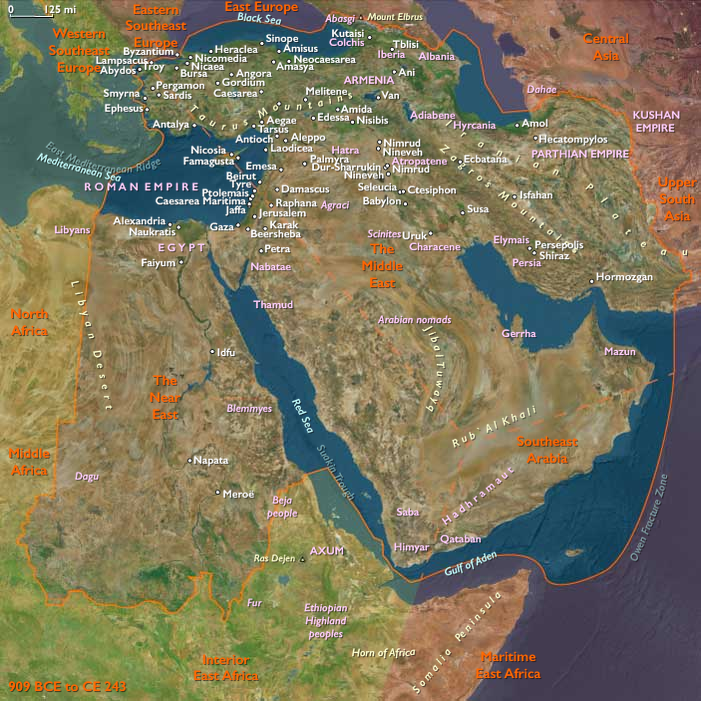
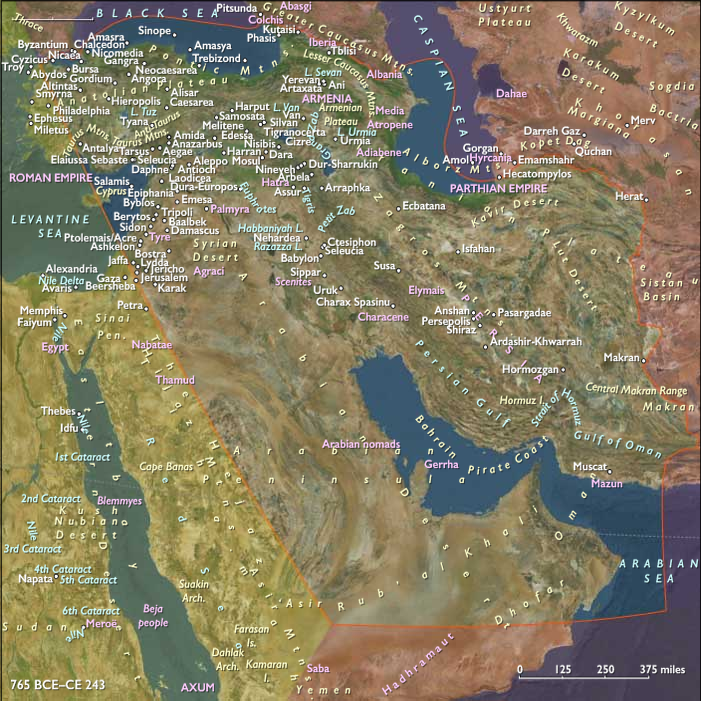
The Persian campaign has resulted in severe casualties to both sides, but the emperor is able to reestablish the Roman frontier by 233, although no formal peace ends the inconclusive Roman-Persian War of 230—33.
Both Alexander and Ardashir must have had reason to avoid further campaigning, as Severus returns to Europe in 233 and Ardashir will not renew his attacks for several years, probably focusing his energies in the east.
Locations
People
Groups
- Persian people
- Syria Palæstina, Roman province of (Judea, Samaria, and Idumea)
- Roman Empire (Rome): Severan dynasty
- Mesopotamia (Roman province)
- Persian Empire, Sassanid, or Sasanid
Topics
Commodoties
Subjects
Regions
Subregions
Related Events
Filter results
Showing 10 events out of 60568 total
Sun Quan has yet another misadventure in his dealings with Gongsun Yuan in 233, Gongsun sends messengers to him, offering to be his subject.
Sun Quan, ecstatic, appoints Gongsun Yuan the Prince of Yan, grants him the nine bestowments, and further sends a detachment of ten thousand men by sea north to assist Gongsun Yuan in his campaign against Wei, against the advice of nearly every single one of his high level officials, particularly Zhang Zhao.
Once the army arrives, however, Gongsun Yuan betrays them, killing Sun Quan's officials Zhang Mi and Xu Yan), whom Sun had sent to grant the bestowments and seizes their troops.
Once this happens, the enraged Sun Quan wants to personally head north with a fleet to attack Gongsun Yuan, and initially, not even Lu Xun's opposition is able to dissuade him, although he eventually calms down and does not follow through.
To his credit, he also personally goes to Zhang Zhao's house and apologizes to him.
Gongsun, apprehensive of another attack from Cao Wei, sends ambassadors to Eastern Wu in 233 to formally submit to its emperor, Sun Quan.
Sun is so pleased that he immediately creates Gongsun the Prince of Yan and grants him the nine bestowments, which are typically reserved for officials so powerful that the bestowments were typically viewed as a sign that the emperor was about to abdicate to them.
However, Gongsun realizes later that Eastern Wu will be of little help in an expedition against him.
He betrays Eastern Wu, slaughters Sun's ambassadors as they arrive in Liaodong, and seizes their troops.
In response, Cao Rui creates Gongsun the Duke of Lelang.
(Part of the Eastern Wu troops are able to escape and eventually return home with the assistance of Goguryeo, a rival of the Gongsuns.)
Alexander Severus returns to Rome from Syria and celebrates a triumph in 233.
Sun Quan, in coordination with Zhuge Liang's final northern expedition against Wei, personally leads a major attack against Wei's border city Hefei in 234, while having Lu Xun and Zhuge Jin attack Xiangyang, with the strategy of trying to attract Wei relief forces and then attacking them.
However, Wei generals correctly see the situation and simply let Sun Quan besiege Hefei.
Only after Sun Quan's food supplies run low does Cao Rui personally arrive with reinforcements, and Sun withdraws, as do Lu Xun and Zhuge Jin.
Another serious crisis posed by Eastern Wu occurs in 234, when Eastern Wu, in a semi-coordinated effort with Shu Han, launches an attack against Cao Wei simultaneously with Zhuge Liang's Northern Expeditions.
At the time, many frontline officials are on family leave, so Man Zhong requests Cao Rui to call them back to fight Sun Quan.
Cao Rui refuses to cancel his subordinates' vacations, and orders Man to focus on the defense.
Cao Rui then personally leads the royal army as reinforcement, and acts as an effective coordinator of the various forces that Cao Wei has on Eastern Wu's borders, and Eastern Wu is unable to make substantial gains.
Yang Yi, the Imperial Secretariat of the state of Shu Han, has participated in the Northern Expeditions of Shu under the command of the strategist Zhuge Liang.
He and Wei Yan do not get along well, and it is only the command of Zhuge Liang that keeps them from fighting one another outright.
Zhuge Liang has launched a series of six invasions on Cao Wei between 228 and 234, but has failed each time due to lack of supplies or the incompetence of his officers.
In the spring of 234, Zhuge Liang leads one hundred thousand troops through Xiagu Pass after three years of preparation since his last Northern Expedition.
At the same time, Zhuge Liang sends an emissary to Shu Han's ally state, Eastern Wu, hoping that Wu will attack Cao Wei concurrently.
In April, Shu forces reach the Wuzhang Plains near the Wei River and make camp there.
The Cao Wei commander, Sima Yi, is well-prepared with a two hundred thousand-strong army, which holds a fortified position on the southern bank of the Wei River.
Guo Huai suggests that Sima Yi form a position in the northern part of the Plains, since Zhuge Liang will likely strike there.
Sima Yi agrees, and sends Guo Huai to set camp there.
Shu forces attack the Wei camp there while it is being built, but Guo Huai is able to hold them off.
Sima Yi will not engage the Shu forces, instead trying to make the enemy retreat through attrition.
Zhuge Liang understands the problem, and implements the tuntian system to sustain his troops.
While the tuntian system is made famous by Cao Cao's administration, Cao's writings show that the system had been instituted as early as the Western Han dynasty, during the reign of Emperor Wu, where soldiers on distant expeditions were set to work converting and farming the conquered land, both to provide food for the army and to convert the region into one based around agriculture—in effect, an economic conquest.
After the death of Emperor Wu, however, the system was only used sporadically and therefore less effectively.
The Shu army awaits an agreed offensive by Wu for the moment to strike.
However, Sun Quan's armies in the Huai River region are defeated by forces led by the Wei emperor, Cao Rui, and succumb to an endemic disease.
Thus the stalemate remains in place and continues for hundreds of days.
Shu forces try to engage the Wei forces several times, but Sima Yi remains firmly in camp and refuses to engage the enemy.
In an attempt to provoke Sima Yi to attack him, Zhuge Liang sends women's clothing to Sima, suggesting that Sima should be a woman since he does not dare to attack him.
Sima Yi's subordinates are enraged by the insult, but Sima himself remains calm.
To appease his men, Sima Yi asks Cao Rui for permission to engage the enemy.
Cao Rui understands the situation and sends minister Xin Pi to persuade the Wei army to be patient.
In another attempt to force Sima Yi to go to battle, Zhuge Liang sends an emissary to urge Sima to fight him.
However, Sima Yi refuses to discuss military issues with the messenger, and instead inquires about Zhuge Liang's daily tasks.
The emissary replies that Zhuge Liang has been personally overseeing all affairs in the army, ranging from strategic planning to his men's daily meals, and that Zhuge himself has not been eating and sleeping well.
Sima Yi later tells an aide that Zhuge Liang will not last long.
In August, Zhuge Liang falls ill due to exhaustion, and his condition worsens daily.
News reaches the Shu emperor, Liu Shan, who sends minister Li Fu to ask Zhuge Liang about future plans for Shu.
Zhuge Liang replies that Jiang Wan can succeed him, and Fei Yi can succeed Jiang.
When Li Fu asks again about Fei Yi's successor, Zhuge Liang falls silent.
Li Fu then returns to the capital Chengdu.
Zhuge Liang also gives instructions on how the Shu forces should withdraw back to Hanzhong: Yang Yi and Fei Yi will lead the army while Jiang Wei and Wei Yan will lead a force to defend the rear; if Wei Yan disobeys orders, the army will proceed on without him.
Zhuge Liang eventually dies at the age of 53 in the early autumn of 234.
Yang Yi and Wei Yan argue about whether to follow Zhuge's orders to retreat.
Their disagreement finally breaks out into a full-fledged battle, which Yang Yi eventually wins.
He also slays Wei Yan's entire family shortly after.

Zhuge Liang grows seriously ill while on his final campaign against Wei in 234.
Liu Shan, hearing of Zhuge's illness, sends his secretary Li Fu to the front line to visit Zhuge Liang and to request Zhuge to leave instructions on important state matters.
Among other things, Zhuge recommends that Jiang Wan succeed him, and that Fei Yi succeed Jiang Wan.
Zhuge Liang refused to answer Li Fu's next question—who should succeed Fei Yi.
Zhuge Liang dies soon thereafter.
Liu Shan follows Zhuge's instructions and installs Jiang Wan as the new regent, but Jiang is more interested in domestic affairs than military expansion.
Thus the death of Zhuge Liang ends a huge strategic threat to Cao Wei and the Wei court soon begins development of ambitious public works.
Sima Yi's success and subsequent rise in prominence paves the way for his grandson Sima Yan's founding of the Jin dynasty, which will eventually bring an end to the Three Kingdoms period.
Alexander Severus is called to face German invaders in Gaul, who in 234 have breached the Rhine frontier in several places, destroying forts and overrunning the countryside.
Alexander musters his forces, bringing legions from the eastern provinces, and crosses the Rhine into Germany on a pontoon bridge.
Initially on the advice of his mother, he attempts to buy the German tribes off, so as to gain time.
Whether this is a wise policy or not, it causes the Roman legionaries to look down on their emperor as one who is prepared to commit unsoldierly conduct.
Herodian says "in their opinion Alexander showed no honorable intention to pursue the war and preferred a life of ease, when he should have marched out to punish the Germans for their previous insolence". (Herodian, 6:7:10)
Sun Quan is still capable of making proper decisions at times, despite the deterioration in his previous clear thinking.
For example, when, as a sign of contempt, Wei's emperor Cao Rui offers him horses in exchange for pearls, jade, and tortoise shells in 235, Sun Quan ignores the implicit insult and makes the exchange, reasoning that his empire needs horses much more than pearls, jade, or tortoise shells.
The South Pointing Chariot is among the notable technological advances of this era.
A directional compass vehicle that actually has no magnetic function, it is operated by use of differential gears (which applies equal amount of torque to driving wheels rotating at different speeds).
It is because of this revolutionary device (and other achievements) that its inventor, engineer and government official Ma Jun, is known as one of the most brilliant mechanical engineers and inventors of his day (alongside Zhang Heng of the earlier Eastern Han Dynasty).
Considered by many to be as brilliant as his predecessor Zhang Heng, Ma Jun is in 235 the inventor of a hydraulic-powered, mechanical puppet theater designed for Emperor Ming of Wei (Cao Rui), and square-pallet chain pumps for irrigation of gardens in Luoyang.
Years: 233 - 233
Locations
People
Groups
- Persian people
- Syria Palæstina, Roman province of (Judea, Samaria, and Idumea)
- Roman Empire (Rome): Severan dynasty
- Mesopotamia (Roman province)
- Persian Empire, Sassanid, or Sasanid