
The foundation population of the humans that …
Years: 90765BCE - 70030BCE
The foundation population of the humans that today inhabit the world are the survivors of what appears to be an evolutionary bottleneck caused by a global catastrophe during the period that begins around 90,000 BCE.
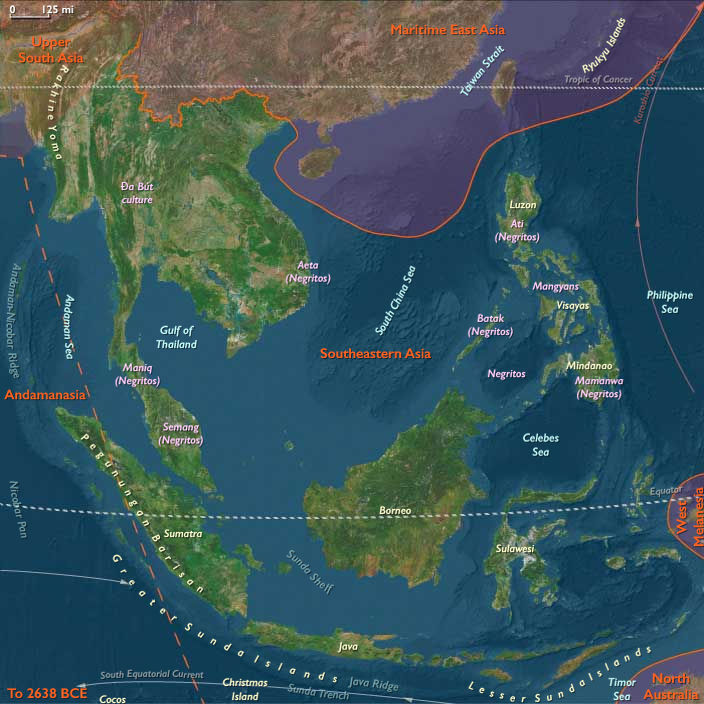
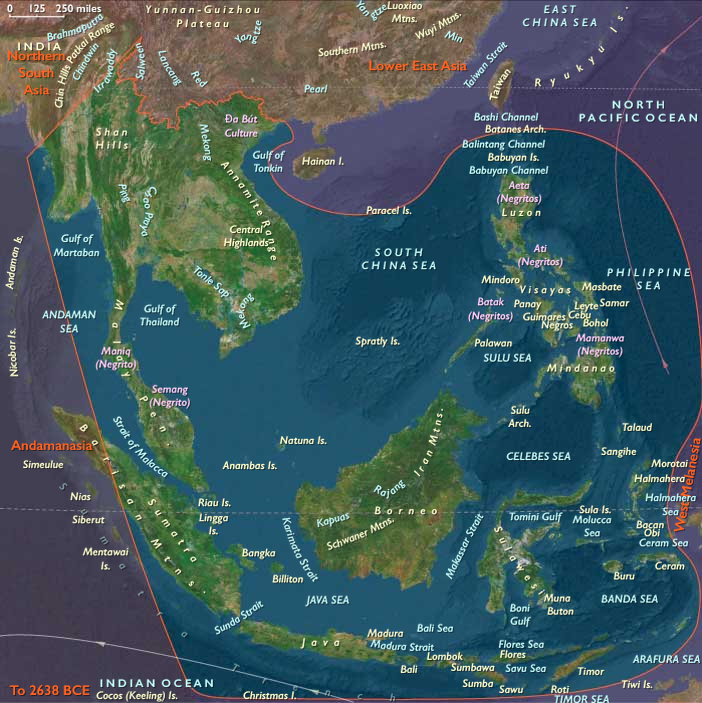
The Toba supereruption (Youngest Toba Tuff or simply YTT), a supervolcanic eruption that occurs some time between sixty-nine thousand and seventy-seven thousand years ago at Lake Toba in Sumatra, Indonesia, is recognized as one of the Earth's largest known eruptions and is the most closely studied supereruption.
The related catastrophe hypothesis holds that this event plunged the planet into a six-to-ten-year volcanic winter and possibly an additional one thousand-year cooling episode.
This change in temperature results in the world's human population being reduced to ten thousand or even a mere one thousand breeding pairs, creating a bottleneck in human evolution.
Consistent with the Toba catastrophe theory, evolutionary biologist Richard Dawkins has postulated that human mitochondrial DNA (inherited only from one's mother) and Y chromosome DNA (from one's father) show coalescence at around one hundred and forty thousand and sixty thousand years ago, respectively.
In other words, all living humans' female line ancestry traces back to a single female (Mitochondrial Eve) at around one hundred and forty thousand years ago.
All humans can trace their ancestry with certainty via the male line back to a single male (Y-chromosomal Adam) at ninety thousand to sixty thousand years ago.
Topics
Subjects
Regions
Subregions
Related Events
Showing 10 events out of 69725 total
Years: 90765BCE - 70030BCE
Topics
Subjects
Regions
Subregions