
...the Peace of Crépy—which is signed by …
Years: 1544 - 1544
September
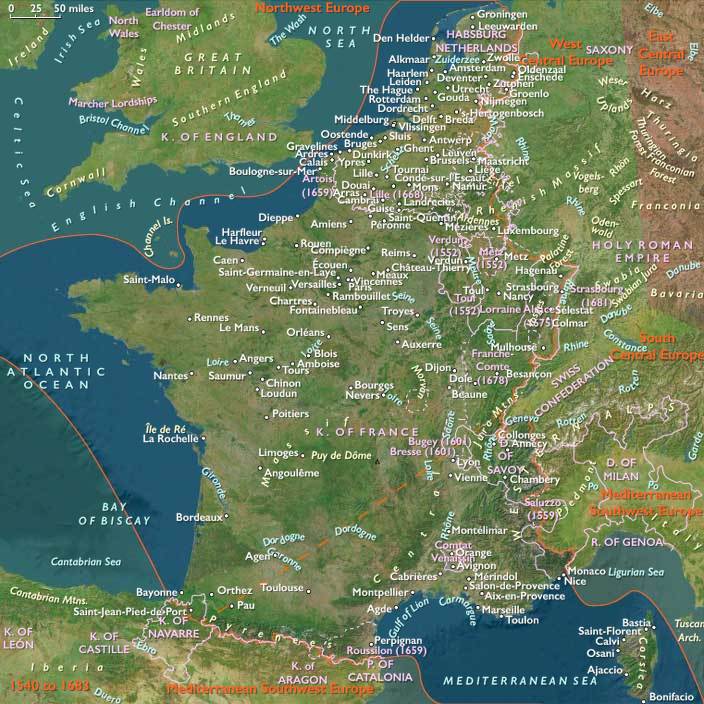
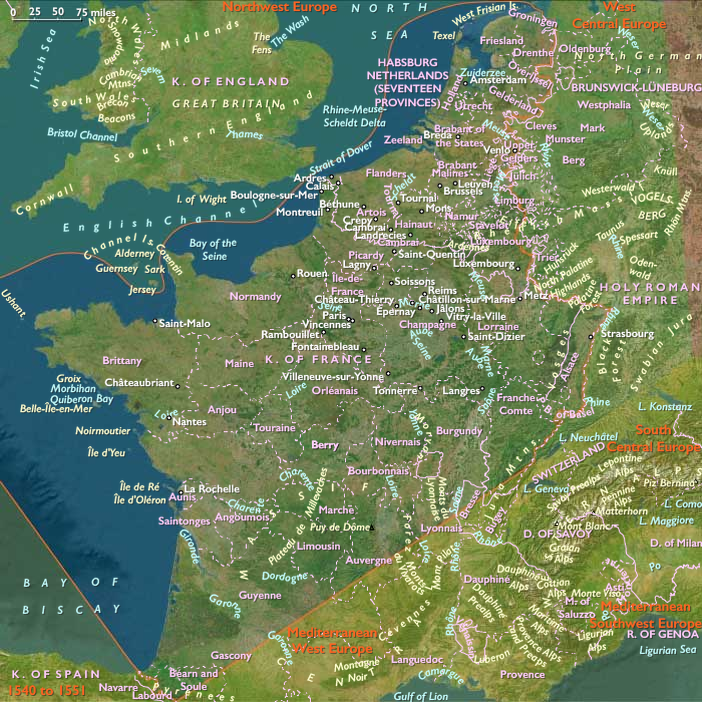
...the Peace of Crépy—which is signed by representatives of the monarchs at Crépy-en-Laonnais in Picardie on September 18, 1544.
The treaty has been promoted at the French court by the Queen Eleanor, who is the Emperor's favorite sister, and by Francis's mistress, the Duchess of Étampes.
By its terms, Francis and Charles are each to abandon their various conflicting claims and restore the status quo of 1538; the Emperor is to relinquish his claim to the Duchy of Burgundy and the King of France is to do the same for the Kingdom of Naples, as well as renouncing his claims as suzerain of Flanders and Artois.
The Duke of Orléans is to marry either Charles's daughter Mary or his niece Anna; the choice is to be made by Charles.
In the first case, the bride is to receive the Netherlands and Franche-Comté as a dowry; in the second, Milan.
Francis, meanwhile, is to grant the duchies of Bourbon, Châtellerault, and Angoulême to his son; he will also abandon his claims to the territories of the Duchy of Savoy, including Piedmont and Savoy itself.
Finally, Francis is to assist Charles against the Ottomans—but not, officially, against the heretics in his own domains.
A second, secret accord is also signed; by its terms, Francis is to assist Charles with reforming the church, with calling a General Council, and with suppressing Protestantism—by force if necessary.
The treaty gains a poor reception from the Sultan; from Henry VIII, who believes that Charles has betrayed him; and from the Dauphin, who feels that his brother is being favored over him.
Francis will fulfill some of the terms; but the death of the Duke of Orléans in 1545 is to render the treaty moot.
Locations
People
- Anne de Pisseleu d'Heilly
- Charles II d'Angoulême, Duke of Orléans
- Charles V, Holy Roman Emperor
- Francis II of France
- Henry II of France
- Henry VIII of England
Groups
- Milan, Archdiocese of
- France, (Valois) Kingdom of
- Saxony, Electorate of
- Brandenburg, (Hohenzollern) Margravate of
- Savoy, Duchy of
- Scotland, Kingdom of
- Ottoman Empire
- Franche-Comté (province of the Holy Roman Empire)
- England, (Tudor) Kingdom of
- Naples, Kingdom of
- Habsburg Monarchy, or Empire
Topics
- Protestant Reformation
- Counter-Reformation (also Catholic Reformation or Catholic Revival)
- Anglo-French War of 1542-46
- Anglo-Scottish War of 1542-49 (War of The Rough Wooing)
- Italian War of 1542-6, or Italian War between Charles V and Francis I, Fourth
Commodoties
Subjects
Regions
Subregions
Years: 1544 - 1544
September
Locations
People
- Anne de Pisseleu d'Heilly
- Charles II d'Angoulême, Duke of Orléans
- Charles V, Holy Roman Emperor
- Francis II of France
- Henry II of France
- Henry VIII of England
Groups
- Milan, Archdiocese of
- France, (Valois) Kingdom of
- Saxony, Electorate of
- Brandenburg, (Hohenzollern) Margravate of
- Savoy, Duchy of
- Scotland, Kingdom of
- Ottoman Empire
- Franche-Comté (province of the Holy Roman Empire)
- England, (Tudor) Kingdom of
- Naples, Kingdom of
- Habsburg Monarchy, or Empire
Topics
- Protestant Reformation
- Counter-Reformation (also Catholic Reformation or Catholic Revival)
- Anglo-French War of 1542-46
- Anglo-Scottish War of 1542-49 (War of The Rough Wooing)
- Italian War of 1542-6, or Italian War between Charles V and Francis I, Fourth
Commodoties
Subjects
Regions
Subregions