
Major agrarian rebellion movements against Wang Mang's …
Years: 45BCE - 99
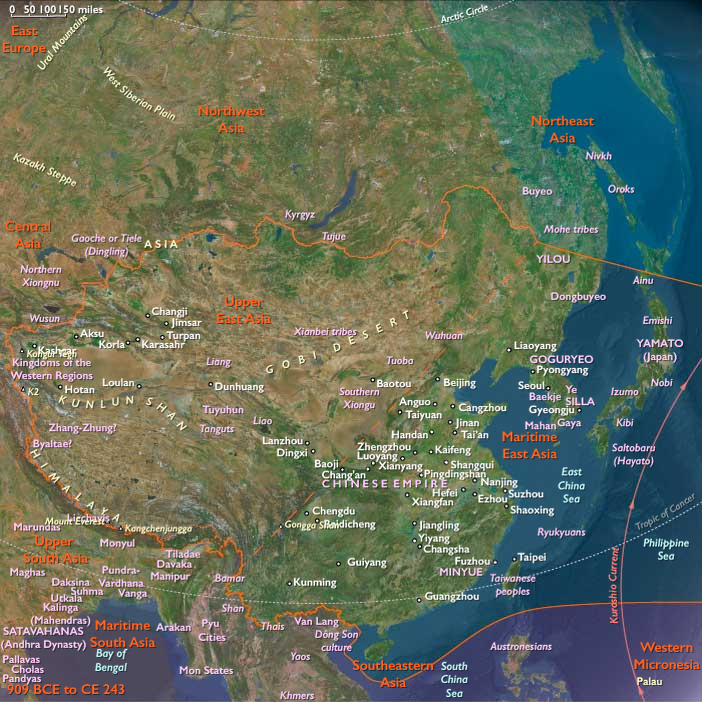
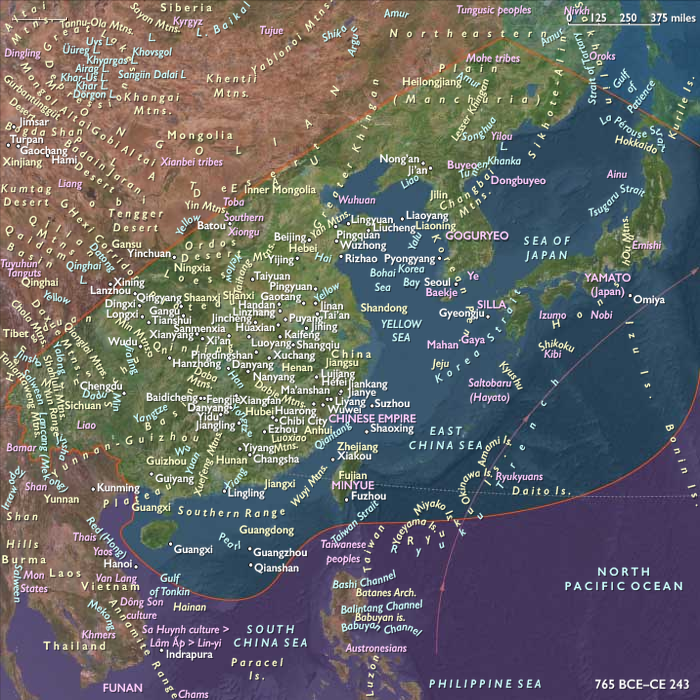
Major agrarian rebellion movements against Wang Mang's Xin Dynasty, initially active in the modern Shandong and northern Jiangsu region, eventually lead to Wang Mang's downfall by draining his resources; this allows the leader of the other movement (the Lülin), Liu Xuan (Emperor Gengshi) to overthrow Wang and temporarily establish an incarnation of the Han Dynasty under him.
Chimei forces eventually overthrow Emperor Gengshi and place their own Han descendant puppet, Emperor Liu Penzi, on the throne, but briefly: the Chimei leaders' incompetence in ruling the territories under their control, which matches their brilliance on the battlefield, causes the people to rebel against them, forcing them to try to withdraw homeward.
They surrender to Liu Xiu's (Emperor Guangwu’s) newly established Eastern Han regime when he blocks their path.
The state of Goguryeo had been free to raid Han's Korean prefectures during the widespread rebellion against Wang Mang; the Han dynasty does not reaffirm its control over the region until CE 30.
The rebellion led by the Trung Sisters of Vietnam is crushed after a few years.
Wang Mang had renewed hostilities against the Xiongnu, who are estranged from Han until their leader, a rival claimant to the throne against his cousin, submits to Han as a tributary vassal in 50.
This creates two rival Xiongnu states: the Southern Xiongnu led by a Han ally, and the Northern Xiongnu led by a Han enemy.
During the turbulent reign of Wang Mang, Han had lost control over the Tarim Basin, which is conquered by the Northern Xiongnu in 63 and used as a base to invade Han's Hexi Corridor in Gansu.
After the Northern Xiongnu defeat and flight into the Ili River valley in 91, the nomadic Xianbei occupy the area from the borders of the Buyeo Kingdom in Manchuria to the Ili River of the Wusun people.
The reign of Emperor Zhang, from 75–88, will come to be viewed by later Eastern Han scholars as the high point of the dynastic house.
Subsequent reigns will be increasingly marked by eunuch intervention in court politics and their involvement in the violent power struggles of the imperial consort clans.
People
Groups
- Vietnamese people
- Xiongnu (Hsiung-nu)
- Xianbei
- Wusun
- Buyeo, Kingdom of
- Goguryeo (Koguryo), Kingdom of
- Chinese Empire, Tung (Eastern) Han Dynasty
Topics
Subjects
Regions
Subregions
Related Events
Showing 10 events out of 62463 total
Years: 45BCE - 99
People
Groups
- Vietnamese people
- Xiongnu (Hsiung-nu)
- Xianbei
- Wusun
- Buyeo, Kingdom of
- Goguryeo (Koguryo), Kingdom of
- Chinese Empire, Tung (Eastern) Han Dynasty
Topics
Subjects
Regions
Subregions