
The pataria is partially the result of …
Years: 1073 - 1073
October
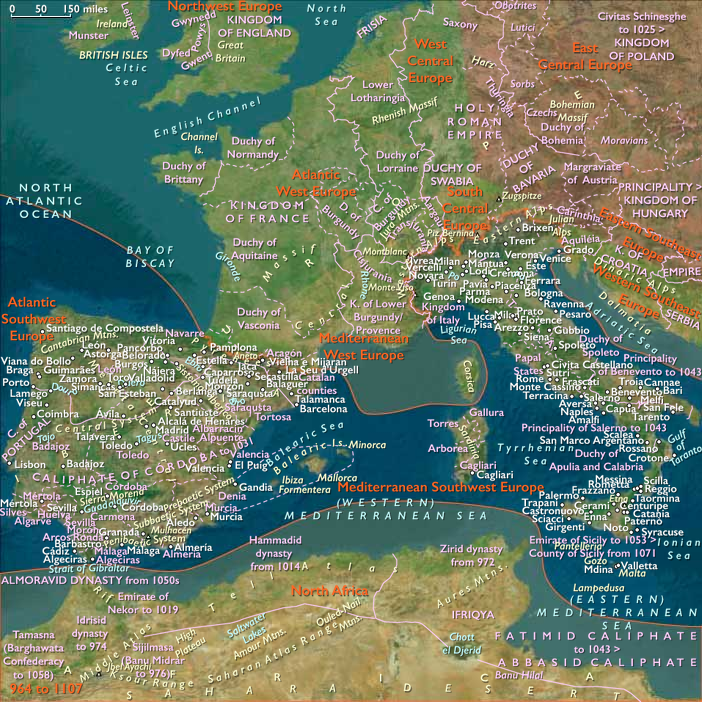
The pataria is partially the result of church reform movements like the Peace and Truce of God and partially of the social situation in Milan.
The influence of southern French movements, such as the Peace and Truce, affect the pataria.
The subsequent popularity of the Cathar movement in Milan during the twelfth century will be a result of the pataria.
The chief targets of the patarini are the rich, secular, aristocratic landowners and the simoniacal and nicolaitan clergy.
They contest the ancient rights of the cathedral clergy of Milan and support the Gregorian reforms.
They join with the lesser clergy in opposition to the practices of simony and of clerical marriage and concubinage.
The morals of the clergy are attacked, too, as is monastic discipline.
The contrast between the impoverished lesser clergy and the magnates of the Church resurface as a point of contention.
The archbishop Guido da Velate had been a particular victim of the patarini.
On the death in 1045 of the warrior and prince-bishop Ariberto da Intimiano, the Milanese had requested the Emperor Henry III, who controlled the election of bishops in his realms, to choose from among four candidates deemed retti ed onesti (upright and honest): Anselmo da Baggio, Arialdo da Carimate, Landolfo Cotta, and Attone.
The Emperor's choice, however, had fallen upon the thoroughly worldly Guido, known for his support of the practice of clerical marriage and concubinage, which was generally accepted in rural areas and which was now being given the name "nicolaism", recalling a passage in the Book of Revelation (2:6, 14–15).
Guido, however, had not not fulfilled his vows to fight simony and had been forced to resign.
The patarini had initially protested the abuse by their refusal to accept communion at the hands of priests with unofficial wives or concubines.
Some churches had been emptied while others were packed with the faithful.
The movement formed behind its leaders, the four rejected "upright and honest" priests.
To defuse the situation, the emperor had named Anselmo da Baggio bishop of Lucca, which carried him securely away from Milan, and the archbishop had excommunicated the intractable Arialdo da Carimate and Landolfo Cotta.
Following the pontificate of Benedict IX, the papacy too began to sense the urgency of reform and Pope Leo IX had condemned both the practice of simony and concubinage among priests.
When Landolfo Cotta attempted to present the position of the Milanese patarini before Pope Stephen IX, the archbishop's ruffians had caught up with him at Piacenza and came near to killing him.
A second attack in 1061 was successful.
In 1060, Pope Nicholas II had sent a delegation to Milan under the direction of Peter Damiani and Anselmo da Baggio, and calm was restored to the city.
After Landolfo's death, his brother Erlembald had stepped in to take his place, and has transferred the movement from one primarily socioreligious to principally military.
The pataria at this moment receive the support of Popes Alexander II and Gregory VII while the Ambrosian see falls into schism and war.
Locations
People
Groups
- Papal States (Republic of St. Peter)
- German, or Ottonian (Roman) Empire
- Italy, Kingdom of (Holy Roman Empire)
- Pataria
- Christians, Roman Catholic
Topics
Commodoties
Subjects
Regions
Subregions
Related Events
Showing 10 events out of 50730 total
Years: 1073 - 1073
October
Locations
People
Groups
- Papal States (Republic of St. Peter)
- German, or Ottonian (Roman) Empire
- Italy, Kingdom of (Holy Roman Empire)
- Pataria
- Christians, Roman Catholic
Topics
Commodoties
Subjects
Regions
Subregions